

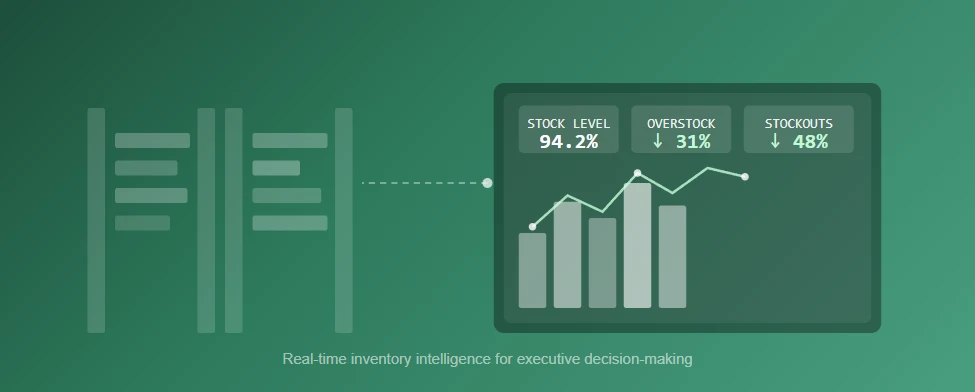
For years, overstocking and stockouts cost retailers billions. A new generation of inventory control software is putting real-time visibility — and smart automation — directly into the hands of executives.
Walk into any major retail chain’s back office a decade ago, and you’d find stacks of printed inventory reports, spreadsheets emailed across time zones, and operations teams making gut-feel decisions about which products to reorder. The result was predictable: shelves that emptied on peak weekends and warehouses packed with slow-moving seasonal goods no one wanted.
Today, the conversation at the executive level has fundamentally changed. CEOs of multi-location retail chains are no longer flying blind. Armed with sophisticated inventory control software and AI-driven forecasting, they’re gaining the kind of real-time visibility that was once reserved for e-commerce giants with nine-figure technology budgets.
Here’s a clear-eyed look at what’s actually working — and what retail leaders need to understand before investing in a new approach to stock management.
The Real Cost of Getting Inventory Wrong
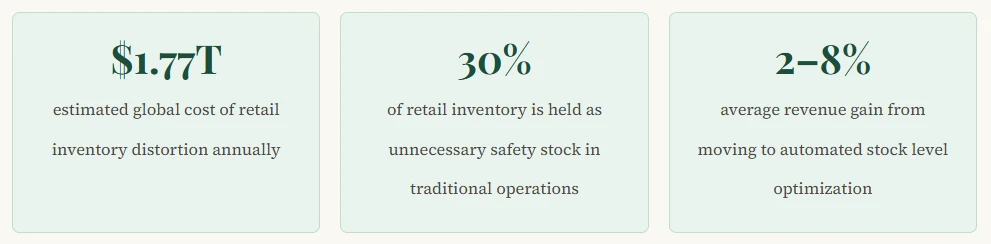
Retail inventory problems come in two painful flavours, and both destroy value. Stockouts drive customers straight to a competitor. Overstock ties up working capital, increases markdowns, and inflates storage costs. For a chain with 50 or more locations, even small inefficiencies compound quickly.
The traditional response — holding more safety stock “just in case” — is expensive and increasingly untenable in a market with tighter margins and faster trend cycles. Modern retail stock management demands a smarter approach: using data to order the right quantity, at the right time, for the right location.
Executive reality check: A 10% overstock across a 100-location chain with an average annual inventory of $5M per location represents $50M in excess capital — capital that could be funding store renovations, new locations, or digital investment.
What Modern Inventory Management Systems Actually Do
The term “inventory management system” covers a wide spectrum, from basic point-of-sale tracking to fully integrated, AI-powered demand planning platforms. For retail chains seeking real operational leverage, here’s what the most effective solutions deliver:
1. Centralized, real-time stock visibility
Rather than relying on end-of-day reports or weekly inventory counts, modern platforms aggregate stock data from every location in real time. A CEO or operations director can see, at a glance, which stores are running low on a top seller and which are holding excess of a product nearing its markdown window.
2. AI-driven demand forecasting
The most powerful element of modern stock level optimization is predictive intelligence. These systems factor in historical sales data, seasonal trends, local events, weather, and even competitor activity to forecast demand at the SKU and location level — far more accurately than any spreadsheet or manual process.
3. Automated replenishment triggers
Instead of waiting for a buyer to notice a low-stock alert, smart platforms can automatically generate purchase orders when inventory drops below dynamically calculated reorder points. This removes human latency from the supply chain and prevents stockouts before they impact customers.
4. Cross-location stock balancing
One frequently overlooked capability: moving stock between stores. If Location A is overstocked on winter coats while Location B is running out, a connected system flags the opportunity. This kind of inter-store balancing can significantly reduce markdowns while improving availability — all without placing a new supplier order.

The four core capabilities that distinguish advanced inventory management systems from basic point-of-sale tracking.
Traditional vs. AI-Powered Inventory Management: A Comparison
Understanding where legacy approaches fall short helps clarify exactly what a modern inventory management system is designed to solve. The differences are significant across every dimension that matters to a retail executive.
| Dimension | Traditional Approach | AI-Powered Inventory System | Business Impact |
|---|---|---|---|
| Data latency | Daily or weekly batch reports | Real-time, continuous updates | Faster decisions; fewer surprises |
| Demand forecasting | Buyer intuition + historical averages | Machine learning on 50+ variables | 15–30% reduction in forecast error |
| Reorder triggers | Manual checks; fixed par levels | Dynamic, location-specific automation | Fewer stockouts; lower safety stock |
| Overstock visibility | Identified late; heavy markdowns needed | Flagged early; inter-store transfer suggested | Improved margins; less waste |
| Supplier integration | Email or phone orders; slow cycles | EDI / API-connected; automated POs | Shorter lead times |
| Multi-location management | Separate spreadsheets per location | Unified platform; cross-location analytics | Scalable operations; less headcount |
| Implementation complexity | Low — minimal setup | Moderate — integration required | Investment of 2–6 months typically |
“The chains that will win the next decade aren’t those with the lowest prices — they’re the ones that never run out of what customers want, and never sit on inventory they can’t move.”
How Leading Retail CEOs Are Using These Tools Differently
Technology alone doesn’t explain the results. How executive teams choose to engage with inventory data matters enormously. The most effective retail CEOs are using these platforms in three distinct ways:
- Exception-based management: Rather than reviewing thousands of SKUs, they’ve configured dashboards to surface only the situations that require human judgment — locations at risk of a stockout within 72 hours, categories where overstock is trending above threshold, or supplier lead-time deviations.
- Inventory KPIs in the board pack: Stock turn rate, days of inventory on hand, and overstock ratio now sit alongside revenue and margin as standard leadership metrics. This elevates retail stock management from a back-office function to a strategic priority.
- Seasonal scenario modelling: Before major promotional events or season changeovers, finance and operations teams run scenario simulations — “What if demand for this category runs 20% hotter than forecast?” — and pre-position inventory accordingly.
The Path to Reduce Overstock in Retail: Where to Start
For retailers who’ve identified overstock as their primary pain point, the journey to reduce overstock in retail typically follows a clear sequence. Jumping straight to the most sophisticated AI tools without the foundational data infrastructure rarely succeeds.
- Audit your data quality first. Forecasting algorithms are only as good as the data they consume. Before selecting software, assess whether your POS data, supplier lead times, and historical sales records are accurate and accessible in a structured format.
- Standardize SKU and location taxonomies. Inconsistent product naming and category hierarchies across locations is one of the most common hidden barriers to effective inventory analytics.
- Start with your top 20% of SKUs. The Pareto principle applies acutely to retail inventory. The 20% of products that drive 80% of revenue deserve the most rigorous forecasting and replenishment rules first.
- Implement dynamic safety stock calculation. Replace fixed safety stock levels with calculations driven by demand variability and supplier lead-time variability. This alone can release 10–15% of working capital for many chains.
- Integrate, don’t replace, existing systems. The best platforms connect to your existing ERP, POS, and supplier portals via APIs rather than requiring a full system replacement. This reduces implementation risk and accelerates time to value.
Platform recommendation: One platform specifically designed for the scale and complexity of multi-location retail is Leafio inventory optimization software — a solution purpose-built for retail chains seeking to automate replenishment, reduce overstock, and improve on-shelf availability across dozens or hundreds of locations simultaneously.
Key Metrics That Signal Your Inventory Strategy Is Working
After implementing a new approach to inventory control software, retail leadership teams should track a focused set of metrics to verify that the strategy is delivering real results — not just cleaner-looking dashboards.
- Inventory turn rate: The number of times your total inventory is sold and replaced over a period. An improving turn rate signals you’re holding less excess stock relative to sales volume.
- In-stock rate (on-shelf availability): The percentage of time a SKU is available for purchase when a customer wants it. World-class retail targets 97–99% on core assortment.
- Days of inventory on hand (DOH): How many days of sales your current stock covers. Reducing DOH without increasing stockouts is the clearest sign that your forecasting is improving.
- Markdown rate: The percentage of inventory that has to be discounted to clear. A meaningful decline in this metric directly improves gross margin and is a strong indicator of better forecasting accuracy.
- Overstock as % of total inventory: Track this by category and location to identify systemic patterns and where additional forecasting refinement is needed.
The Bottom Line for Retail Leadership
The gap between retail chains that manage inventory reactively and those that manage it predictively is widening — and it shows up directly in margin, working capital, and customer satisfaction scores. The technology required to close that gap is no longer the exclusive domain of the largest global players.
CEOs who treat retail stock management as a strategic discipline — not just an operational necessity — are building businesses that are more resilient to demand volatility, more attractive to suppliers who value reliable forecast accuracy, and more profitable quarter over quarter.
The tools exist. The data is available. The question for retail leadership today is no longer whether to modernize inventory operations — it’s how quickly the organization can build the capability to do it well.
