

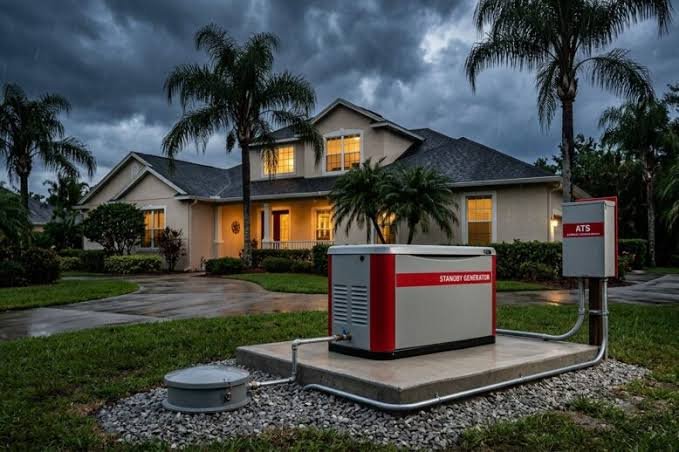
Hurricane Milton knocked out power for 3.4 million Florida customers in October 2024. Two weeks earlier, Helene had already worked through the state. If you own a home in Florida and you still don’t have a standby generator, that back-to-back punch is about as clear a signal as you’re going to get. The problem isn’t just that storms happen. It’s that outages are getting longer, hitting harder, and arriving in clusters your neighbors weren’t ready for.
This article walks you through what a standby generator actually does for a Florida home, how to choose the right setup, and why keeping it maintained is just as important as buying it in the first place.
Florida’s Outage Problem Is Worse Than Most Homeowners Realize
Most people think of a power outage as a few hours of inconvenience. That mental model is badly out of date. U.S. electricity customers experienced an average of 11 hours of power outages in 2024, nearly twice as many as the annual average across the previous decade, according to a report from the U.S. Energy Information Administration. For Florida specifically, 2024 was a direct hit. Major events such as Hurricanes Beryl, Helene, and Milton accounted for 80% of the hours without electricity in 2024, according to the EIA.
Florida sits in a uniquely exposed position because of its geography. It juts into the Gulf and the Atlantic, offering two flanks for any storm tracking north. Even a storm that doesn’t make a direct landfall can strip power lines along hundreds of miles of coastline. Pair that with the state’s high humidity, aging distribution infrastructure, and dense residential development, and you get outages that stretch from hours into days.
The honest takeaway: if you’re waiting for the “big one” to justify a generator, you’ve already missed two or three smaller ones that cost your neighbors hundreds of dollars in spoiled food, hotel bills, and productivity.
Standby vs. Portable: Why Most Florida Homeowners Choose Wrong
Walk into any big-box store in May, and you’ll see portable generators lined up near the entrance. They’re cheap, they’re visible, and they’re almost certainly the wrong choice for a Florida home.
Here’s the practical difference. A portable generator requires you to be home before the storm, manually set it up, run extension cords, and keep fuel stocked. In a rapid-evacuation scenario, or if the storm hits while you’re at work, it does nothing. A standby generator is permanently installed, connects directly to your home’s electrical panel, and starts automatically within seconds of a grid failure. You don’t touch it. It just works.
“The whole point of a standby generator is that it removes the human from the failure loop,” said a frequently cited principle among home resilience engineers. When the grid goes down at 2 a.m. during a storm, no one wants to pull a generator out of a garage in the dark.
Standby units run on natural gas or propane, so there’s no fuel storage issue and no fumes concern inside the home. They power your whole house, including the A/C, refrigerator, and medical equipment, not just a few outlets. For Florida homeowners, where losing air conditioning in August is a genuine health risk, that full-home coverage matters.
Sizing a Generator for a Florida Home
Bigger isn’t automatically better. An oversized generator wastes fuel and can actually run less efficiently than a properly sized unit. Here’s how to think through it.
| Home Size | Typical Load | Recommended Generator Size
|
| Under 1,500 sq ft | Essential appliances + A/C | 10 to 14 kW |
| 1,500 to 2,500 sq ft | Full home including 2 HVAC zones | 16 to 20 kW |
| Over 2,500 sq ft | Whole home + pool pump + EV charger | 22 to 26 kW |
These ranges are starting points, not final answers. A licensed installer will do a load calculation that accounts for your specific appliances, your panel capacity, and how many circuits run simultaneously during a typical storm event. Skipping that calculation and buying the biggest unit you can afford is how people end up with a 22 kW machine wet-stacking in the driveway because it never runs hard enough to burn clean.
The Generator Readiness Checklist: Before Every Hurricane Season
Call this the Pre-Season Audit. Run through it every year in April, before the June 1 season start, and you’ll catch 90% of problems while parts are available and technicians aren’t booked solid.
- Test the automatic transfer switch. This is the component that detects a grid failure and signals the generator to start. A failed transfer switch means the generator runs fine during a manual test and does absolutely nothing during a real outage.
- Change the oil and air filter. Manufacturer-recommended intervals exist for a reason. A generator sitting idle for months still needs fresh oil before the season opens.
- Inspect the fuel supply. For propane units, verify tank level and check for regulator corrosion. For natural gas, confirm the meter shutoff is accessible.
- Run a load test. Crank the generator under actual electrical load, not just an idle startup. Problems show up under load that don’t appear at idle.
- Check coolant levels and battery health. A weak starting battery is one of the most common reasons a generator fails to auto-start. Replace it proactively every three to four years.
If any step reveals a problem, you want that fixed in April, not on September 28 when a storm is 48 hours out and every generator technician in the state has a two-week waitlist.
Why Repair and Maintenance Are Not Optional
A generator you can’t rely on is a generator that failed you twice: once when you bought it, and once when you needed it. The most expensive mistake Florida homeowners make is treating a standby generator like a smoke detector, something you install and forget about for years.
The 2024 Atlantic hurricane season had 18 named storms, of which 11 turned into hurricanes, and five were classified as major Category 3 or stronger storms, according to NOAA’s National Environmental Satellite, Data, and Information Service. Florida absorbed direct hits from both Debby and Milton, two storms from that same list. When the interval between major hurricanes is measured in weeks rather than years, your maintenance window is shorter than you think.
Professional repair visits aren’t just about fixing broken parts. A good technician will spot the capacitor that’s borderline, the fuel line showing micro-cracks, or the control board throwing fault codes that haven’t triggered a shutdown yet. Those small catches prevent the catastrophic failures that leave a family without power for four days after a Cat 2 hits. That’s exactly why homeowners searching for Generator Repair Services Across Florida should prioritize certified, round-the-clock technicians who specialize in standby systems rather than general electricians doing generator work on the side.
Timing Your Installation or Service Call
The single worst time to install a standby generator is August. Lead times for quality units stretch to eight or ten weeks during peak demand, installers are booked through the season, and permitting offices in South Florida get backed up with hurricane-prep applications. Order in January through March and you’ll likely get the unit installed before June 1 with time to spare for a full load test.
The same calendar logic applies to service calls. Spring scheduling fills fast in hurricane-prone counties. If your last maintenance visit was more than 12 months ago, book now, not when you see the first storm spinning in the Gulf. Florida isn’t getting less storm-prone. The smarter question isn’t whether you’ll need that generator. It’s whether yours will start when it counts.
