

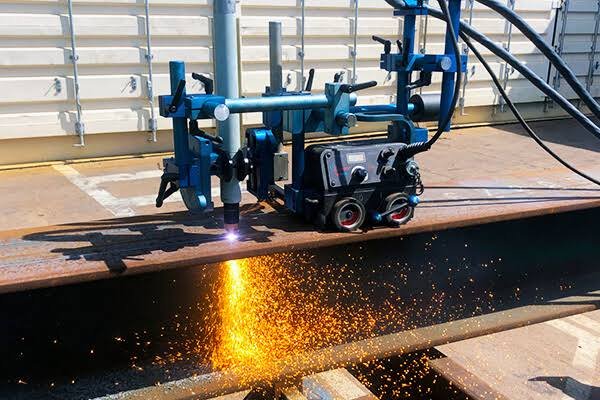
Manual welding remains necessary for short runs and awkward joints, but repeated seams expose its limits. A welder must manage travel speed, torch angle, and arc length while tracking each pass. Fatigue and small hand movements can change bead shape across a long workpiece.
A welding carriage controls travel along a planned path, giving crews a practical advantage on jobs that demand consistent linear welds and predictable production. Five tasks show where that difference matters most.
1. Long Plate Seams
On long, straight seams, the operator sets the travel line and monitors the arc instead of advancing the torch by hand. Industrial welding tractors carry the torch at a steady pace along a rail or workpiece edge, reducing variation from arm movement and supporting repeatable bead placement. The welder still chooses settings, checks fit-up, and watches the puddle throughout each pass.
Shipyards use long seams to join plate sections in hulls, decks, and bulkheads. A carriage holds a steady travel rate over the weld length, while the operator focuses on joint alignment and arc conditions. That division of work matters on extended passes, where small hand-speed changes can create uneven bead width or excess heat in one area.
2. Repeated Frame Welds
Production lines often require the same weld on many frames, brackets, or equipment bases. Manual travel speed varies between operators and across a shift, so identical parts can receive visibly different beads. A carriage follows the same path at a controlled pace on each piece, helping the shop maintain consistent appearance and reduce variation between units.
The setup still needs careful preparation. Workers should position each component against a reliable stop, confirm the joint gap, and check the torch path before welding. Once those conditions are repeatable, mechanized travel reduces the time spent guiding each pass by hand. Operators can focus on inspecting fit-up and monitoring the weld.
3. Tank and Vessel Shells
Tank fabrication often involves long circumferential seams or straight shell joints. A carriage can maintain travel along a prepared path, while the welder monitors the arc and the changing joint position. Consistent movement helps control bead shape across a lengthy seam, where manual progress can slow as the operator adjusts posture or reaches across the shell.
Curved work requires attention to alignment and clearance. The crew must select a suitable guide arrangement and verify that the carriage tracks the intended line without obstruction. Before production, a trial on representative material helps confirm torch angle, travel settings, and access. These checks prevent a convenient travel system from masking poor joint preparation.
4. Heavy Structural Members
Bridge components, building frames, and heavy equipment often include long fillet welds along beams or stiffeners. Holding a torch steady beside a large member takes concentration, especially when the welder must move around clamps or supports. A carriage handles forward travel, leaving the operator free to watch the puddle and maintain correct torch position.
For these assemblies, access planning matters as much as travel control. The path must remain clear, and the workpiece must stay secure throughout the pass. A carriage cannot correct a poor joint fit or replace inspection, but it reduces hand motion during a repetitive weld. That makes it useful when several similar members need the same seam.
5. Pipe and Rail Assemblies
Longitudinal seams on pipe sections and rail-like assemblies suit mechanized travel when the joint follows a straight, accessible line. Manual welding requires the operator to coordinate movement with the joint while maintaining a consistent torch angle. A carriage keeps its travel aligned with the work, which helps produce an even pass along a repeated assembly.
The crew should check whether the surface supports stable tracking and whether nearby components limit movement. Tack welds, clamps, and changes in section can interrupt the route, so a dry run helps identify problems before the arc starts. Where the path is clear and the weld is repeated, controlled travel improves pace consistency without reducing the need for skilled oversight.
Conclusion
Before assigning a carriage, the crew should review the joint length, access, fit-up, and required weld process. A short trial pass on representative material reveals whether the travel path stays clear and the bead meets the job’s acceptance criteria. Record the settings that produce an acceptable result, then use the same setup for comparable seams. This simple qualification step turns mechanized travel into a repeatable production method, while leaving weld quality under skilled human supervision.
