

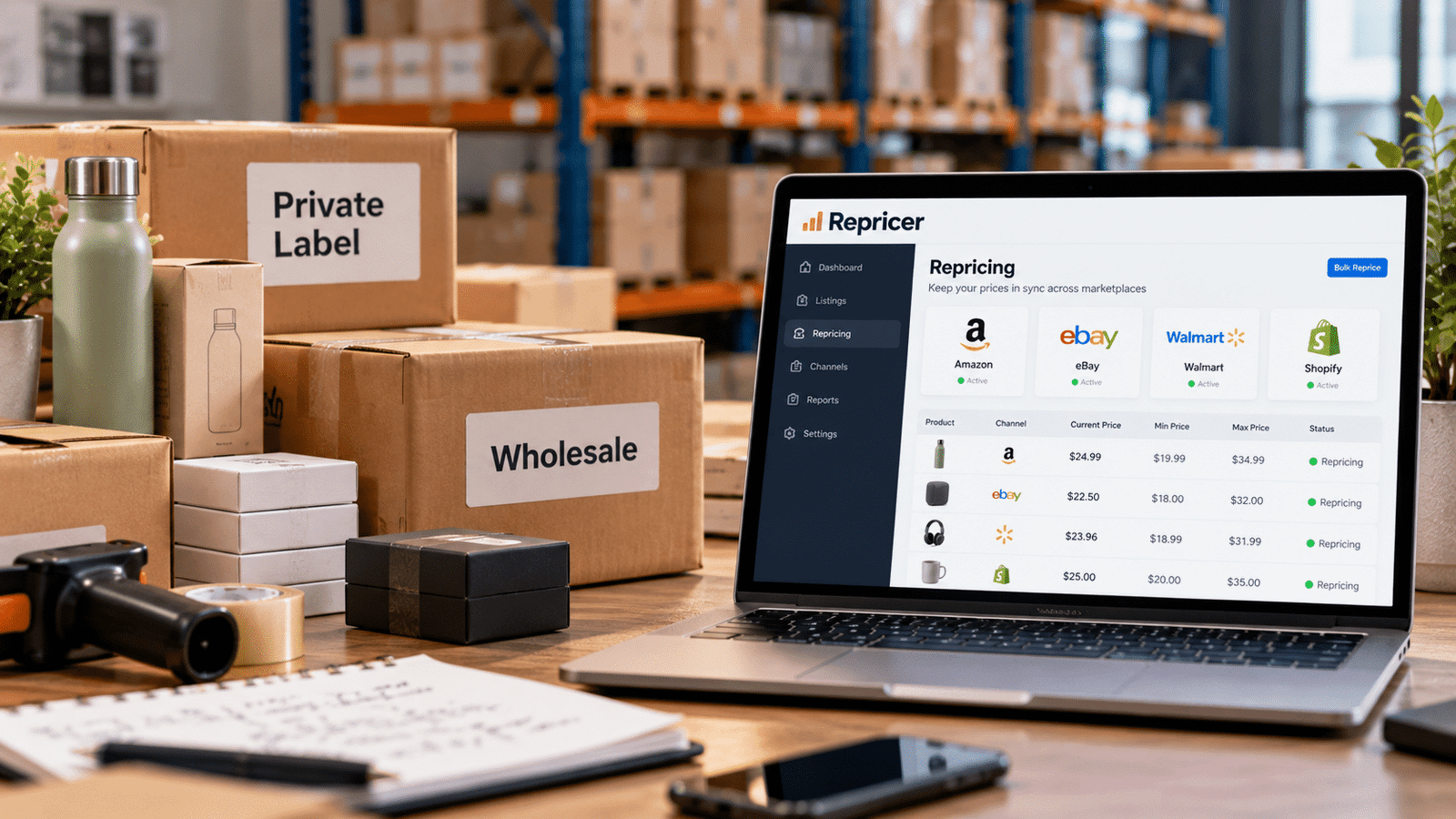
Automated repricing is sold on a premise: somebody else is competing for your listing, and you need to respond faster than you can manually. If you own your brand and you are the sole seller on your ASINs, that premise does not describe your business. There is nothing to react to.
Which produces a reasonable question, asked by a lot of private-label sellers who have been told repricing is essential infrastructure: is this category of tool simply not for me?
Mostly, yes. But “mostly” is carrying some weight, and the exceptions are the interesting part.
What Governs Your Price When Nobody is Competing
With no rival offer on the ASIN, your price is set by four forces, and none of them is a competitor’s price.
Demand elasticity. How your conversion rate and unit volume respond when you move price. This is testable and almost nobody tests it properly. Most private-label pricing is a cost-plus number chosen at launch and never revisited, which is a strange thing to leave unexamined when it determines your entire margin.
Advertising economics. Your price and your cost per acquisition are a single system. A price increase that holds conversion makes every advertising dollar more efficient; a price cut that does not move volume makes advertising less viable. Treating pricing and ad spend as separate decisions is the most common structural mistake in private-label businesses.
Category context. Not a competing offer on your listing, but the prices of the alternatives a customer sees in search results and comparison widgets. You are not competing for the Featured Offer. You are competing for the click.
Amazon’s own reference points. This is the one sole sellers consistently underestimate, and it is where the repricing world does intersect with yours.
The Force You did Not Expect: Amazon’s View of Your Price
Being the only seller does not make your price unexamined.
Amazon holds reference points for what your item should plausibly cost — drawn from the item’s own price history and from prices for the same product away from Amazon. Price above that reference and real things happen: your offer can lose Featured Offer status, the buy button can be withdrawn from the page entirely, or the listing can be deactivated under a potential high pricing error.
Sole sellers hit this constantly and find it baffling, because the instinctive explanation — a competitor undercutting you — does not apply. The usual actual cause is external: your own distributor, a reseller on another marketplace, a clearance channel, or your own direct-to-consumer site advertising the product cheaper than your Amazon listing. Amazon compares, and your Amazon price loses.
So the pricing discipline that matters for a sole seller is not competitive response. It is channel consistency — knowing every price at which your product is publicly advertised anywhere, and making sure Amazon is not the expensive one.
This is also why minimum and maximum price fields are worth populating even with no competition. Amazon uses them to frame what counts as a plausible price on your offers; left empty, it uses its own internal data instead.
The Four Events That Change Your Answer
A sole-seller position is a current state, not a permanent one. Four events move you into genuinely competitive territory, and the third is the one that catches brands unprepared.
- A hijacker appears. Someone lists against you on your own ASIN, often with questionable stock. This is an enforcement and brand-protection problem first. Automated repricing is not the answer — racing a counterfeiter to the bottom funds them and devalues your brand.
- You authorise resellers. The moment you have distributors selling on Amazon, you have competition on your own listing, by design. Now you need a view on price management across the group, and reactive automation becomes relevant — though your stronger lever is the reseller agreement, not the rule engine.
- You win, and the category notices. Successful private-label products attract direct imitators with nearly identical items on separate ASINs. This is competition that never touches your listing and never triggers a repricing rule, but it absolutely moves your elasticity. No repricer detects it. You detect it by watching search results.
- You start selling to businesses. Amazon Business introduces tiered quantity pricing and business-specific prices — a genuine pricing-mechanics problem with nothing to do with competitive response. Worth knowing that Amazon’s own documentation notes its automated pricing API does not support B2B rules, so this is an area where tooling is thinner than you might assume.
What to do Instead, If You are Genuinely Sole Seller
A short list that will do more for your margin than any repricing subscription:
Run a real price test. Pick one SKU with stable volume. Move price 7–10% and hold it for a full sales cycle — long enough to clear the noise, with no concurrent promotion or ad change. Measure units, revenue and contribution, not just conversion rate. Then move it the other way. Most private-label sellers discover their launch price was conservative.
Audit every channel price quarterly. Your site, every marketplace, every reseller, every comparison engine. The cheapest public price anywhere is effectively your Amazon ceiling.
Set and maintain min and max in Seller Central, recalculated whenever costs or fees move. The 2026 US fee changes and the fuel and logistics surcharge added in April 2026 both invalidated floors built on earlier inputs.
Build a cost-change trigger, not a calendar reminder. Recalculate when a supplier price moves, when freight resets, when packaging changes, when Amazon publishes a fee change — not on the first of the quarter.
Watch the ASIN for new offers. You want to learn about event one from your own monitoring, within hours, not from a sales dip three weeks later.
The Honest Summary
If you are the only seller on your listings, automated repricing is solving a problem you do not have, and the money is better spent on testing what your customers will actually pay. What you do need is channel-price discipline and maintained price boundaries — because Amazon is forming a view about your price whether or not anyone is competing with you.
The research team at PricingMag has worked through the full decision for brands who are the only seller on my listings, including the events that change the answer and what to do about each.
Sole seller is a position worth defending. It is not a position that needs a repricer.
