

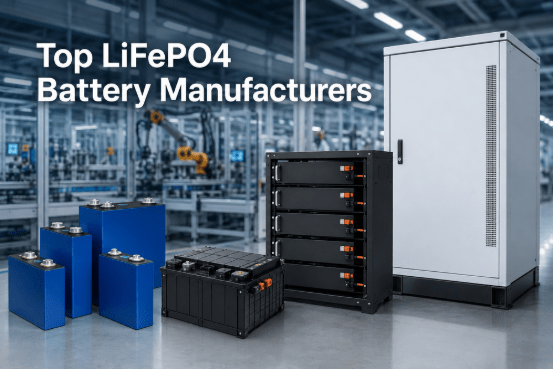
LiFePO4 (lithium iron phosphate) batteries are widely used in energy storage, EVs, and off-grid systems because they offer strong thermal stability, long cycle life, stable chemistry, and broad operating-temperature capability in properly designed systems.
Their nickel- and cobalt-free cathode chemistry also supports lower material costs and reduced flammability compared with many NMC alternatives. According to the IEA’s 2026 battery-market analysis, LFP accounted for more than half of global EV batteries and over 90% of battery energy storage systems in 2025.
Given these advantages, how can you choose the right LiFePO4 battery manufacturer? This guide examines leading global LiFePO4 battery manufacturers, their representative products, and the factors buyers should consider when selecting a supplier.
Top LiFePO4 Battery Manufacturers and Products to Watch
| Manufacturer | Representative product | Main application |
| EVE | LF105 | ESS, marine, light mobility, medium- and heavy-duty commercial vehicles, industrial transportation |
| BYD | Second-Generation Blade Battery | EVs, energy storage, electric transportation |
| CATL | Third-Generation Shenxing Battery | EVs, utility-scale & C&I energy storage |
| CALB | 314Ah Gen2.0 Cell | EVs, energy storage, electric transportation |
| HiTHIUM | ESS Cell 314Ah and larger cells | Utility-scale & C&I energy storage |
-
EVE Energy: LF105 Prismatic LFP Cells
Founded in 2001, EVE Energy is a leading lithium battery manufacturer with a broad product portfolio covering consumer electronics, power batteries, and energy storage. Its LFP product range includes large-format energy-storage cells, prismatic cells, and cylindrical cells.
Based on information from its official website, EVE has developed mature product R&D capabilities and extensive application experience in both the energy-storage and power-battery sectors. Key achievements include:
- Energy Storage: Ranked 2nd globally in energy-storage battery shipments in 2025.
- Power Batteries: Among China’s top five by power-battery installations and ranked 2nd globally in commercial-vehicle battery installations.
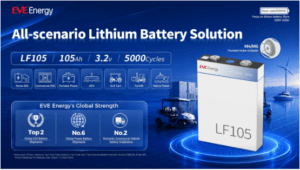
The LF105 is one of EVE’s LiFePO4 prismatic cells, offering 3.2V, 105Ah capacity, 5,000 nominal cycles, and a -35°C to 65°C discharge temperature range. With dimensions of approximately 200.5 × 130.3 × 36.35 mm, it provides a compact option for home and backup energy storage, portable power, forklifts, golf carts, AGVs, sightseeing vehicles, orchard utility vehicles, and tow tractors.
Furthermore, the cell can also be configured into different battery packs according to project-specific voltage, capacity, power, and BMS requirements. EVE’s LiFePO4 stock in Germany also supports its efforts to reach more European customers looking for flexible 100Ah LiFePO4 battery solutions.
-
BYD: Second-Generation Blade Battery
BYD is one of the best-known vertically integrated LFP battery manufacturers, producing batteries as well as electric vehicles and charging equipment. Its Blade Battery uses long, narrow cells and a cell-to-pack structure designed to improve space utilization and structural rigidity.
In March 2026, BYD introduced its Second-Generation Blade Battery. When paired with BYD’s dedicated Flash Charging infrastructure, the company reports charging from 10% to 70% in five minutes and from 10% to 97% in nine minutes. BYD also states that the new generation improves energy density and reduces capacity degradation compared with the original Blade Battery.
This product is most relevant to vehicle manufacturers and automotive partners. It should not be treated as an off-the-shelf prismatic cell for ordinary solar or DIY storage projects.
-
CATL: Third-Generation Shenxing Superfast Charging Battery
With solutions spanning passenger vehicles, commercial transportation, and energy storage, CATL is one of the world’s most prominent battery technology companies. Within its extensive product portfolio, the Shenxing family represents CATL’s focus on applying LFP chemistry to fast-charging electric vehicles.
The Third-Generation Shenxing Superfast Charging Battery, introduced in April 2026, delivers an equivalent 10C and peak 15C charging rate, according to CATL. Under the company’s stated conditions, it can charge from 10% to 80% SOC in 3 minutes 44 seconds and reach 98% in 6 minutes 27 seconds.
CATL also reports more than 90% capacity retention after 1,000 complete cycles and a charging time of approximately nine minutes from 20% to 98% at −30°C. The platform is aimed primarily at passenger EVs rather than standalone stationary storage.
-
CALB: 314Ah Gen2.0 Energy-Storage Cell
CALB operates across both power batteries and stationary energy storage, supplying battery cells and integrated solutions for vehicles, renewable-energy projects, and commercial and utility installations.
In the storage segment, CALB has developed the ZHIJIU portfolio around long-cycle cells and high-capacity containerized systems. Its mass-produced 314Ah Gen2.0 cell is designed for applications requiring frequent cycling and long operating periods, including renewable-energy plants, grid-side storage, and commercial and industrial ESS. CALB has also presented the 314Ah Gen2.0 alongside its 6.25MWh liquid-cooled storage system.
-
HiTHIUM: ESS Cell 314Ah and Long-Duration Storage Cells
Unlike diversified battery groups that serve both EV and storage markets, HiTHIUM concentrates specifically on energy storage. Its product range extends from individual LFP cells and modules to utility-scale, commercial and industrial, residential, and off-grid systems.
The ESS Cell 314Ah represents HiTHIUM’s established cell format for stationary storage. Its product page lists at least 11,000 nominal cycles, a gravimetric energy density of at least 173.2Wh/kg, and a volumetric energy density of at least 382.6Wh/L. It also references IEC 62619, UL 1973, UL 9540A, GB/T 36276, and UN 38.3 documentation.
For projects moving beyond conventional 280Ah and 314Ah architectures, HiTHIUM also offers 587Ah, 1175Ah, and 1300Ah LFP cells. The 1175Ah and 1300Ah models are positioned for long-duration energy storage, while the 587Ah format targets higher-capacity utility and industrial systems.
How to Choose the Right LiFePO4 Manufacturer
-
Match the Manufacturer to the Application
Start by defining the project’s application and technical requirements, such as whether it involves an EV, stationary ESS, off-grid solar system, UPS, forklift, or other electric mobility application. Different applications may require different cell formats, capacities, power outputs, cycle life, temperature ranges, and pack configurations.
The manufacturer’s application coverage and product portfolio should then be matched to these requirements. EVE Energy, for example, serves both power-battery and energy-storage markets. Its LF105 is used across energy storage and mobility applications, making EVE a potential fit for projects that require a versatile prismatic LFP cell rather than a solution focused on a single application category.
The key is to evaluate whether the manufacturer’s products, technical capabilities, and application experience align with the specific requirements of the project.
-
Verify Certifications and Test Performance
Do not evaluate LiFePO4 cells based on capacity alone. Buyers should request technical documentation covering:
- Capacity and energy under defined test conditions
- Cycle life and end-of-life criteria
- DC internal resistance and self-discharge
- Charge and discharge rates
- Operating and storage temperatures
- Cell consistency and batch traceability
- Safety, transport, and application-specific standards
Beyond basic performance data, the applicable safety and compliance requirements should also be verified according to how and where the battery will be used. For example, UN 38.3 is relevant to the transportation of lithium batteries, while standards such as IEC 62619 and UL 1973 may apply to industrial or stationary battery applications. For energy-storage projects, UL 9540A documentation can provide information on thermal-runaway fire propagation testing.
A bare cell does not contain BMS protection. If purchasing a module or pack, verify overcharge, over-discharge, overcurrent, short-circuit, balancing, and temperature-protection functions separately.
-
Compare MOQ, Lead Time, and Logistics
Pricing is only one part of battery procurement. Buyers should also confirm minimum order quantities, sample availability, production lead times, Incoterms, dangerous-goods shipping support, export documentation, and experience in the destination market.
The supplier’s ability to support the required procurement format is also important. For example, some projects may require individual cells for in-house pack assembly, while others may need pre-configured modules or complete battery packs. Buyers should therefore confirm whether the manufacturer can provide the required cell, module, or pack configuration, as well as the technical support needed for integration.
For applications such as ESS, UPS, power systems, data centers, and electric mobility, this can affect not only procurement efficiency but also system integration, testing, and deployment timelines.
-
Evaluate Long-Term Partnership Capability
A suitable LiFePO4 manufacturer should be able to support more than the first shipment. Review its technical communication, product-change notification process, warranty handling, customization capability, production scalability, global service network, and ability to maintain cell consistency across future batches.
For projects with recurring demand, also consider whether the manufacturer can support stable long-term supply, consistent product specifications, batch traceability, and future pack or system requirements.
These factors become particularly important for ESS integrators, mobility OEMs, UPS manufacturers, and other equipment manufacturers that need predictable battery performance across multiple production cycles.
Conclusion
Choosing the right LiFePO4 battery manufacturer requires more than comparing capacity, cycle life, or price. The right supplier should offer products that match your application, whether you need batteries for ESS, EVs, UPS systems, industrial equipment, or electric mobility.
Manufacturers such as EVE, BYD, CATL, CALB, and HiTHIUM demonstrate different strengths across power and energy-storage applications. Before making a decision, verify technical specifications, certifications, safety documentation, MOQ, lead times, logistics support, and pack integration capabilities.
For long-term projects, also assess production scalability, quality consistency, technical support, and supply stability. A careful evaluation of these factors can help buyers select a reliable LiFePO4 battery manufacturer and reduce procurement and integration risks.
