

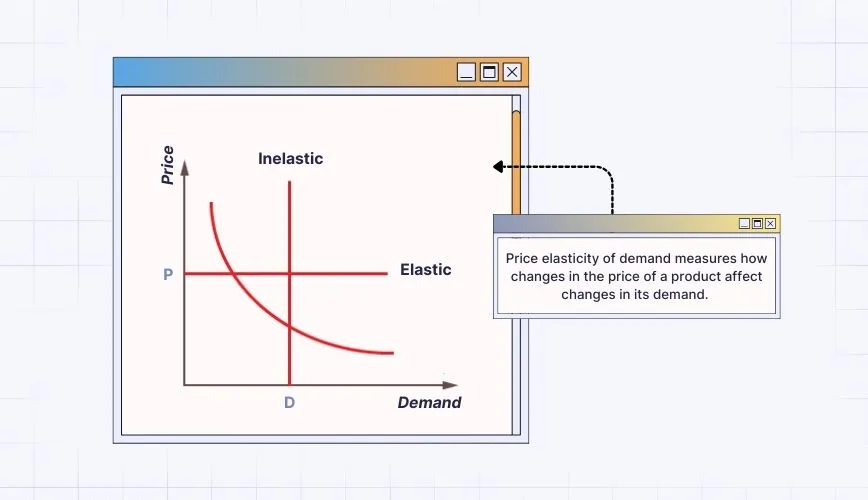
Price elasticity tells an FMCG brand how much volume it will lose or gain for each percentage change in price. Measuring it properly means separating three things most teams blend together: own-price from cross-price effects, regular-price from promotional-price response, and one retailer or channel from another. Get those separations right and elasticity becomes the most useful number in a retailer negotiation or a cost-driven price increase. Get them wrong and it becomes a number that justifies whatever the team already wanted to do.
What elasticity actually measures
Own-price elasticity is the percentage change in a product’s volume divided by the percentage change in its own price. An elasticity of -1.5 means a 10% price increase cuts volume by roughly 15%. Cross-price elasticity measures how your volume responds to someone else’s price, whether a rival brand, the retailer’s private label or a sibling SKU in your own range. A positive cross-price elasticity means the products are substitutes: when the rival gets more expensive, some of its buyers come to you.
Both matter because shoppers never see your price in isolation. They see it on a shelf next to four alternatives. A brand that estimates own-price elasticity without controlling for competitor prices will often misread how sensitive its own shoppers are, because some of the volume swings it attributes to its own price actually came from competitors moving theirs.
Regular price and promo price are different animals
The most common mistake is pooling all price variation into one estimate. Promotional price cuts are temporary and visible. They are often supported by displays and feature ads, and they trigger stockpiling. Regular (base) price changes are permanent and quieter, and shoppers adjust to them over months.
As a result, promotional response is usually much steeper than base price response. If a model sees a 25% temporary price cut deliver a big volume spike and treats that as the general price response, it will predict that a 5% permanent increase is a disaster. Hypothetically, a brand might find a promotional elasticity around -3 and a base price elasticity closer to -0.8. Those numbers are illustrative, but the gap between them is the point: a blended figure is wrong for both decisions.
The fix is structural. Model base price and promotional discount depth as separate variables, and add display, feature and multibuy flags so the model doesn’t credit the price cut with what the end-of-aisle display did.
Elasticity varies by retailer and channel
The same SKU meets different shoppers in a discounter, a premium supermarket, a convenience store and an online marketplace. Discounter shoppers tend to be more price-aware. Convenience shoppers are paying for immediacy. Online, a comparison is one click away, and competitors’ dynamic pricing means the reference price can move daily.
A national elasticity averages all of this together and is rarely useful for any single account. Estimating by retailer, or at least by channel cluster, needs more data, but weekly scan data by retailer usually provides it. Where one retailer shows little price variation, a hierarchical model that borrows strength from similar accounts gives a steadier estimate than modeling that retailer alone.
The inputs are familiar: two to three years of weekly sell-out by SKU and retailer, shelf and promoted prices recorded separately, competitor prices for the main substitutes, distribution, and media and seasonality as controls. The hard part is that they tend to live in different places, from syndicated panels and retailer portals to trade promotion systems and agency spreadsheets. Brands that treat price elasticity modeling as an always-on capability, refreshed as new weeks of data arrive, avoid rebuilding that pipeline from scratch every time a negotiation lands on the calendar.
Using elasticity in a retailer negotiation
Retailers push back on list price increases with a familiar argument: your shoppers will switch. Retailer-level elasticity lets a brand answer with evidence instead of assertion.
Say a brand needs to pass through a 6% cost increase at one grocery chain. Its base price elasticity at that chain is estimated at -0.9, and cross-price elasticity with the chain’s private label is low. Expected volume loss is roughly 5.4%, but each unit sells for 6% more, so the category’s sales value at that retailer stays broadly flat. The retailer’s cash margin can be protected. That is a very different conversation from “please accept our increase.”
Cross-price results add a second argument. If the shoppers who trade away mostly move to other brands within the same store, rather than to a competing store, the retailer loses little category value.
Deciding where to take a cost-driven increase
Elasticity is rarely uniform across a range. Hero SKUs with loyal buyers can often absorb increases that fringe SKUs cannot. Pack architecture matters too. A brand might take a larger increase on a small single-serve pack, where shoppers compare on absolute price, and a smaller one on the family pack, where they compare on price per unit against private label.
Price ladders deserve attention as well. If a premium variant sits just above a mainstream one and only the mainstream price rises, the gap narrows and some shoppers trade up. That shift can raise average margin even as total volume dips slightly.
Common mistakes
- Treating elasticity as fixed. Shopper sensitivity shifts, especially during periods of broad inflation. Estimates from three years ago may not describe today’s shopper.
- Ignoring competitor reactions. If the category leader follows your increase within a few weeks, your realized volume loss will be smaller than a model holding competitor prices constant predicts.
- Confusing timing with causation. When price increases always land in the same season, the model can blame price for a seasonal dip.
- Reporting one number. A single elasticity per brand hides the retailer, pack and promo differences that drive the actual decision.
Measured carefully, elasticity stops being an academic figure and becomes something a sales team can take into the room.
