

War is typically a time when gold prices rally, but this is not happening this time. What this reveals about the state of today’s global economy is far more valuable than any single number.
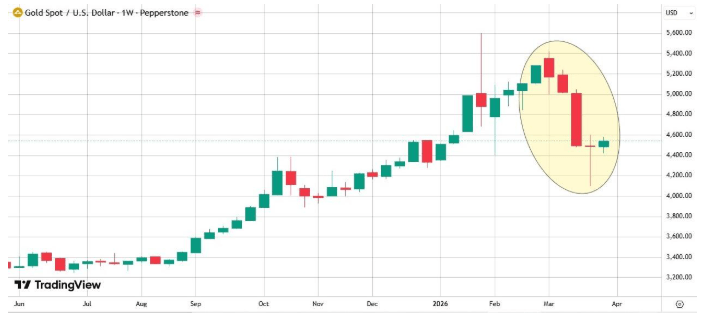
Weekly XAUUSD chart highlighting the period around the outbreak of the Iran conflict
In late March, gold spot prices fell to around $4,570, representing a loss of 21% compared to the all-time high of $5,589 set in January. The price decline began to accelerate in late February when U.S.-Israeli airstrikes on Iranian territory resulted in the closure of the Strait of Hormuz and pushed Brent crude to a new record high of over $120 per barrel.
In almost any other period of history, such an extreme event would provide fuel to support gold prices. Instead, gold fell sharply, declining 17% in just eight trading days ending on March 23rd. It represented gold’s worst week since the 1980s.
The explanation behind this breakdown can be attributed to a term that has largely disappeared from market commentary since the 1970s: stagflation.
Why did the oil shock create a chain reaction that hurt gold?
There are several ways in which higher energy prices — stemming from the oil shock — work against gold. For example, higher energy costs result in higher input costs for producers, as evidenced by last month’s +0.7 percent U.S. PPI report, exceeding market expectations. These higher production costs, in turn, cause the Federal Reserve to keep interest rates higher for longer.
When the Federal Reserve met last month, they lowered their estimated number of rate cuts from two down to just one, citing inflation persistence due to the Hormuz disruption. The CME FedWatch Tool is currently pricing zero rate cuts for 2026, compared to the three cuts priced in January.
From here, we encounter perhaps the most difficult aspect of gold for investors: opportunity cost. With yields on the 10-year Treasury Note having risen to 4.2%, investors now face significantly greater opportunity costs for investing in gold, a non-yielding asset.
At the same time, the U.S. dollar has appreciated further as it is viewed as the world’s true safe-haven reserve currency. Therefore, gold is becoming more expensive for foreign buyers, leading to a decline in physical demand.
According to Oanda’s analysis published later in March, the 20-day moving average correlation coefficient between WTI Crude Oil and gold has turned negative (-0.5), reversing their historic relationship. When oil goes up, gold falls.
The very crisis that should be providing support to gold is instead fueling the assets that undermine it. While recession risks are rising rapidly, this does not necessarily equate to lower gold prices.
On a broader macroeconomic level, conditions are deteriorating. According to Moody’s AI-based recession model, the probability of a recession has increased to approximately 50% — a threshold that has historically been a strong warning sign. Oxford Economics also recently reduced its forecast for U.S. Consumption Growth in 2026 to 1.9% — the weakest forecast outside of the COVID-19 pandemic era.
Historically, recessions have supported gold prices, but only when central banks respond with rate cuts and additional monetary stimulus. For example, during the 2008 financial crisis, the Fed responded by slashing short-term interest rates to virtually zero and initiating quantitative easing, propelling gold to multi-year highs, exceeding $1900 per ounce. The differentiator in 2026 is that this potential recession is occurring simultaneously with an inflation shock, rather than a deflationary one. The Fed cannot cut interest rates to stimulate growth when faced with an inflation shock due to a potential loss of credibility regarding its inflation mandate. As such, monetary policy remains trapped in a hawkish position despite weakening economic conditions. This is the classic definition of stagflation — a historically unfavorable environment for non-yielding assets.
What needs to occur before gold recovers?
Goldman Sachs still holds a year-end XAU/USD price target of $5400, indicating a 20% increase from current levels. Their rationale stems from two key catalysts: either a negotiated settlement to the conflict with Iran that brings oil prices below $80 per barrel, reducing inflationary pressures enough for the Fed to pivot dovish; or a significant economic downturn that forces emergency rate cuts regardless of inflation prints.
Pepperstone Research Strategist Dilin Wu framed the recent selloff as a “pricing logic adjustment” rather than a complete reversal of gold’s long-term upward trend. Although cyclical headwinds like higher interest rates may exist presently, the structural factors driving gold’s multi-decade bull run — central bank buying, de-dollarization, and large government deficits — remain firmly in place.
