


A front-end stack refers to the frameworks, libraries, and architectural patterns used to build the user-facing layer of an application. It governs how users interact with software, how fast interfaces load, and how easily teams can evolve the product over time.
In 2026, investing in front-end development services has become a strategic infrastructure priority. CTOs are expected to make decisions that balance performance, developer velocity, hiring realities, compliance, and long-term maintainability. And all while keeping pace with AI-driven interfaces and rising user expectations.
This guide is written for CTOs and engineering leaders who want depth and practical insights on choosing the Right Front-End Stack.
Why Front-End Stack Decisions Are More Critical Than Ever in 2026
The modern enterprise front end sits at the intersection of business growth and technical execution. Customers now judge platforms within milliseconds. Internal users expect consumer-grade experiences. Product teams ship continuously rather than quarterly.
A front-end stack today must support:
→ High-frequency releases without breaking stability
Enables teams to ship updates weekly or even daily through modular architecture, strong versioning, and automated testing. So speed never compromises reliability.
→ Multiple teams contributing simultaneously
Supports parallel development with clear boundaries, shared design systems, and consistent conventions. Which prevents merge conflicts and UI fragmentation at scale.
→ Complex integrations with backend services, analytics, and AI models
Handles real-time data flows, secure API consumption, event tracking, and AI-driven features without creating tight coupling or performance bottlenecks.
→ Seamless experiences across devices, regions, and network conditions
Delivers consistent UX through responsive design, localization support, adaptive performance strategies, and resilience on low-bandwidth or high-latency networks.
In 2026, the cost of a wrong decision is not only the technical debt. It is a slower go-to-market, higher attrition among developers, and a lost competitive advantage.
The CTO Blueprint for Building the Right Front-End Stack in 2026
By 2026, front-end systems account for over 50% of perceived application performance and user experience in most enterprise products.
For CTOs, this shifts the front end from a tooling decision to a delivery strategy. And one that directly impacts release velocity, cross-team autonomy, and the organisation’s ability to adapt without destabilizing core systems.
Start With Business Reality, Not Framework Popularity
One of the most common mistakes CTOs still make is starting the discussion with a framework comparison. The correct starting point is your business and product context.
Consider how different requirements shape different choices:
- A customer-facing SaaS platform prioritizes SEO, performance, and rapid experimentation
- An internal enterprise portal values long-term stability, predictable upgrades, and governance
- A regulated product must emphasize security, auditability, and controlled change
A front-end stack should be selected based on how your product will evolve over the next five to seven years, not how fast it can be built in the next three months.
Core Framework Choices in 2026: What Holds Up at Enterprise Scale
React: Flexible Power for Large, Distributed Teams
According to a StackOverflow report, 42.87 percent of professional developers preferthe React framework for front-end development.
React continues to dominate enterprise environments because it scales well across organizations.
React’s strength lies in its flexibility. It allows teams to build complex user interfaces while choosing their own state management, rendering strategies, and architectural patterns. This makes it ideal for enterprises with multiple teams and evolving requirements.
A real-world enterprise scenario might involve a SaaS platform in which onboarding, billing, analytics, and settings are managed by different teams. React enables these teams to work independently while still sharing a common design system.
However, this flexibility demands discipline. Without strong architectural guidelines, React applications can quickly become inconsistent and hard to maintain.
Angular: Predictability, Structure, and Enterprise Governance
Angular remains a strong choice for enterprises that prioritize standardization and control over flexibility.
Angular’s opinionated structure enforces consistency across teams. It comes with built-in solutions for routing, forms, dependency injection, and state handling, which reduces decision fatigue and architectural drift.
Enterprises in banking, healthcare, and government often prefer Angular because it supports long-term maintainability and aligns well with compliance-heavy environments.
The trade-off is reduced flexibility and a steeper learning curve, but for many large organizations, this is a worthwhile exchange.
Vue: Balanced Productivity for Growing Enterprises
Vue.js has evolved into a stable and capable framework that appeals to teams seeking productivity without overwhelming complexity.
Vue is often chosen by mid-sized enterprises and fast-growing SaaS companies.
Those who want faster onboarding, cleaner syntax, and solid performance without the heavier structure of Angular.
In 2026, Vue’s ecosystem maturity makes it a viable long-term option—especially when paired with modern tooling and architectural discipline.
CTO Guide to Front-End Rendering Strategies and Their Business Impact
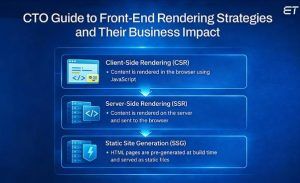 In modern front-end architecture, how you render your application is just as critical as the framework you choose. The rendering strategy directly affects SEO visibility, performance metrics, infrastructure costs, and user engagement.
It makes a CTO-level architectural decision rather than an implementation detail.
- Client-side rendering (CSR) works best for authenticated dashboards and internal tools where SEO is irrelevant and user interactions are dense and continuous.
- Server-side rendering (SSR) becomes essential for public-facing pages where search visibility, first-load performance, and conversion rates directly impact revenue.
- Static site generation (SSG) is ideal for content-heavy sections such as documentation, help centres, and blogs that change infrequently but must load instantly.
Modern frameworks like Next.js and Nuxt enable enterprises to combine all three rendering strategies within a single, unified codebase. All these without fragmenting teams or duplicating logic.
Shopify uses a hybrid rendering model across its platform to align front-end architecture directly with revenue and operational efficiency. High-conversion storefront pages are rendered using server-side rendering (SSR) to maximize search visibility and reduce first-load latency.
Both of which are proven drivers of conversion, with even 100–200 ms improvements materially impacting checkout completion rates at scale.
At the same time, Shopify relies on client-side rendering (CSR) for merchant admin dashboards, where users spend hours managing products, orders, and analytics.
Here, interaction speed, real-time updates, and application-like responsiveness outweigh SEO concerns.
Static generation (SSG) is used for documentation and developer resources. It enables near-instant load times and global distribution with minimal infrastructure overhead.
For CTOs, the takeaway is clear: rendering strategy is a business optimisation lever, not just a technical preference.
Micro Frontends: Architecture for Organizational Scale
Micro frontends are e a direct response to organizational and delivery constraints at scale.
When multiple teams contribute to a single, monolithic front-end codebase, release coordination, shared dependencies, and cross-team testing quickly become the dominant bottlenecks rather than feature development itself.
From a technical standpoint, micro frontends decompose the UI into independently owned, built, and deployed slices. Each of these is aligned to a business domain (for example, billing, analytics, or user management).
Teams can ship changes without waiting on a central release train, while still integrating into a unified user experience at runtime.
This architectural model is particularly effective for enterprises with:
- Multiple product lines or business domains requiring independent roadmaps
- Distributed engineering teams operating across regions and time zones
- High-frequency, parallel releases where the coordination cost outweighs shared-code efficiency
However, micro frontends introduce non-trivial technical complexity. CTOs must account for:
- Deployment orchestration across multiple UI artifacts
- Shared dependency management to avoid version drift and bundle bloat
- Cross-application observability, including distributed logging and performance tracing
- Runtime performance considerations, such as duplicated frameworks or increased network requests
As a result, micro frontends should be adopted as a scaling mechanism. Without strong governance, shared design systems, and platform-level standards, they can easily replace monolithic bottlenecks with fragmented, hard-to-debug systems.
The Silent Long-Term Risk of State Management
State management is rarely a problem at launch. It becomes a problem when applications grow. In 2026, modern front-end stacks increasingly distinguish between:
- Local UI state
- Shared client state
- Server-driven state
Enterprises handling real-time data, dashboards, or collaborative workflows benefit from server-centric state models that reduce front-end complexity and synchronization issues.
The key insight for CTOs is simple: state strategy should follow data complexity, not framework trends.
Design Systems: A Non-Negotiable Enterprise Asset
By 2026, design systems are no longer optional—they are foundational. A robust design system enables:
- Consistent branding across products
- Faster feature development
- Improved accessibility compliance
- Reduced UI defects
Enterprises that invest early in design systems see measurable improvements in developer productivity and user experience quality.
Your front-end stack must support scalable component reuse, theming, and versioning to make this investment worthwhile.
Performance, Security, and Compliance Considerations
At enterprise scale, front-end performance directly affects business metrics. Slow interfaces increase abandonment rates. Inefficient bundles increase infrastructure costs. Poor accessibility creates legal risk.
A future-ready front-end stack must support:
- Code splitting and lazy loading
- Secure dependency management
- Accessibility standards such as WCAG
- Data privacy and regulatory compliance
These considerations should be built into the stack from day one, not added as afterthoughts.
Hiring, Cost, and Long-Term Maintainability
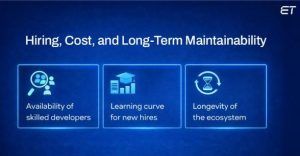
Technology decisions are also talent decisions. CTOs must consider:
- Availability of skilled developers
- Learning curve for new hires
- Longevity of the ecosystem
Frameworks with strong histories of enterprise adoption reduce hiring risk and ensure long-term support. A technically superior stack that your organization cannot staff sustainably is still a poor choice.
How CTOs Should Finalize the Decision in 2026
The strongest front-end stack decisions are made through validation, not assumption. Mature organizations pilot architectures, gather developer feedback, and measure impact before full adoption.
The goal is not to find a “perfect” stack, but to select one that aligns with your business trajectory and technical principles.
Final Thoughts
By 2026, the front end will have become a core delivery layer where performance engineering, security controls, user trust, and developer productivity converge.
CTOs who plan front ends as infrastructure build platforms that scale across teams and regions. A well-architected front end reduces regression risk and enables parallel development.
It allows organizations to respond to changing business demands without repeated rewrites or mounting technical debt.
Ultimately, the right front-end stack does more than render user interfaces. It enables sustained innovation, faster experimentation, and predictable delivery in an increasingly complex digital environment.
It is most effective when supported by disciplined, enterprise-grade software development company that translate architectural intent into long-term execution.
