

The image of event security has long been a familiar one: uniformed guards at the gate, a wristband check at the door, maybe a metal detector wand for larger venues. Effective enough for decades — but increasingly inadequate for the scale, complexity, and threat environment of modern events.
The industry is undergoing a quiet but significant transformation. Artificial intelligence, computer vision, autonomous drones, and robotic patrol units are no longer pilot programs or futuristic concepts. They are being deployed right now at stadiums, festivals, corporate conferences, and community gatherings around the world. For business leaders who run or commission large events, understanding this shift isn’t optional — it’s a strategic responsibility.
The traditional event guard security model placed enormous cognitive load on human personnel: monitor dozens of camera feeds simultaneously, track crowd movement across a sprawling venue, identify threats before they escalate, and coordinate responses in real time. Human attention is finite, and in high-pressure environments it degrades. AI doesn’t get tired. It doesn’t lose focus at the four-hour mark. And increasingly, it’s better at pattern detection than any individual observer.
Computer Vision and Crowd Analytics
The most widely adopted AI application in event security is computer vision — camera systems equipped with machine learning algorithms that analyze crowd behaviour in real time rather than simply recording it.
These systems don’t just watch. They interpret. AI-monitored crowd density sensors can identify dangerous compression at pinch points before pressure becomes critical, and studies show they reduce safety incidents by up to 25 percent. When abnormal crowd patterns are detected — sudden surges, unusual dispersal, people moving against the flow — the system flags the anomaly and routes an alert to the security operations centre within seconds.
This matters because the gap between a developing situation and a critical one at a large event is often measured in minutes, not hours. The Astroworld tragedy in 2021 and the Itaewon crowd crush in 2022 both involved crowd compression that built gradually before becoming catastrophic. Modern AI density estimation platforms are specifically designed to detect and respond to exactly these conditions — triggering ingress flow adjustments and identifying choke points before unsafe pressure is reached.
Crucially, the most advanced systems achieve this without facial recognition or personal tracking. France’s security deployment at the Paris Olympics deliberately excluded personal identification, focusing purely on behavioural patterns — a model that demonstrates effective threat detection doesn’t require invasive surveillance.
Autonomous Drones: Eyes Above the Crowd
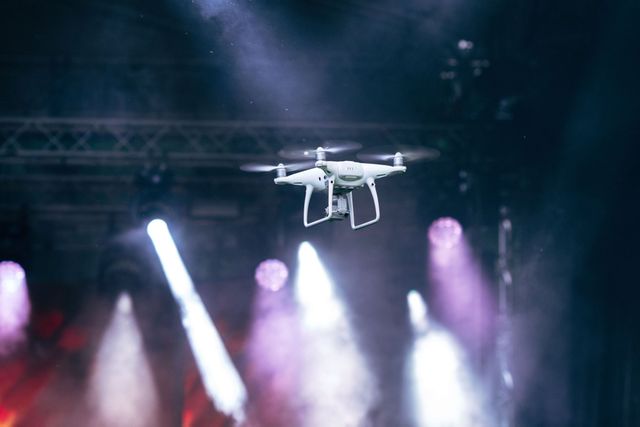
Fixed camera infrastructure has blind spots, and no CCTV grid can cover the perimeter of a sprawling outdoor festival. Autonomous drones are filling that gap with capabilities that would have been prohibitively expensive just five years ago.
At a 2025 country music festival in Australia, security teams deployed drones with thermal cameras to monitor campgrounds overnight. The drones identified unauthorised gatherings and responded to medical emergencies faster than ground teams could have managed, with thermal imaging able to detect the heat signature of a campfire or a group forming in a restricted zone.
At a tech conference in Dubai, an autonomous drone patrol streamed live video into a command centre where AI analytics flagged overcrowding in hallways in real time — a deployment that would have required a dozen additional human observers to replicate manually.
Drones are particularly effective for crowd density estimation from above, perimeter monitoring, and rapid incident response across large outdoor footprints. As regulations around autonomous aerial vehicles continue to mature, their integration into standard event security protocols is accelerating.
Robotic Patrol Units
Ground-based autonomous security robots are moving out of shopping centres and corporate campuses and into event environments. Units like the Knightscope K5 combine 360-degree video capture, thermal imaging, anomaly detection, and environmental monitoring — identifying not just security threats but also physical hazards like gas leaks or smoke.
These robots operate autonomously along patrol routes, logging events, flagging anomalies, and alerting human teams without requiring constant operator supervision. In the event security context, they extend the effective reach of a security team across large venues without proportionally increasing staffing costs.
Twelve percent of top-tier events now use AI-powered robots for on-site assistance — a figure that has grown significantly year-on-year as the technology becomes more reliable and cost-effective.
AI-Powered Access Control
Entry management is one of the most operationally stressful phases of any large event, and it’s where first impressions are made. AI-powered facial recognition and biometric entry systems are dramatically changing what’s possible. AI-powered facial recognition can reduce check-in times by up to 50 percent — compressing queues, reducing friction, and freeing human staff for higher-value roles.
Automated security scanners powered by AI can process 600 people per hour, with accuracy that consistently exceeds manual screening. Smart credentialing systems — including AI chips embedded in event badges — can automatically flag unauthorised access attempts, validate different participant categories, and generate real-time logs that support post-event compliance reporting.
At the 2025 Maha Kumbh Mela in Prayagraj, facial recognition was used not only to manage entry for an expected 400 million attendees, but also to track missing persons and reunite separated groups — demonstrating the technology’s range well beyond simple gatekeeping.
The Human Equation
None of this makes the human security professional obsolete. What it does is fundamentally change their role.
Computer vision augments rather than replaces the security team. AI platforms surface detection events into a security operations centre and dispatch alerts through existing channels, allowing personnel to be allocated to situations that actually require human judgement, communication, and physical response — rather than sustained monitoring of camera feeds where human detection performance degrades within twenty minutes of sustained attention.
The most effective event security operations in 2026 are those that combine AI-driven situational awareness with experienced human decision-making. The technology handles the data. The people handle the nuance.
What This Means for Business Leaders
For executives responsible for corporate events, sponsored activations, or public-facing gatherings, the emergence of AI-driven security changes the risk calculus in important ways.
The capability gap between firms that have integrated these technologies and those that haven’t is widening. An event security provider that operates purely on traditional staffing models is offering a fundamentally different — and demonstrably less capable — level of protection than one that layers AI surveillance, autonomous patrol, and smart access control over its human team.
When commissioning security for your next significant event, the questions worth asking have changed. It’s no longer just about guard ratios and licensing. It’s about what technology the provider deploys, how their systems integrate with venue infrastructure, how alerts are escalated, and whether their approach has kept pace with where the industry actually is in 2026.
The events that go wrong rarely do so because there weren’t enough guards. They go wrong because the warning signs were missed. AI is increasingly good at making sure they aren’t.
