

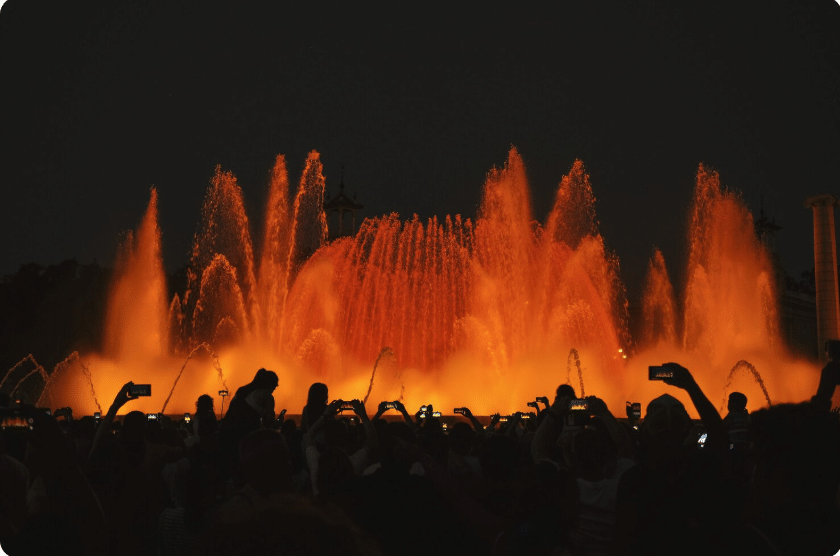
A water show budget depends less on a single “price per minute” than on the technical ambition, site constraints, creative direction and operating conditions. In professional event planning, the right question is not only “How much does it cost?” but “What level of spectacle is realistic for the venue, audience size and safety requirements?”
As consultants involved in aquatic entertainment projects for public events, resorts and destination venues, we usually assess cost through four dimensions: equipment, scenography, logistics and operation. A compact fountain display for a private evening does not have the same financial structure as a large-scale water show using synchronized fountains, lighting, sound, video projection and special effects.
The main cost drivers of an aquatic spectacle
The first factor is scale. A larger basin, longer show duration or wider viewing area requires more pumps, nozzles, control systems, power supply and crew. The second factor is customization. A standard sequence is more affordable than a fully choreographed show built around a brand, a music score or a cultural theme.
Site conditions also matter. An existing lake, marina or pool may reduce infrastructure needs, but it can also introduce constraints: water depth, wind exposure, electrical access, public circulation, permissions and environmental rules.
| Cost factor | What it changes | Budget impact |
| Show size | Number of fountains, pumps and effects | High |
| Creative customization | Music, choreography, storytelling, branding | Medium to high |
| Venue constraints | Access, water depth, power, anchoring, safety | Variable |
| Technical effects | Lights, lasers, flames, video, mist screens | Medium to high |
| Installation time | Crew, transport, testing and rehearsal days | High |
| Operating model | One-night event or permanent installation | Very different cost logic |
One-off event or permanent installation?
A temporary aquatic spectacle generally includes rental equipment, transport, installation, technicians, rehearsals and dismantling. This model is suitable for festivals, corporate events, national celebrations and destination launches.
A permanent installation has a higher initial investment but can become more efficient over time. Resorts, theme parks and waterfront attractions often choose this model because the show becomes part of the visitor experience. In that case, maintenance, water treatment, winterization and staff training must be included from the beginning.
In the practice of project planning, underestimating maintenance is one of the most common mistakes. During the analysis of a coastal venue project, the creative concept was technically strong, but salt exposure increased maintenance needs. The lesson was clear: a spectacular design must be matched with realistic operating conditions.
Why technical design changes the final price
A professional water show involves precise synchronization between water movement, lighting, music and sometimes projection. This requires control software, programming time and safety testing. The more elements are synchronized, the more expertise is needed.
Safety is not a detail. Public distance, wind direction, electrical protection, emergency access and local regulations can all influence design choices. A lower-cost option that ignores these factors is rarely a good bargain. It may increase risk, reduce reliability or limit the show’s visual impact.
Real feedback from an event context
Marie, event manager for a municipal summer festival, explained after a waterfront show that the biggest challenge was not the artistic concept but the installation schedule. Her team had only one night to prepare the site, test the equipment and secure the public area. The final result was successful, but she noted that adding one extra technical rehearsal would have reduced stress and improved timing accuracy.
This type of feedback is useful because it shows that budget is also about preparation time, not only equipment.
How much does a water show cost?
The cost varies widely depending on scale, duration, technical effects and venue constraints. A small temporary display and a permanent multimedia installation are not comparable. A serious estimate requires a technical brief and site analysis.
What information is needed to estimate a budget?
The key details are venue type, water surface, audience size, show duration, desired effects, event date and available power. Photos, plans and access details help refine the estimate.
Is a customized show always more expensive?
Usually yes, because it requires creative design, programming and testing. However, partial customization can control costs while still adapting the show to a brand, venue or theme.
Can a show be installed anywhere there is water?
Not always. Water depth, stability, permissions, wind exposure, power supply and safety distances must be checked. Some sites require additional structures or adaptations.
A realistic aquatic spectacle budget should balance ambition, safety and long-term reliability. The best approach is to define the desired audience experience first, then adjust the technical solution to the site, schedule and operating constraints.
