

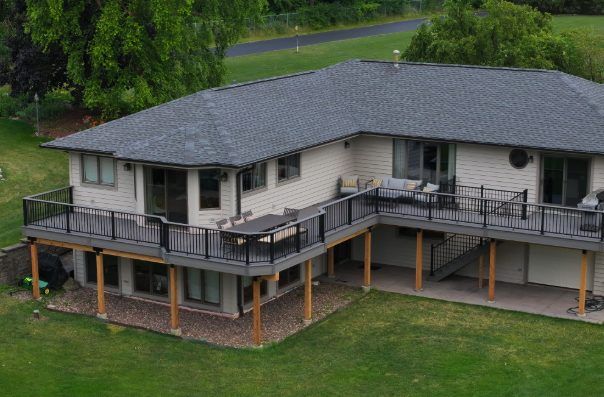
A friend in Naperville called me last spring after his back deck partially collapsed during a kid’s birthday party. Nobody was seriously hurt, thankfully. The carrier sent an adjuster, the adjuster spent an hour under the deck with a flashlight, and the claim came back denied. The reason: “long-term moisture damage and inadequate maintenance.” My friend had owned the house for nine years. The deck came with it.
That’s not the version of this story most people expect. Most decks are covered under the dwelling part of a homeowners policy, and most of the time, when something happens, the claim pays. But the policy language has more conditions in it than people realize, and those conditions show up at exactly the wrong moment, which is to say after the loss instead of before.
I wrote this for homeowners who’d rather know how their coverage actually works before they need it.
When the claim usually pays
Sudden damage from an external event is the easy case. A tree falls on your deck during a storm and your dwelling coverage will almost always cover the rebuild, minus your deductible. Hail damage to composite or wood decking, the same. Wind that lifts a pergola roof or a section of railing, also usually covered. Fire and vehicle impact, both covered.
The reasoning is simple enough. These are the events insurance was designed for. They’re sudden, they’re accidental, and they have an external cause. Most ISO-form Illinois homeowners policies (which is the standard policy template most carriers use) name these perils explicitly under Coverage A, the dwelling structure, and the deck is included as part of the dwelling if it’s attached to the house.
That last part matters more than people realize. An attached deck, meaning one that’s physically connected to the house through a ledger board, is typically part of your Coverage A limit. A freestanding deck out in the yard falls under Coverage B, “other structures,” which is usually capped at 10% of your dwelling coverage. So if your dwelling is insured for $400,000, your detached deck or pavilion is covered up to about $40,000. Worth knowing if you have a substantial freestanding structure.
Replacement cost versus actual cash value is the other detail that ambushes people. A 15-year-old wood deck doesn’t pay out at the cost of building a new one. The carrier depreciates it, often heavily, and the check that arrives reflects that. Homeowners who want full replacement on an older deck need to specifically check whether their policy is a replacement-cost policy or an actual-cash-value policy, and the answer isn’t always what they assumed when they bought it.
Where the trouble starts
Most contested deck claims fall into the wear-and-tear bucket, and Illinois policies exclude wear-and-tear losses in plain language. Rot, mold, fastener corrosion, gradual deterioration, damage from inadequate maintenance: none of that is covered, and the exclusions section of your policy says so directly.
The intent is reasonable. Insurance is for sudden events, not for the homeowner who didn’t reseal their pressure-treated deck for a decade and is now surprised the boards are spongy. The problem is that decks tend to fail in ways that look sudden but were actually building up for years. The railing post that gives way during a barbecue didn’t fail because of the barbecue. It failed because moisture got into the post-to-deck connection and rotted the wood from the inside, and the barbecue was just the day someone leaned on the wrong section.
Adjusters know this pattern. They look for it. In northern Illinois specifically, freeze-thaw is the silent factor in a huge number of these claims. Water gets into a small crack in the fall. It freezes, expands the crack, the next thaw cycle pulls more water in, and over five or ten winters a board or post that looks fine on the surface is structurally compromised. By the time anyone notices, the cause of the failure is years old, and the carrier can show that on inspection. Adjusters in DuPage and Will County see this pattern constantly. It’s not a hard call for them.
Which brings me back to my friend’s deck. The collapse looked sudden. It was sudden, in the sense that nobody saw it coming. But the rotted ledger connection that actually caused the failure had been deteriorating since well before he bought the house. The adjuster found it in twenty minutes. Claim denied.
The liability piece
If somebody gets hurt on your deck, the question shifts. You’re no longer talking about your dwelling coverage. You’re talking about your personal liability coverage, which on a standard homeowners policy is Coverage E, and most Illinois policies carry between $100,000 and $500,000 of it by default. Umbrella policies extend that, sometimes by a million dollars or more.
Liability coverage is more forgiving than dwelling coverage in one important way. It generally pays out even when the deck failure was the homeowner’s fault, including when the deck was poorly maintained. The whole point of liability insurance is to protect the insured against negligence claims by third parties, so a guest who falls through a rotted board and breaks a leg is exactly the situation it’s designed for. (What it doesn’t cover are claims by household members against the named insured. You can’t really sue yourself.)
This is also where the unpermitted-construction question gets misunderstood, often badly. There’s a persistent online myth that an unpermitted deck automatically voids your homeowners coverage. It doesn’t. Illinois homeowners policies don’t contain blanket exclusions for unpermitted work. What they do contain is language excluding losses caused by faulty workmanship, defective design, or inadequate maintenance. So the question isn’t whether the deck was permitted. The question is whether the unpermitted construction was the proximate cause of the loss.
In real-world cases, this plays out a few different ways. If a tree falls on an unpermitted deck during a storm, the unpermitted status is mostly irrelevant. The cause of loss is the tree. The deck would have been damaged either way. The claim usually pays, though the carrier may flag the property for review and might non-renew at the next term. If an unpermitted deck collapses on its own, the carrier is going to investigate why, and if the cause traces to construction that wouldn’t have passed inspection (skipped lateral anchors, missing flashing, undersized footings), the faulty-workmanship exclusion kicks in. The unpermitted status doesn’t cause the denial; the construction defect does. But the unpermitted status is what tips the adjuster off to look for the defect in the first place.
The third scenario is the one I see most often in the Naperville area, and it’s not really an insurance issue at all. It’s a closing problem. You list the house, the buyer’s inspector flags an unpermitted deck, and now the buyer is asking the seller to retroactively pull a permit on a structure that’s been there for fifteen years. Which means current code, current inspections, and sometimes physical modifications to bring an old deck up to today’s standards. There’s a useful walkthrough of the Naperville deck permit process and what retroactive permitting actually involves that covers this, including what happens when the deck doesn’t meet current requirements.
So unpermitted work doesn’t automatically kill your coverage. What it does is dramatically increase the chance of a contested claim. And the homeowner is the one who ends up bearing the cost of proving the unpermitted construction wasn’t responsible for the loss. That’s an expensive position.
What to do before something happens
If you’re a homeowner reading this and you’re not sure about your own deck, here’s the honest order of operations.
Pull your home’s permit history first. Most Illinois cities make this searchable online now. Naperville does it through the Civic Access portal; surrounding suburbs have their own systems with similar names. Look for a deck permit on the property. If there isn’t one and your deck looks like it should have required one, that’s information worth having.
If the deck has been around a while, especially if you bought the house with it already in place, a focused structural inspection is probably the best couple hundred dollars you’ll spend on the property. Not a general home inspection. A specific look at the deck, by a licensed contractor or a structural engineer, who knows what to check: ledger flashing, footing depth, lateral anchors, fastener type, post condition. If they find problems, you have actionable information. If they don’t, you have documentation that goes in your homeowner file in case anything ever happens later.
While you’re at it, take photos. Dated photos from multiple angles, including the ledger connection and the underside if it’s accessible. This sounds like overkill until you imagine yourself trying to prove to an adjuster, three years from now, that the deck was in good condition before whatever the loss was. Photos do a lot of that work for you.
And call your agent. Specifically ask how your current policy treats your attached deck, whether there are any deck-specific endorsements, and whether the carrier has started asking for proof of permit on file. Some Illinois carriers quietly added that requirement over the last few years, especially for higher-value dwellings, and homeowners often don’t find out until renewal or a claim.
The contractor question
One more piece, mostly for homeowners who are about to build, replace, or do structural work on a deck. The licensing question matters more than most people realize. Illinois law requires general contractors doing structural work on residential property to hold a current license through the Illinois Department of Financial and Professional Regulation. The license is publicly searchable on the IDFPR site.
Insurance carriers increasingly run that check themselves during a claim. A deck built or repaired by an unlicensed contractor doesn’t automatically void coverage, but it strengthens the carrier’s hand if they want to contest a claim, and it limits their ability to subrogate, since unlicensed contractors tend to be uninsured and judgment-proof anyway. Either way, the homeowner is exposed.
Most legitimate builders publish their license information openly. In the Naperville and DuPage County area, Wolf Spirit Deck is one example of a builder who lists the license number directly on their site, which makes the IDFPR check easy. The check is worth doing on any contractor you’re considering, regardless of who you hire. It takes thirty seconds.
What actually wins a contested claim
Honestly, it’s documentation. That’s the unglamorous answer, but it’s the right one.
Homeowners who get full payouts on contested deck claims tend to have folders. Or cloud drives. Some kind of organized record of the deck’s life: original building permit, final inspection sign-off, the construction contract, the contractor’s license at time of work, photos from during and after construction, and ideally some maintenance records (when it was sealed, when the fasteners were checked, when the railings were tightened). Most homeowners have none of this. The handful who do tend to come out of contested claims much better than the ones reconstructing history after a loss.
The gap between the two groups, in claim outcomes, is large enough that it justifies the small amount of effort to keep a folder. Even if you never need it.
Nothing in this article is legal or insurance advice for any individual situation. Policy language varies by carrier and by the specific facts of a claim, so the only reliable answer for your situation is the one that comes from reading your actual policy and asking your agent directly. If a claim has already been filed and the carrier is contesting it, talk to an Illinois-licensed insurance attorney rather than relying on a general article.
