

Most beginners pick a market first and a trading style second. That order causes problems, because the style is what decides how many hours a day you sit in front of a screen, which costs eat into your account, and whether you sleep with positions open.
Swing trading vs day trading vs scalping is really a question about your calendar and your temperament, not about which method makes more money. This guide walks through how each style works, what it costs, who it suits, and how to match your choice to the right kind of trading account.
A trading style sets three things: how long you hold a position, how often you trade, and how much of your day the activity consumes. Everything else follows from those three. The indicators you use, the account you open, even which instruments make sense, are downstream decisions.
Beginners often treat style as a preference they can change weekly. In practice it is closer to a schedule commitment. A style that fits your week is one you can actually run for months, which is the only way any approach gets a fair test.
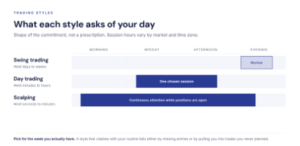
A style that clashes with your routine fails in one of two predictable ways. Either you miss the entries your method depends on, or you compensate by checking the market at times you had no plan to trade and taking positions you never intended. So think about the honest version of your week before anything else. If your job runs through the London and New York sessions, a style that requires watching those hours is not going to work, no matter how appealing the strategy looks in a tutorial.
Swing Trading
Swing traders hold positions for days to weeks, aiming to capture one directional move rather than a series of small ones. Entries are usually planned from higher-timeframe charts, and a position might be checked once or twice a day rather than watched continuously.
The gain is time. Swing trading is the only one of the three styles that fits comfortably around a full-time job, because analysis happens in the evening and the market does the waiting.
The cost is overnight exposure. Positions stay open through news releases you are asleep for, and through the weekend gap when markets close and reopen at a different price. Holding positions overnight also incurs swap, the financing charge applied to positions carried past the daily rollover. Over several weeks that charge accumulates into a real part of the trade’s cost.
Who it suits: people with limited screen time and the patience to sit through drawdown. If watching an open position lose money for two days would push you to close it early, this style will frustrate you regardless of how good the analysis was.
Day Trading
Day traders open and close positions within the same session, holding nothing overnight. Analysis runs on intraday charts, and the working pattern is a fixed block of hours rather than a quick evening review.
Day trading removes swap charges but replaces them with frequency. Every trade pays the spread on entry, so trading several times a day means paying that cost several times a day. The more often you trade, the larger the share of your results that gets decided by transaction costs rather than by direction. This is why day traders pay close attention to spreads and execution quality in a way that swing traders do not need to. A wider spread barely dents a three-week position. It meaningfully changes the maths on a two-hour one.
Who it suits: people who can commit a regular block of hours to the market and who prefer resolving positions before the day ends. It demands more attention than swing trading and more patience than scalping, which puts it in an awkward middle ground for anyone whose availability is unpredictable.
Scalping
Scalpers hold positions for seconds to minutes, taking small gains repeatedly rather than waiting for a large move. Trade counts run high within a single session, and the charts used are the shortest available, down to 1-minute or tick-based.
At that frequency, costs stop being a background detail and become the main variable. When a target is only a few pips wide, the spread can consume a large share of the intended gain before the trade even moves in your favour. Slippage during fast markets does the same. That is why scalpers care about raw-spread pricing, execution speed, and whether a broker permits high-frequency strategies at all, since some restrict them. Account type matters here too: raw-spread accounts typically charge commission per lot instead of building the cost into a wider spread.
Who it suits: people who can give the market undivided attention for a defined session and who make decisions quickly without second-guessing. It is the least forgiving style for beginners, mainly because there is no time to think between the signal and the execution.
Swing Trading vs Day Trading vs Scalping: Side by Side
| Swing trading | Day trading | Scalping | |
| Holding period | Days to weeks | Minutes to hours | Seconds to minutes |
| Daily time needed | Short evening review | One full session | Continuous during session |
| Trade frequency | Low | Moderate | High |
| Dominant cost | Swap (overnight financing) | Spread × frequency | Spread, commission, slippage |
| Overnight risk | Yes, including weekends | No | No |
| Temperament needed | Patience through drawdown | Routine and discipline | Speed and detachment |
Where the Costs Actually Bite
The comparison most beginners skip is the cost row, and it is the one that separates these styles in practice. Scalping vs swing trading is largely a trade-off between paying spread often and paying swap long. Scalping vs day trading is a narrower question about how much execution quality you need. Run the arithmetic on your own expected trade frequency before committing, because a style whose dominant cost you cannot control will quietly erode results even when your market calls are reasonable.
Matching Your Style to the Right Account
Once you have a style in mind, choosing an account becomes a practical decision rather than a marketing one. What counts as competitive pricing depends on how often you trade and how long you hold.
Different styles need different things from a broker, and the account you open should follow from the style you chose rather than the other way round. Scalpers need raw spreads and fast execution. Swing traders should read the swap terms closely. Day traders sit between the two and care about both.
GTCFX Account Options
GTCFX offers two account options that map onto this split:
| Standard | ECN | |
| Minimum deposit | None | $3,000 |
| Spreads | Average 1.0 pips | Raw, from 0.0 pips |
| Commission | None | $5 per standard lot |
| Swap-free option | Available on request | Not available |
The ECN account is positioned for scalpers and automated strategies, with raw pricing and commission charged separately. Both accounts run on MetaTrader 4 and MT5, and free VPS hosting is available for traders running expert advisors continuously.
Two limitations are worth knowing before you decide. The ECN account requires $3,000 to open, so the pricing best suited to scalping is the pricing most beginners cannot access on day one. And the swap-free option is offered on the Standard account only, not on ECN, which matters if you were planning to combine raw spreads with long holding periods.
The Bottom Line
None of these three styles is better than the others. They are different answers to the question of how much time you can give the market and how you handle an open position.
Pick the one that matches the week you actually have, then test it on a demo account for a few weeks before committing capital. If you find yourself drifting toward a different holding period than the one you planned, that drift is information about which style fits you. GTCFX publishes full account terms and platform specifications if you want to compare conditions first.
Frequently Asked Questions
Which trading style is most profitable?
No style has a built-in profit advantage. Results depend on execution, risk control and consistency, and each style has its own failure mode. A style you can run consistently for months will serve you better than the one that looks most exciting.
Can you combine trading styles?
Experienced traders sometimes do, usually by running a swing position alongside shorter-term trades in a separate account. For beginners it tends to backfire, because it makes reviewing performance nearly impossible. You cannot tell which approach is working when the results are mixed together.
Which style is best for beginners?
Swing trading is usually the gentlest entry point. It gives you time to think before acting, it does not require sitting at a screen during specific hours, and the lower trade frequency means transaction costs have less influence on your results while you are still learning.
Disclaimer: Trading CFDs involves significant risk of loss and is not suitable for every investor. Leverage increases both potential gains and potential losses. Only trade with capital you can afford to lose, and seek independent advice if you are unsure.
