

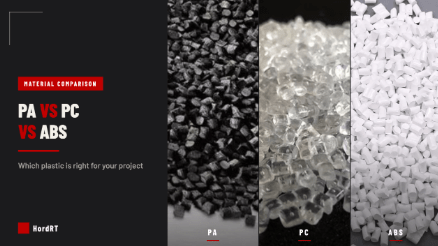
PA (nylon), PC (polycarbonate), and ABS are among the most widely used engineering thermoplastics, each excelling in different applications due to its unique combination of mechanical, thermal, and physical properties. Picking between them isn’t a matter of taste. The right choice depends on matching the material’s performance characteristics with the part’s operating environment, moisture exposure, optical requirements, and mechanical demands.
This guide compares the three head to head on the properties that matter most, then walks through where each one wins and where each one has a catch that’s easy to miss until parts are already in production.
Comparison at a Glance
| Property | PA6 (Nylon) | PC (Polycarbonate) | ABS |
|---|---|---|---|
| Moisture sensitivity | High; absorbs water from air, 1.25% weight gain measured [1] | Low; “no change in dimensions due to water absorption” per manufacturer [2] | Low |
| Glass transition / heat resistance | Service temp depends heavily on grade and fiber loading [3] | Glass transition up to 148°C [2] | HDT around 92.5°C unfilled [4] |
| Tensile strength retention (dry vs. moisture-conditioned) | Drops from 185 to 115 MPa in a 30% glass-filled grade [3] | Stable; low moisture uptake limits this effect [2] | Stable; ABS is not hygroscopic in the way PA is |
| Optical clarity | Not transparent | 88-89% luminous transmittance [2] | Not transparent |
| Typical melt temperature | 290°C representative setpoint [5] | 280-320°C [2] | 200°C in documented test conditions [6] |
| Relative cost | Moderate | Higher | Lower |
PA (Nylon): The Wear-Resistant Workhorse
PA earns its place in gears, bearings, automotive under-hood parts, and cable ties because of how well it resists wear and chemical exposure, not because it’s the easiest material to mold correctly.
Where PA Excels
PA’s wear resistance and chemical resistance are difficult to match with PC or ABS, which is why it remains the default for moving mechanical parts like gears and bearings that see repeated friction. Glass-fiber-reinforced PA6 grades push stiffness even further. A 30%-glass-filled PA6 datasheet shows tensile modulus reaching 9,500 MPa dry, against roughly 6,200 MPa once the part equilibrates with ambient moisture [3].
The Catch: Moisture Changes Everything
PA absorbs moisture readily, and that absorption isn’t cosmetic. The same 30%-glass-filled PA6 grade shows stress at break dropping from 185 MPa dry to 115 MPa moisture-conditioned [3], roughly a 35% reduction between the as-molded state and real-world equilibrium. An academic study comparing injection-molded PA6 and PA66 parts measured weight gains of 1.25% for PA6 and 0.95% for PA66 from humidity exposure, with measurable dimensional shift following that moisture uptake [1]. Proper pre-drying to the manufacturer’s recommended moisture specification is essential for achieving consistent mechanical properties and dimensional stability.
PC (Polycarbonate): The Clear and Tough Option
PC is the only one of the three that combines real optical clarity with serious impact resistance, which is why it shows up in lenses, safety equipment, and transparent enclosures where ABS and PA simply aren’t candidates.
Where PC Excels
Covestro’s Makrolon polycarbonate datasheets show a glass transition temperature reaching up to 148°C and luminous transmittance of 88-89% at typical wall thicknesses [2], a combination that lets PC parts handle heat near electronic components while still being clear enough for lenses and light guides. PC also doesn’t suffer PA’s moisture-driven dimensional swing; its water absorption equilibrium value is just 0.12% [2], far below PA’s moisture uptake.
The Catch: Processing Discipline and Cost
PC requires drying to below 0.02% residual moisture before injection molding, and Covestro’s own guidance notes drying can take 2 to 12 hours depending on dryer capacity [2]. Skipping or shortchanging that step degrades the polymer in ways that show up as molecular weight loss, not just a surface defect. PC also costs more per kilogram than ABS, and its melt temperature range of 280-320°C [2] demands more from both the molding machine and the mold’s thermal design than ABS does.
ABS: The Cost-Effective All-Rounder
ABS is often the material of choice when good surface finish, easy processing, and cost efficiency are the primary design priorities. It is well suited for applications that do not require the optical clarity of PC or the wear resistance of PA.
Where ABS Excels
ABS processes easily, takes a good surface finish well, and costs less than either PA or PC, which is why it’s the default for housings, interior trim, and general consumer parts. A representative unfilled ABS grade documented in a US patent comparative example shows a notched Izod impact strength of 75.1 J/m and a tensile strength of 52.08 MPa [4], properties that cover the needs of most non-structural housings without requiring PA’s wear resistance or PC’s clarity.
The Catch: Limited Heat and Weather Resistance
The same ABS formulation reports a heat deflection temperature of 92.5°C [4], which is lower than that of PC and many reinforced PA grades. ABS also offers lower chemical resistance than PA. For long-term outdoor applications, standard ABS typically requires UV-stabilized grades or protective coatings to resist weathering and color change.
Decision Framework
| Priority | Best fit |
|---|---|
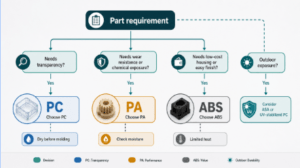
| Transparency + impact resistance | PC |
| Wear resistance + chemical exposure | PA |
| General-purpose parts at lower cost | ABS |
| Outdoor exposure | Neither ABS nor PC alone; consider ASA or UV-stabilized PC |
| Sustained high heat exposure | PC or heat-stabilized, glass-filled PA |
PC/ABS blends are worth considering specifically when a part needs PC’s heat resistance and the impact performance gap above PA’s level, but at a lower processing cost than full PC. That blend sits in the gap between
the two materials rather than replacing either one outright.
For applications where optical clarity, low moisture absorption, dimensional stability, or specialized barrier performance are more important than the characteristics of PA, PC, or ABS, it may also be worth evaluating a cyclic olefin copolymer (COC). TOPAS Advanced COC Polymers offers COC materials designed for applications requiring a different balance of optical, thermal, and moisture-related properties.
While COC is not a direct replacement for PA, PC, or ABS across general engineering applications, it can be a relevant specialty-material option when the project requirements extend beyond what these three conventional thermoplastics can provide.
Getting the Material Decision Right Before Tooling
None of these three materials is universally “best.” Each one wins on the specific properties that matter for a given part, and a manufacturer with experience molding all three can flag the trade-off before it becomes a production problem rather than after. With experience processing PA, PC, ABS, and their filled and blended variants, HordRT helps customers evaluate performance, processability, and cost based on the part’s actual operating environment. However, material selection at the design stage does not replace prototype validation. Even a well-matched material choice on paper should be verified through first-shot samples before committing to production tooling, especially for applications with strict requirements for moisture stability, optical performance, or thermal resistance.
Conclusion
There’s no universal winner between PA, PC, and ABS, only the best fit for a specific part’s requirements. Define the part’s top priorities first: does it need to flex repeatedly without wearing out, does it need to be clear, or does it need to be inexpensive and easy to finish? The material decision follows directly from that answer. When two materials seem close on paper, prototype in both before committing to production tooling rather than guessing from datasheet numbers alone.
Sources
- Clavería, I., Elduque, D., Santolaria, J., Pina, C., Javierre, C., Fernández, Á. “The influence of environmental conditions on the dimensional stability of components injected with PA6 and PA66.” Polymer Testing, Vol. 50, pp. 15-21, 2016. https://www.sciencedirect.com/science/article/abs/pii/S0142941815301938
- Covestro. “Makrolon® Product Range — Typical Values.” Covestro Solution Center. https://solutions.covestro.com/-/media/covestro/solution-center/brands/downloads/imported/1556888808.pdf
- BASF SE. “Ultramid® B3EG6 (PA6-GF30) Product Information — Mechanical and Rheological Properties.” https://www.albis.com/en/products/download/doc/en/SI/basf/UltramidB3EG6.pdf
- US Patent 4,985,497. “Thermoplastic blends containing ethylene terpolymers and the preparation thereof.” Comparative Example 1 (unmodified ABS resin properties). United States Patent and Trademark Office. https://image-ppubs.uspto.gov/dirsearch-public/print/downloadPdf/4985497
- DuPont. “Zytel® and Minlon® Nylon Resins Molding Guide.” https://dupont.materialdatacenter.com/links/processing/Zytel.pdf
- Chen, H.-L., Huang, P.-W., Huang, Y.-S. “Influence of Draft Angle Design on Surface Texture–Dimensional Accuracy Coupling in Injection-Molded Commodity and Engineering Polymers with Semi-Crystalline and Amorphous Characteristics.” Polymers, Vol. 17, No. 21, p. 2892, 2025. https://pmc.ncbi.nlm.nih.gov/articles/PMC12610838/
