

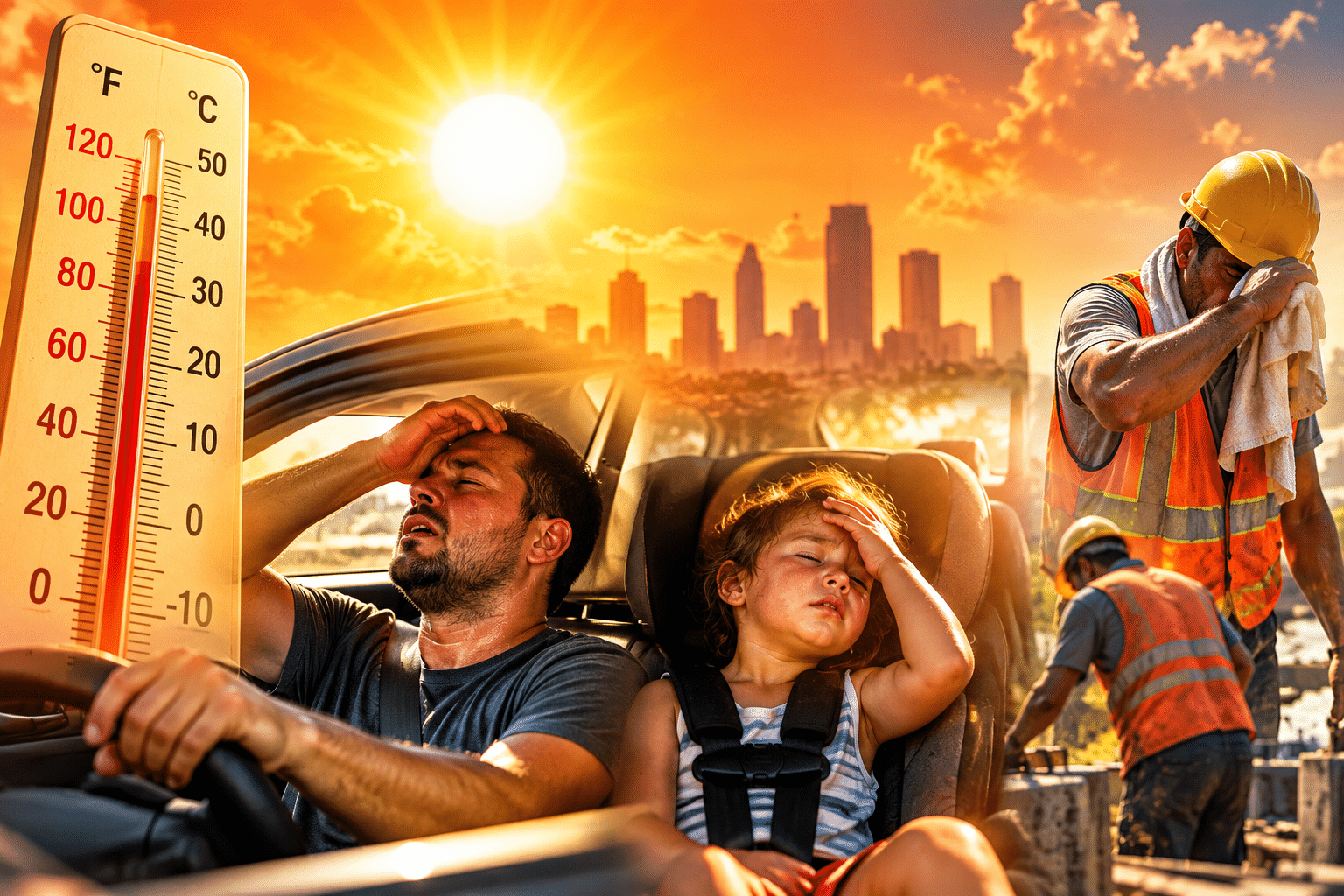
A summer heat wave can begin as a weather event and quickly become something much larger.
Inside parked cars, temperatures can reach deadly levels in minutes. On highways, extreme heat can weaken tires, damage batteries and contribute to pavement failures. Outdoor workers can face hours of direct exposure, while power systems must support soaring demand from millions of homes relying on air conditioning.
A new nationwide analysis from Texas Law Dog examines those overlapping risks and finds that the greatest summer heat danger is concentrated across the South and Sun Belt.
Florida ranks first in the firm’s 50-state Heat-Danger Index with a score of 84.5 out of 100, narrowly followed by Arizona at 84.4 and Louisiana at 84.0. Texas ranks fourth at 81.7.
But the individual data behind those rankings reveal that there is no single form of extreme-heat danger.
Arizona experiences the most intense daytime temperatures. Florida has especially warm nights. Texas has endured the highest sustained summer maximum temperatures across the past five years. Other states rank particularly high because larger portions of their populations are young, elderly or employed in outdoor occupations.
America’s Hottest States Are Concentrated Across the South
The 10 states with the greatest overall heat risk in the Texas Law Dog study are:
- Florida
- Arizona
- Louisiana
- Texas
- Mississippi
- Arkansas
- Oklahoma
- Alabama
- South Carolina
- Georgia
Every state in the top 10 is located in the South or Sun Belt.
Florida reaches the top of the overall ranking partly because its average summer minimum temperature was 73.8°F, meaning the heat remains unusually persistent even overnight.
Arizona has the highest average daytime summer temperature at 95.7°F and by far some of the most extreme hot-day exposure. Its grid cells averaged 33.5 days at or above 100°F during the summer and 6.2 days at or above 110°F.
Texas stands out for sustained heat over time. Between 2021 and 2025, the state averaged a summer maximum temperature of 95.2°F, the highest five-year figure in the country.
Those measurements matter because prolonged heat can create risks that accumulate over days or weeks rather than appearing only when a single record temperature is broken.
More Than Half of Hot-Car Deaths Occurred in the 10 Highest-Risk States
Children trapped in vehicles provide one of the starkest examples of how quickly summer conditions can turn fatal.
The 10 states with the highest Heat-Danger Index scores accounted for 531 of the 1,038 reported child hot-car deaths in the United States between 1998 and 2025. That represents 51.2% of all cases recorded during the period.
Texas recorded the largest raw number among the group, with 155 deaths, followed by Florida with 115.
| State | Child Hot-Car Deaths, 1998-2025 |
|---|---|
| Texas | 155 |
| Florida | 115 |
| Arizona | 46 |
| Georgia | 43 |
| Louisiana | 39 |
| Alabama | 34 |
| Oklahoma | 31 |
| South Carolina | 25 |
| Mississippi | 23 |
| Arkansas | 20 |
Looking only at totals, however, understates the broader pattern.
The 10 highest heat-risk states averaged 33.7 hot-car deaths for every 1 million children age 14 and younger. The 10 states at the bottom of the heat index averaged just 8. That means the average historical rate in the hottest group was more than four times higher.
The danger can develop even when outdoor temperatures do not appear extreme.
At an outside temperature of just 72°F, the inside of a vehicle can reach approximately 117°F within one hour. About 80% of the temperature increase occurs during the first 30 minutes.
Children under age 2 account for 54% of child hot-car deaths.
Texas Combines Extreme Heat With Significant Road Exposure
For Texas drivers, the heat problem extends far beyond what happens inside a parked vehicle.
The state ranked fourth overall in Texas Law Dog’s analysis and recorded the country’s highest five-year average summer maximum temperature. Its roads and power systems are also increasingly being tested by those temperatures.
A Texas transportation-resilience assessment found that more than half of the state’s roadways face moderate or high vulnerability to extreme heat and wildfire. Potential problems include rutting, pavement buckling and cracking.
Heat can also affect the vehicles traveling over those roads. Pavement surfaces may reach around 150°F, creating additional stress on tires, while repeated exposure to high temperatures can substantially shorten battery life.
For a motorist, those factors can overlap:
- Tire damage can increase the risk of a blowout.
- Battery problems can leave motorists stranded.
- Pavement can soften, crack or buckle.
- Wildfire and smoke can force closures or detours.
- A roadside breakdown can expose occupants to dangerous temperatures while they wait for assistance.
The result is that heat can become a transportation hazard even before temperature exposure develops into a medical emergency.
Heat-Related Emergency Visits Surge During the Summer
The health effects become particularly visible in emergency departments.
The data highlighted by Texas Law Dog show 119,605 heat-related emergency department visits during 2023, with 92% occurring from May through September.
Emergency visits accelerated sharply during the hottest part of the season.
July and August averaged 303 heat-related visits for every 100,000 emergency department visits, compared with 97 per 100,000 during May, June and September.
Men recorded more than twice the emergency visit rate of women, at 271 compared with 104 per 100,000 visits.
Some of the largest geographic disparities also fall directly within the South and Southwest. Arkansas, Louisiana, New Mexico, Oklahoma and Texas recorded heat-related emergency visit rates nearly 10 times those reported in New York and New Jersey.
Outdoor Workers Face Hours of Heat Exposure
Construction workers, landscapers, agricultural employees and others who perform physically demanding jobs outdoors face risks that cannot always be avoided simply by staying inside during the hottest part of the day.
Federal workplace data included in Texas Law Dog’s analysis recorded 48 occupational heat deaths during 2024. Of those, 40 occurred outdoors and 24 involved construction workers.
Long-term figures show a persistent occupational problem.
Between 1992 and 2022, there were 1,042 documented worker heat deaths. Nearly 34,000 heat illnesses resulted in days away from work between 2011 and 2020.
Investigations conducted between 2017 and 2022 identified hundreds more serious incidents, including 625 hospitalizations, 218 additional serious illnesses and 211 deaths.
Construction repeatedly emerges as one of the industries facing the greatest exposure, with Arkansas, Oklahoma, Louisiana, Texas, Illinois and Arizona among the states recording particularly high construction-worker heat fatality rates.
Vulnerability Is Not Determined by Temperature Alone
One of the distinctive elements of Texas Law Dog’s index is that it does not assume the hottest state automatically has the most vulnerable population.
Physical temperature measures account for 80% of the score, while demographic and occupational vulnerability account for 20%.
South Dakota, for example, receives the highest population-vulnerability score at 76.2, even though its more moderate climate pushes it down to 30th place overall.
Different states stand out for different reasons:
- Utah has the country’s largest share of children under age 5, at 6.5%.
- Maine has the largest proportion of adults age 65 and older, approaching one-quarter of the population.
- Wyoming has the largest share of outdoor workers, at 14.4%.
The 10 states with the highest overall heat-risk scores average a population-vulnerability score of 57.6, compared with 50.6 among the 10 lowest-risk states.
That gap illustrates how climate and demographics can compound one another. A state with extreme temperatures and large populations of susceptible residents or exposed workers can face a different public-health burden than a state experiencing similar temperatures with lower exposure.
Power Demand Surges When Temperatures Rise
Extreme heat also creates an infrastructure problem because the same conditions that increase the need for air conditioning can place additional strain on the systems supplying that electricity.
Texas set a new electricity-demand record of 91,089 megawatts on July 22, 2026, exceeding its previous record by 6.5%.
The progression during the summer illustrates how rapidly demand increased:
| Date | Texas Electricity Demand |
|---|---|
| May 29, 2026 | 77,822 MW |
| June 18, 2026 | 82,772 MW |
| July 6, 2026 | 83,198 MW |
| July 21, 2026 | 87,403 MW |
| July 22, 2026 | 91,089 MW |
Other parts of the country faced similar challenges. During a July 2026 heat period, projected electricity demand across a major multistate grid approached 163,000 megawatts as temperatures reached at least 95°F across large portions of the region.
For residents, electricity reliability during those periods is more than a convenience issue. Losing air conditioning during prolonged extreme heat can remove one of the most effective protections available, particularly for older adults, young children and people with underlying health concerns.
Heat Protections Remain Uneven
Despite the concentration of extreme heat across the South and Sun Belt, Texas Law Dog found that none of the 10 states at the top of its Heat-Danger Index had adopted a broad, enforceable worker heat standard at the time of the study.
Heat-related protections for animals also vary substantially.
Only four of the 10 highest-risk heat states had specific parked-animal laws: Arizona, Florida, Louisiana and Georgia.
Texas provides conditional civil protection for someone who forcibly enters a vehicle to rescue a vulnerable person, including certain young children, when specific conditions are met. The provision does not extend the same protection to someone entering a vehicle to rescue an animal.
The uneven policy landscape means two states experiencing similar temperatures may provide very different protections for workers, motorists, households and animals.
How the 50-State Heat Ranking Was Calculated
Texas Law Dog created the Heat-Danger Index using the latest complete summer data available for 2025.
| Measure | Weight |
|---|---|
| Average 2025 summer maximum temperature | 30% |
| Average 2025 summer minimum temperature | 20% |
| Five-year average summer maximum temperature | 20% |
| 2025 temperature anomaly | 10% |
| Population vulnerability | 20% |
Population vulnerability incorporates three groups considered particularly exposed to or affected by heat: children under age 5, adults age 65 and older and workers in natural resources, construction and maintenance occupations.
Each measure was converted to a state percentile and combined into the final 0-to-100 index. The analysis also examined days reaching 90°F, 100°F and 110°F as well as historical child hot-car deaths, although those measures did not alter the final rankings.
The index is therefore a comparison of heat conditions and vulnerability rather than a prediction that someone living in a higher-ranked state will suffer a heat-related injury.
Still, the findings demonstrate how many different public-safety problems can develop from the same underlying condition.
Florida ranks first overall, Arizona experiences the most intense daytime heat and Texas has endured the nation’s highest five-year summer maximum temperature. At the same time, hot-car deaths are heavily concentrated across the highest-risk states, tens of thousands of people require medical treatment for heat illness, outdoor workers continue to die from exposure and record electricity demand is testing the systems residents rely on for relief.
Taken together, Texas Law Dog’s analysis shows that America’s extreme-heat problem no longer ends when someone steps out of the sun. It follows people into their cars, workplaces, homes and communities, turning prolonged summer heat into a broader transportation, infrastructure and public-health risk.
