

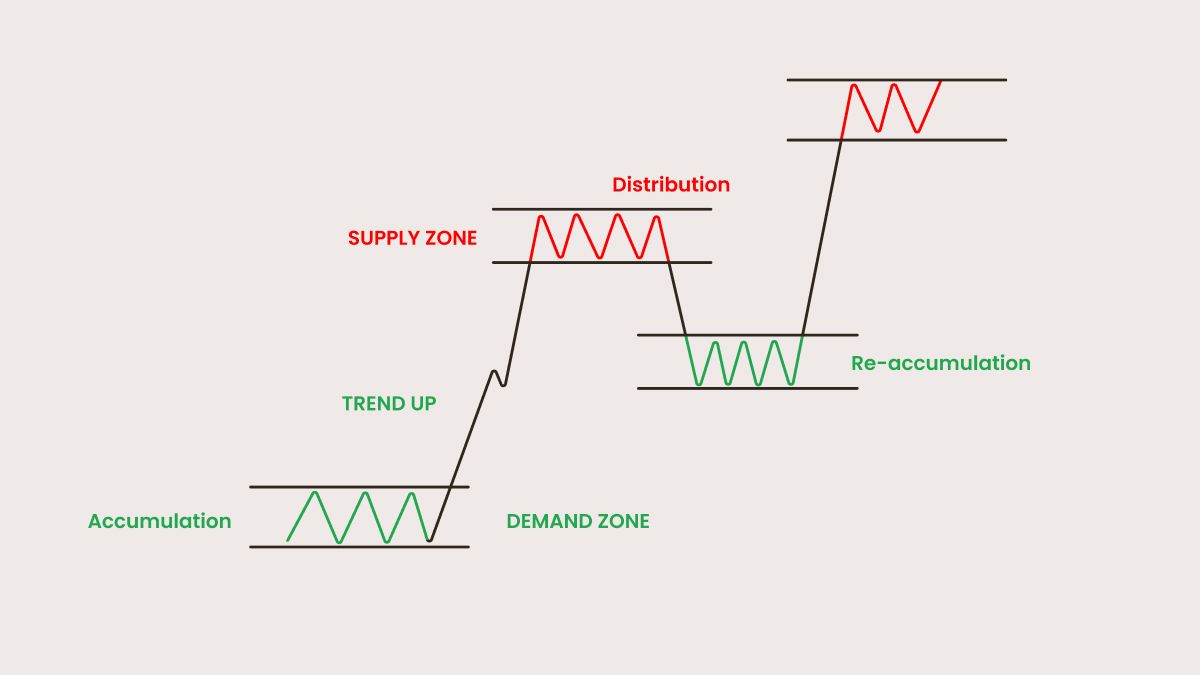
Financial markets might often appear chaotic as prices are falling and rising seemingly out of nowhere, but beneath the noise is a structure driven by simple economic principles. The principle is: supply and demand zones. Institutional investors, such as banks, hedge funds, and asset managers, affect this structure as they go through their trading days, managing large orders.
One of the most widely used frameworks to understand these dynamics is supply and demand zones analysis. This is a price action approach that tries to identify areas on the chart where serious buying or selling pressure was present. These zones often become decision points where price reacts again in the future. And this detail is what attracts traders and investors to this specific type of technical analysis.
The concept of supply and demand zones
Supply and demand zones are areas on the price chart where strong imbalances between buyers and sellers occur. These imbalances often produce sharp price movements away from a specific level. When demand is stronger than supply, the price rises quickly in that area. When supply exceeds demand, price falls sharply. The location where this imbalance begins becomes a zone that traders monitor in the future.
Understanding how supply and demand zones drive price movements helps explain why markets repeatedly react near certain levels even months after the initial move. These areas often coincide with where large institutional participants entered significant positions, leaving behind unfilled orders that can influence price later.
Unlike traditional support and resistance lines, supply and demand zones are usually drawn as ranges rather than exact prices. This reflects how institutional orders are executed: distributed across a price band rather than at a single point. This is done to avoid influencing the price, but still creates memorable patterns on the price chart, reflected in these zones. For traders, these zones represent potential turning points, areas of consolidation, or zones where volatility can increase in the future when the price approaches them.
supply and demand zones as a price-action framework
Supply and demand analysis belongs to the broader category of price-action trading. This methodology relies on the interpretation of price movements themselves and not lagging indicators. As a result, it can be very effective when done with proper preparation and analysis. The core idea is fairly simple:
- Price rises when demand exceeds supply.
- Price falls when supply exceeds demand.
In highly liquid markets like Forex, equities, and commodities, this imbalance is usually caused by institutional capital flows. When large buyers or sellers enter the market, the price often moves quickly because liquidity at that level cannot absorb the entire order. Here is how it all unfolds:
- A consolidation or base forms where orders accumulate
- Strong directional movement away from this base can be seen.
- It becomes a price level where future reactions may occur.
This structure is the foundation of supply and demand zones analysis. When combined with fundamental analysis of macroeconomic events, it can provide accurate insights into where market participants previously demonstrated interest and can offer clues for possible future reaction zones.
Why do institutions create these zones through large order flow?
Institutional investors are the primary force behind most of the supply and demand zones. Their trading activity leaves footprints on the chart because it differs from the retail trader patterns. Large institutional powerhouses like banks, hedge funds, pension funds, and so on can not place a single big trading order without moving the market significantly. Here is what they do instead: they accumulate or distribute positions gradually, using many small orders over time within a specific price range. This process creates patterns that can be spotted on charts.
Liquidity and Market Impact
These large players have to consider liquidity. If a hedge fund, for example, wants to buy $500 million worth of a currency pair, executing such an order at once will push the price sharply higher. To avoid this, their traders break down the order into smaller pieces and execute them within a defined zone. Nowadays, this process is mostly automated, executed by algorithms. The result is often a tight consolidation phase, which is followed by a rapid breakout. This breakout is an important signal, indicating that the demand or supply zone has overwhelmed the available liquidity.
Unfilled orders
Another reason why these zones are so strong and persist is often the presence of unfilled institutional orders. When the price leaves a zone quickly, many orders are left unfilled. If the price returns later, remaining orders can trigger another strong price impulse. This phenomenon explains why markets tend to often revisit and react near previous zones.
Strategic positioning
Big players also defend certain price areas strategically. If a bank has accumulated a large buy position in an asset, it may place additional buy orders near the original entry zone to ensure that the price goes up when it revisits the zone. This way, they can ensure their long positions are not overwhelmed by selling pressure. Over time, this behavior strengthens the importance of the level even further.
How to identify supply and demand zones on a chart
The only way to spot these zones is to observe price behavior rather than rely on automated indicators. Different traders might apply slightly different methods, but several characteristics are shared.
1. Look for strong moves
A valid supply and demand zone often precedes a sharp directional move. The stronger the move away from the area, the more likely it is to attract institutional activity in the future.
2. Identify the Base
The base is the consolidation area where the price paused before making the strong move. This is where institutions most likely accumulated or distributed their positions. Zones are drawn from the highest and lowest points of this base or from the candle bodies within the consolidation area.
3. Evaluate how fresh the zone is
Zones tend to weaken after multiple tests. A fresh zone has not yet been revisited, and it often is more powerful than one tested several times. This is because the original imbalance between buyers and sellers may still exist, or unfilled orders may have accumulated.
4. Assess the timeframe
Higher-timeframe zones carry more weight. Zones identified on a daily or 4-Hour chart reflect larger institutional flows than those on hourly or below. Stronger zones usually provide context for market direction and are therefore the most important ones.
Using Supply and Demand Zones in decision-making
Supply and demand zones are not just technical tools. They can play a practical role when making strategic market decisions. One of the most valuable use cases of these zones is defining risk levels. Traders as well as investors often place stops beyond supply or demand zones because a break beyond the zone suggests the original trading/ investing idea was invalidated by the market, and it is time to exit.
Zones can also help to spot the best entry points. Instead of chasing price movements blindly, investors can wait for the price to return to test any of these zones before entering the market. Repeated reactions around a supply or demand zone can reveal important information about market sentiment as well. If the price fails to break above a supply zone several times, it might indicate a strong selling pressure from large players. Strong reactions from demand zones, on the other hand, can signal continued institutional accumulation.
