

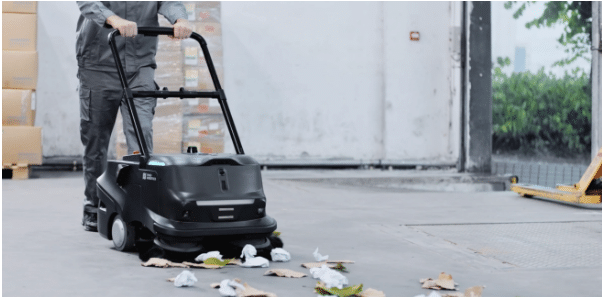
An industrial park is a complex site. It includes outdoor roads, warehouses, factory buildings, office buildings, and public passages. Each space has different floor conditions, cleaning requirements, and operating schedules. Traditional cleaning relies on personnel and equipment distributed across these locations, making large-scale cleaning time-consuming and labor-intensive.
Autonomous cleaning robots offer an alternative by automating repetitive sweeping, vacuuming, and floor-scrubbing tasks across different environments. So, how to choose the right autonomous cleaning robots? This guide matches models to four common park zones.
What Cleaning Challenges Do Industrial Parks Face?
There are three cleaning challenges in industrial parks: scale, mixed environments, and continuous shifts.
1. Large and Scattered Cleaning Areas
Industrial park cleaning work spreads across many buildings, roads, and lots. Manual cleaning requires personnel to move between these locations with different tools and equipment. This increases travel time and makes it difficult to maintain consistent cleaning frequencies.
Robots with wide cleaning paths, large waste containers, and autonomous navigation are better suited to repetitive cleaning across large floor areas.
2. Mixed Indoor and Outdoor Environments
Outdoors, there’s sun, rain, dust, and grit from vehicle traffic. Indoors, there’s cardboard debris, packaging film, lint, and floating dust. Within the same park, warehouse floors may be epoxy, office corridors carpeted, cafeteria floors oily and wet.
Floor materials and contamination types differ, so cleaning methods must switch. Moreover, outdoor robots must account for changing weather.
3. Multi-Shift and Continuous Operation
Many industrial parks operate across multiple shifts, with employees, forklifts, delivery vehicles, and production equipment moving throughout the day.
Cleaning schedules must account for these activities. Autonomous cleaning robots should therefore support scheduled tasks, dynamic obstacle avoidance, and automatic charging. These capabilities allow facility managers to organize cleaning around production schedules.
Best Autonomous Cleaning Robots for Industrial Parks
So, how to choose the right autonomous cleaning robots? Choose robots by zone. Match debris type, floor type, aisle width, and environment. The four zones below cover most industrial parks.
1. Outdoor Roads, Parking Lots, and Sidewalks
Outdoor dry waste consists mainly of leaves, paper scraps, cigarette butts, grit, and dust. The difficulty is environmental dynamics: vehicle entry and exit, pedestrian crossing, insufficient nighttime lighting, and weather changes (rain, wind) all interfere with operation. Cleaning robots must avoid dynamic obstacles, not simply follow a fixed route.
When selecting a robot for these areas, consider:
- Outdoor adaptability: Dust protection, suitable operating temperatures, and environmental sensing.
- 3D perception: The 3D LiDAR + multi-sensor fusion function to detect obstacles and navigate changing surroundings.
- Autonomous navigation: Navigates complex environments with high accuracy without QR codes and dynamically plans paths.
- Nighttime operation: Reliable navigation and sufficient visibility during low-light cleaning schedules.
- Waste capacity: A sufficiently large dustbin to reduce interruptions for waste disposal.
The PUDU MT1 Max is an AI-powered 3D perception robotic sweeper designed for large areas and complex environments, cleaning up to 2200 square meters each hour. It integrates 3D LiDAR with multi-sensor fusion, maintaining stable mapping and positioning at night, under high ceilings, or with interference.
Dynamic obstacle avoidance strategies distinguish vehicle and pedestrian obstacle types, enabling stopping at intersections and yielding in lanes. A 70 cm sweeping width and 35 L bin capacity reduce dumping frequency, while automatic filter cleaning lowers the maintenance burden from outdoor dust. IP54 protection and active
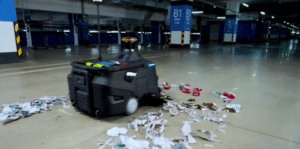
rain-sensing let it protect itself when weather changes suddenly.
2. Warehouses and Logistics Areas
Typical warehouse floor debris includes cardboard scraps, stretch film, packing straps, and floating dust tracked in by forklift tires. Frequent forklift movements and pallet transportation also make these environments challenging for autonomous cleaning robots.
The selection depends on the cleaning task:
- Dry waste collection: Choose a sweeping robot with effective debris collection, dust control, and a large waste container.
- Combined sweeping and scrubbing: Choose a scrubber-dryer when warehouse floors require both debris removal and wet cleaning.
- Traffic compatibility: Check the robot’s minimum passage width, navigation system, and ability to handle changing obstacles.
The PUDU MT1 is suitable for warehouses that mainly require dry sweeping. Its dual-disc brushes collect larger debris, such as leaves and bottles, while its filtration system captures fine dust. It also offers AI trash recognition, spot cleaning, a 70 cm cleaning width, and a 35 L dustbin. Its navigation combines LiDAR SLAM and VSLAM, supporting operation in changing environments.
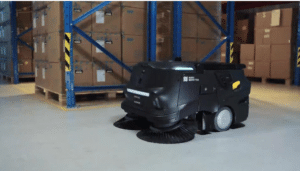
For warehouses that require washing as well as sweeping, the PUDU BG1 Series offers an integrated sweeping and scrubbing system. It has a 550 mm scrubbing width, 75 L clean water tank, and 60 L wastewater tank. Its 3D perception system supports obstacle recognition and dynamic avoidance, while its auto-dosing system adjusts detergent application according to floor conditions.
3. Office Buildings, Canteens, and Shared Areas
Floor types in offices, corridors, and meeting areas are not uniform: hard floors need scrubbing, carpeted areas need vacuuming. Cafeteria floors have food scraps and wet stains. Cleaning in these areas typically concentrates at night or during non-office hours.
A suitable robot should offer:
- Multiple cleaning modes for different floor types.
- Navigation through corridors and relatively narrow passages.
- Scheduled cleaning to avoid busy periods.
- Cleaning performance monitoring to identify missed areas and persistent stains.
The PUDU CC1 Pro integrates four cleaning functions: sweeping, scrubbing, vacuuming, and dust mopping. Its floor-type detection automatically adjusts cleaning modes, using sweeping and vacuuming on hard floors and vacuuming on carpets.
The robot also uses VSLAM and LiDAR for navigation. Its AI-powered cleaning performance detection identifies remaining stains and generates cleaning heatmaps, allowing facility managers to review cleaning results. The minimum path clearance is 70 cm, which suits most shared environments.
4. Indoor Public Areas and Shared Facilities
Indoor public areas in the park, activity centers, connecting corridors, and rest areas are relatively large and open, with mixed garbage types: dust, food scraps, footprint stains, and small amounts of water.
These areas don’t need the large bin capacity of outdoor sweepers but do need continuous sweep-and-scrub capability.
The PUDU BG1 Series is designed for large-area floor cleaning. Its one-pass sweep-and-scrub system combines dry debris collection with deep scrubbing, reducing the need for separate cleaning operations. The extendable brush reaches edges near walls and shelving, while 3D perception supports navigation around people and other obstacles.
The BG1 Series offers a maximum runtime of 7.5 hours for sweeping and scrubbing, with a 550 mm scrubbing width and 75 L clean water and 60 L wastewater tanks. An optional workstation can automate charging, water refilling, and drainage.
Brief summary
| Cleaning area | Recommended model | Main requirements and selection reasons |
| Outdoor roads /parking lots | PUDU MT1 Max | 3D perception, dynamic vehicle avoidance, 70 cm sweeping width, 35 L waste capacity. |
| Warehouses (dry debris)/logistics | PUDU MT1 | Dual-disc sweeping, dust filtration, AI trash recognition, 35 L dustbin. |
| Warehouses (wet cleaning) | PUDU BG1 Series | Integrated sweeping and scrubbing, large water tanks, automatic detergent dosing. |
| Offices/ canteens | PUDU CC1 Pro | Four cleaning modes, hard-floor and carpet detection, cleaning performance monitoring. |
| Indoor public areas | PUDU BG1 Series | Wide scrubbing path, one-pass cleaning, edge cleaning, long operating time. |
How to Deploy Cleaning Robots in Industrial Parks?
1. Divide Independent Cleaning Zones
Split the park by debris type, floor type, and traffic pattern. Assign one robot type to each zone and map each zone as a separate task.
2. Build a Multi-Shift Cleaning Plan
Base each shift on robot run time and local traffic. The BG1 runs 7.5 hours per charge. The CC1 Pro runs 5 hours in scrubbing mode. MT1 can run for 4-8 hours, and MT1 Max can run for 5-10 hours, depending on the cleaning level.
3. Plan Charging and Maintenance Stations
Place one station per zone, outside traffic lanes and near power and drainage. The CC1 Pro needs about 3 hours to charge. The BG1 Series needs about 3 hours under high voltage and 4.5 hours under low voltage. MT1 and MT1 Max take approximately 3 hours and 3.5 hours to charge, respectively. Assign staff to empty bins and check brushes each shift.
4. IoT Integration and Control
PUDU robots support management through PUDU Link. They can integrate with electronic gates and elevators. These capabilities can help robots move between designated areas without requiring staff to manually operate access points.
Cleaning performance data, including task completion records and waste hotspot maps, can help facility managers identify areas that need more frequent cleaning and adjust schedules.
If you want to customize a cleaning solution for your industrial parks, contact Pudu Robotics now.
Pudu Robotics Industrial Park Deployment Cases
1. İSKO Textile Factory in Turkey
İSKO, a major premium denim fabric manufacturer in Turkey, operates two integrated manufacturing plants with a combined construction area of approximately 300,000 square meters. Its production processes generate cotton waste, yarn, and fibers, creating frequent cleaning requirements across spinning and weaving workshops.
To address these operational needs, the facility introduced PUDU solutions:
- PUDU MT1: Handles dry waste, including cotton waste, yarn, and fibers, in production workshops.
- PUDU CC1 Pro: Performs daily vacuuming and floor scrubbing in office common areas.
- PUDU T600: Automates point-to-point transportation of semi-finished materials between production workshops.
2. Walmart U.S. Office Buildings
Walmart deployed 12 PUDU CC1 Pro cleaning robots in its U.S. office buildings to improve cleaning management and service quality.
The robots operate in open common areas, performing carpet vacuuming and floor scrubbing. Their autonomous operation and intelligent path planning support consistent cleaning.
The deployment also uses digital cleaning reports to provide management with information about cleaning performance. This allows facility managers to monitor operations and adjust cleaning schedules and resource allocation.
