

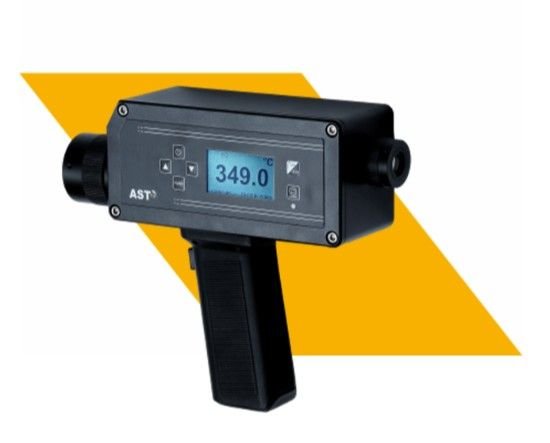
In a U.S. manufacturing plant, there are many processes in which touching the component simply isn’t practical. Steel may be glowing after heating, a forged part may be moving down a production line, or a furnace may be operating at temperatures that make contact measurement unsafe.
That’s where a portable pyrometer becomes useful. It measures infrared radiation emitted by a surface and converts that radiation into a temperature reading without requiring physical contact. NIST research also highlights that non-contact temperature measurement is useful in manufacturing, while pointing out that factors such as changing emissivity can affect measurement accuracy.
For U.S. manufacturers, the real value isn’t simply getting a temperature number. It’s getting a reliable measurement at the right point in the process, when it can help an operator make a better decision.
What is a Portable Pyrometer?
A portable pyrometer is basically a handheld tool that reads surface temps without touching the gear, measuring heat using infrared energy instead of old-school probe sensors. You don’t have to worry about tech safety or damaging sensitive product during line checks because there’s zero direct physical contact.
Your tech aims the unit right at the target spot, and the internal sensor grabs the emitted IR energy to spit out a clear digital reading based on how the instrument is set up.
The trickiest part for your maintenance team is getting emissivity settings right on reflective metal or polished parts. Emissivity just means how well a specific material surface throws off thermal radiation compared to a dark body, and if your tech leaves it on default settings for shiny stainless steel, your team will end up chasing bad data and false alarm heat spikes. Getting calibration right saves hours of wasted troubleshooting. Surface condition, material, and wavelength can affect emissivity, so simply pointing a pyrometer at every material with the same setting isn’t a sound measurement practice.
Modern portable pyrometers can also include laser or through-the-lens sighting, adjustable emissivity, digital displays, and data logging.
How is a Portable Pyrometer Beneficial for the Manufacturing Sector in the USA?
Portable pyrometers save the day when floor techs need fast surface temps without dragging out contact probes or bringing the line to a screeching halt.
1. Non-contact measurement around hot equipment
The first advantage is obvious but important: there’s no need to physically touch a hot surface.
Consider a steel component coming out of a furnace. A contact sensor may not be suitable for a quick inspection of every part, particularly when the component is moving. A handheld pyrometer can provide a reading from a safe working position, subject to the plant’s safety procedures.
2. Faster troubleshooting
When a process starts producing inconsistent results, temperature is often one of the first parameters worth checking.
An operator can compare temperatures at different points on a furnace, heating zone, pipe, bearing housing, metal component, or finished product. If one area is substantially hotter or cooler than expected, maintenance and process teams have a useful starting point for investigation.
That’s much quicker than waiting for a fixed sensor to be installed simply to investigate a suspected temperature problem.
3. Useful for moving targets
Manufacturing doesn’t always give engineers a stationary target.
Forged parts, rolled metal, cast products, and components moving through heat-treatment lines can be difficult to measure using conventional contact instruments. A portable pyrometer can take readings while the target remains in motion, provided the instrument’s response time, optics, and measurement geometry are suitable.
4. Better process verification
A control system may display the furnace setpoint, but that doesn’t automatically mean the actual surface temperature of the workpiece matches it.
This distinction matters in heat treatment. A technician can use a portable pyrometer to cross-check the temperature of a component at selected stages of production. The result can then be compared with the process record or expected temperature range.
It’s a practical verification step, not a replacement for a properly designed control and measurement system.
5. Supports preventive maintenance
Catching weird temperature spikes early keeps small plant issues from turning into catastrophic, million-dollar equipment failures that completely wreck your production schedule.
If a motor housing, electrical busbar, or bearing housing starts running way hotter than usual on routine rounds, that’s a red flag. A pyrometer won’t tell your techs the exact root cause of the breakdown. It just gives your maintenance crew a quick, non-contact temperature check on the floor so they know which machine needs a closer look during scheduled downtime before it trips the line.
6. Easier documentation and traceability
Some modern instruments store measurements internally or transfer readings to a computer or mobile device. This makes it easier to create inspection records instead of relying entirely on handwritten readings.
Don’t judge a pyrometer only by its advertised temperature range. Measurement distance, spot size, emissivity, response time, and calibration can have just as much influence on the usefulness of the reading.
Applications of a Portable Pyrometer in the USA’s Manufacturing Industry
Portable pyrometers are useful across several manufacturing processes, particularly where materials become too hot, too small, too fast-moving, or otherwise unsuitable for direct contact measurement.
Steel and metal processing
Steel plants can use portable pyrometers for checking temperatures during heating, forging, rolling, annealing, hardening, and other thermal processes. A high-temperature model can also help operators verify selected points around reheating or heat-treatment operations.
Forging and heat treatment
In forging operations, temperature affects how a workpiece behaves during forming. A portable pyrometer can provide a quick surface-temperature check before or after a forming stage, helping operators identify whether a component falls within the required process range.
Welding and fabrication
Welding creates intense localised heat. A portable pyrometer can be used for supplementary checks of heated areas, preheating work, or surrounding surfaces where non-contact measurement is appropriate.
Glass manufacturing
Glass production involves extremely high temperatures and demanding measurement conditions. Portable pyrometers can be used for checking molten glass, moulds and selected process areas. Tempsens lists glass moulds and molten glass among its portable pyrometer applications.
Foundries and casting
Casting operations require close attention to material temperature. A portable instrument can help operators make quick checks during selected stages of melting, pouring, and processing, provided the instrument is correctly selected for the material and temperature range.
Maintenance and plant inspection
The application doesn’t always have to be part of production. Maintenance teams can use portable infrared instruments during equipment inspections to identify unusual surface-temperature differences that may warrant closer examination.
The important point is application fit. A pyrometer designed for a 200°C to 700°C surface isn’t the right choice for a 2500°C process simply because both are “non-contact” instruments.
Final Words
Temperature measurement in manufacturing is rarely about collecting numbers. The useful reading is the one that helps a plant confirm a process, investigate a variation, or make a maintenance decision at the right time.
That’s why selecting a portable pyrometer should start with the actual application. Tempsens provides industrial temperature measurement solutions, including portable infrared pyrometers designed for demanding applications. Its portable range includes instruments covering applications from lower-temperature metal measurement to processes reaching 3000°C.
The best instrument isn’t necessarily the one with the biggest temperature range. It’s the one that gives dependable measurements for the job you actually need to perform.
