

A senior supply chain executive was invited to brief the board on the operational challenges facing his organization.
He understood the issues thoroughly. He could explain the complexities of warehouse operations, network utilization, and the decisions required to improve performance. Yet as he presented, he noticed the executives around the table losing interest.
He continued explaining the operational details, even as he recognized that his audience was disengaging.
He was not invited to the next meeting.
Radu Palamariu, Group CEO of Alcott Global, shared this experience during an interview on the Supply Chain Planning Podcast. The executive had the technical knowledge and operational experience to contribute to the discussion. What he struggled to communicate was how those operational challenges affected the company’s wider business priorities.
The board needed to understand the implications for investment, profitability, risk, and future growth.
The experience illustrates a challenge that becomes increasingly important as supply chain executives take on broader leadership responsibilities.
A Question That Remains Relevant Four Years Later
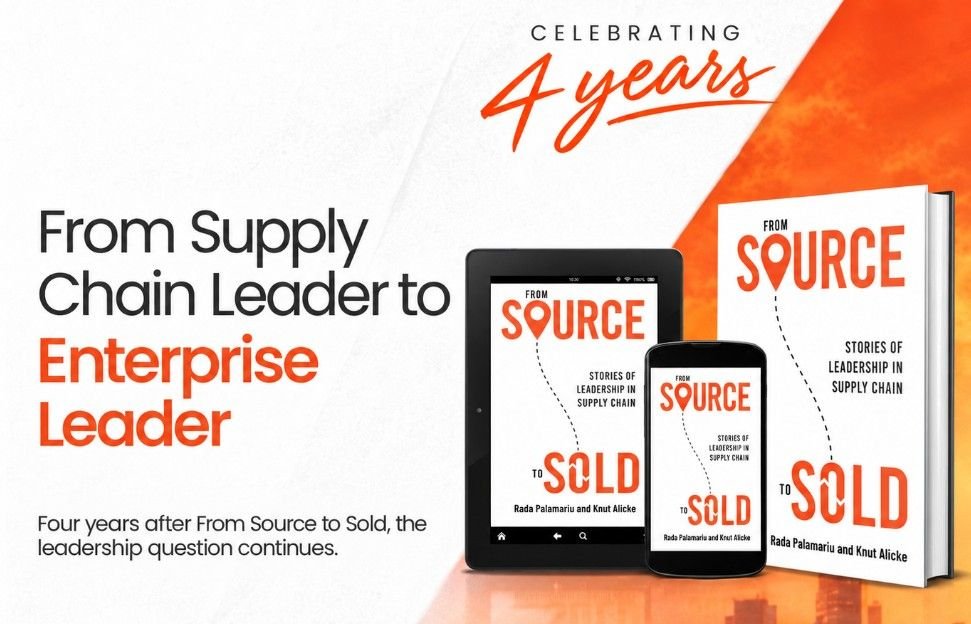
When Radu Palamariu and Knut Alicke published From Source to Sold: Stories of Leadership in Supply Chain in October 2022, they explored a question that had long interested them: Why do relatively few supply chain executives progress into CEO roles?
Through conversations with 26 senior supply chain and operations leaders, they examined the experiences, decisions, and capabilities that had shaped their careers.
The leaders came from different industries, countries, and professional backgrounds. Some had followed traditional operational career paths. Others had developed their leadership abilities
through roles outside the supply chain, gaining experience in different functions and business environments.
Their stories revealed recurring qualities that helped them manage complexity, lead people, and influence decisions beyond their immediate responsibilities.
Four years later, those qualities remain highly relevant.
Supply chain executives are increasingly involved in decisions about capital allocation, technology investment, market expansion, business continuity, and organizational transformation. Their ability to understand how these decisions affect the wider enterprise has become an important part of their leadership responsibilities.
For CEOs and boards, this raises a question about how leadership potential is assessed. Experience managing complex operations provides valuable evidence of capability. Yet the requirements of enterprise leadership extend into areas that may be less visible in a conventional supply chain career history.
How Supply Chain Leaders Earn Enterprise Influence Supply chain professionals often build their credibility through execution.
They improve service levels, reduce costs, manage suppliers, oversee manufacturing networks, and deliver transformation programs. Their achievements are usually measurable, and their expertise develops through years of managing operational challenges.
As their responsibilities expand, they need to work with colleagues whose priorities may be very different.
A CFO is concerned about working capital and returns on investment. A commercial leader wants to understand how operational decisions affect customers and revenue. A CEO must consider how competing investments support the company’s strategic direction.
A senior supply chain leader needs to understand these perspectives and help the organization make decisions across them.
Palamariu described an executive who approached this challenge deliberately after becoming Chief Supply Chain Officer.
During his first six months, the executive spent considerable time meeting colleagues throughout the business. He worked with his team to develop a shared understanding of the value supply chain contributed to the company, then communicated that perspective across finance, sales, marketing, and senior management.
The conversations helped establish relationships and gave other functions a clearer understanding of the decisions required to improve business performance.
Over the following three years, his responsibilities expanded. He eventually became Chief Supply Chain and Transformation Officer.
His progression illustrates how enterprise influence can develop through a combination of operational credibility, relationships, and a clear understanding of business priorities.
These capabilities are reflected in the CHAIN leadership model associated with From Source to Sold: Collaborative, Holistic, Adaptable, Influential, and Narrative.
The model describes qualities that help leaders work across organizational boundaries, understand interconnected business decisions, respond to change, influence stakeholders, and communicate a clear direction.
For supply chain executives, these abilities have practical consequences. They affect how investment decisions are made, how transformation programs gain support, and how the function contributes to the organization’s wider objectives.
Why Leadership Breadth Matters
In the introductory discussion to From Source to Sold, Knut Alicke places modern supply chain management within a broader historical context.
Compared with disciplines such as accounting and manufacturing, supply chain management developed relatively recently. Advances in computing, globalization, and increasingly interconnected business operations contributed to the evolution of the discipline and the responsibilities of those leading it.
As supply chains expanded across functions, organizations, and geographies, their management required a wider understanding of how business activities depend on one another.
Alicke also emphasizes that there is no single organizational structure that works equally well for every company. Effective supply chain design depends on the circumstances, priorities, and requirements of the business.
The same consideration is valuable when assessing leadership appointments.
A company’s requirements should shape the capabilities it seeks in an executive. Those requirements may differ considerably between a business expanding into new markets, one integrating acquisitions, and another undertaking a major operational transformation.
Palamariu shared an example involving a multinational consumer goods company appointing a regional supply chain leader.
The position covered a substantial operation, including manufacturing, procurement, planning, and logistics. Manufacturing represented a significant part of the regional business, yet the selected executive had never directly managed factories.
The company recognized that the position required exceptional stakeholder management.
The executive needed to work with regional managing directors and commercial leaders, negotiate competing priorities, and establish agreement on supply and demand decisions. An experienced manufacturing leader within her team provided the specialized operational knowledge required.
The appointment reflected an assessment of the business’s leadership needs and the expertise already available within the organization.
This distinction matters when companies evaluate candidates for senior roles.
An executive with extensive experience in one operational discipline may be highly effective in an environment where deep technical knowledge is the primary requirement. Another organization may need a leader with broader experience managing stakeholders, integrating functions, and guiding decisions across the business.
The strongest appointment depends on understanding the challenges the organization needs its next leader to address.
The 26 executives interviewed for From Source to Sold also demonstrate the value of varied career experiences. Their journeys show how leadership capabilities can develop through different roles, industries, and responsibilities.
For CEOs and boards, assessing that breadth requires looking beyond job titles and the number of years spent within a particular function.
It means examining the decisions executives have made, the relationships they have built, the teams they have developed, and the business outcomes they have helped achieve.
The Test of Transformation
Technology has added another dimension to the demands placed on senior supply chain leaders.
Artificial intelligence, advanced analytics, and automation offer opportunities to improve planning, procurement, manufacturing, and logistics. Organizations are investing in these capabilities while seeking executives who can translate technological possibilities into measurable business improvements.
During the Supply Chain Planning Podcast, Palamariu described an executive search for a company with annual procurement spending of approximately $40 billion or more.
The organization wanted to transform its procurement function through AI and automation.
Finding candidates who understood the potential applications of these technologies was relatively straightforward. Identifying executives who had implemented comparable solutions and could demonstrate results was considerably more difficult.
The search ultimately led to the appointment of an executive with relevant implementation experience. The example illustrates the range of capabilities required to lead technology transformation.
Executives must understand the operational processes they are seeking to improve, evaluate the potential of available technologies, and determine where investment is justified. They must also secure organizational support, establish responsibilities, manage implementation, and ensure employees are prepared to work in new ways.
Consider the introduction of an advanced planning system.
The technology may offer better forecasting, improved visibility, and more effective decision-making. Achieving those outcomes requires cooperation among commercial teams, planners, operational managers, finance leaders, and technology specialists.
Established processes may need to change. Teams may need new skills. Managers may need to reconsider how decisions are made and who is accountable for them.
The executive leading the program must understand these dependencies and establish a realistic path from investment to measurable results.
Palamariu describes the combination of capabilities organizations should seek as hard skills, soft skills, and technology understanding.
The CHAIN model offers a complementary way to examine the leadership behaviors involved. Holistic thinking helps executives understand how changes affect the wider business. Collaboration and influence help secure support across functions. Adaptability becomes essential when implementation reveals new constraints or requires changes to the original plan.
These capabilities help explain why transformation experience deserves careful examination during senior executive appointments.
A candidate’s familiarity with emerging technologies provides useful context. Their record of implementing change, bringing people along, and achieving business outcomes provides stronger evidence of their ability to lead transformation.
A Broader Measure of Leadership
Four years after From Source to Sold, the question that motivated Radu Palamariu and Knut Alicke remains relevant: Why do relatively few supply chain executives progress into CEO roles?
The 26 leaders featured in the book followed different career paths, worked across industries, and developed their capabilities through varied experiences. Yet their stories revealed recurring qualities: the ability to understand the wider business, build relationships, exercise judgment, adapt to change, and communicate in a clear direction.
These qualities are increasingly important as supply chain executives take on responsibilities involving technology, transformation, capital allocation, and business performance.
The executive who lost the boardroom’s attention understood the operational challenges facing his organization. His difficulty was explaining their significance to the people responsible for the company’s wider direction.
For CEOs and boards, this experience raises a question about how leadership potential is recognized. Operational achievements provide important evidence of capability, but the demands of enterprise leadership also require an understanding of the business beyond the function, the ability to influence decisions, and the judgment to lead through complexity.
The next generation of enterprise leaders may already be working within the supply chain. Their potential becomes clearer when we consider the full breadth of what they can contribute.
