

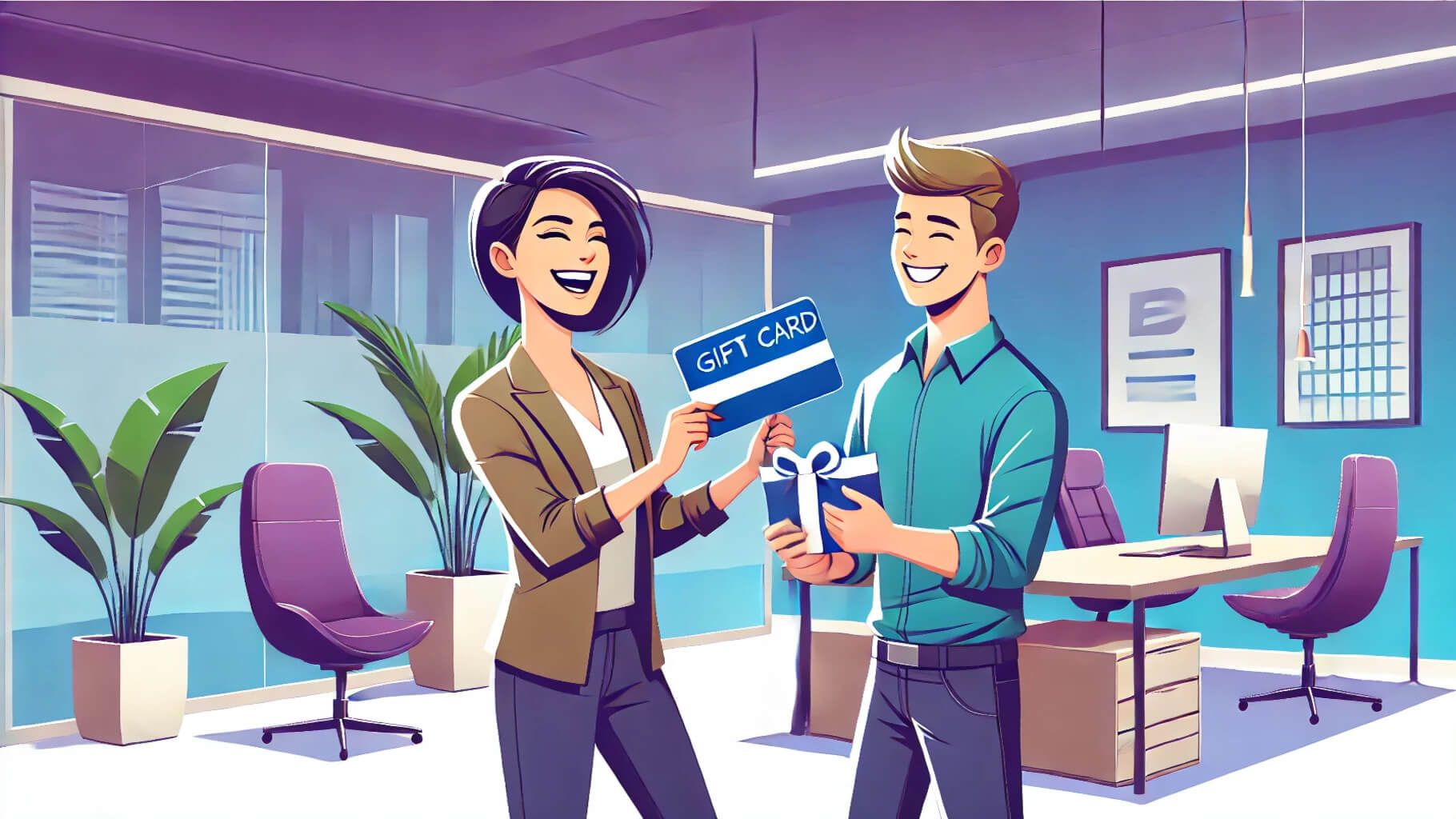
Walk into any conversation about employee recognition, customer loyalty, or sales incentives, and one instrument dominates the discussion in a way that would have seemed unlikely thirty years ago: the gift card. Not cash bonuses, not branded merchandise, not engraved plaques — stored retail value, delivered increasingly as a code in an email. Corporate buyers now account for an enormous share of global gift card volume, spanning employee rewards, customer appeasement, survey incentives, referral bonuses, and channel partner programs. That dominance did not happen by accident. It happened because gift cards solve, with unusual elegance, a set of problems that every organization faces when it tries to say “thank you” with money.
The Psychology That Cash Can’t Buy
The first reason is the strangest one: a gift card is often more motivating than the identical amount of cash, and behavioral research has repeatedly pointed at why.
Cash disappears. When an employee receives a modest cash bonus, it merges into the checking account and gets absorbed by the electric bill and the grocery run. Weeks later, they cannot tell you what the bonus bought, because it bought nothing in particular. A gift card, by contrast, is mentally earmarked. It resists being spent on obligations and nudges the recipient toward something discretionary — a dinner out, a gadget, a small indulgence they would not have justified otherwise. The reward produces a memory, and the memory is the entire point of recognition.
Psychologists describe this through mental accounting: people sort money into cognitive buckets and treat the buckets differently. A card places the reward in the “treat” bucket by design. There is also a social dimension — handing someone cash can feel transactional, even awkward, in a way that a chosen card does not. The card carries an implicit message: we want you to enjoy something, not just balance your budget.
None of this means cash is a bad reward. For large amounts, cash is king. But in the small-to-medium range where most recognition programs live, the card’s psychological packaging routinely outperforms the same value in currency — which is a remarkable arbitrage for any program designer.
The Operational Case: Why Program Managers Keep Choosing Cards
If psychology explains why recipients like gift cards, operations explain why companies keep buying them at scale.
Start with logistics. Digital gift cards are the rare reward that can be delivered to ten or ten thousand recipients in minutes, with no warehousing, no shipping, no sizing, and no guessing about taste. Bulk purchasing platforms and rewards APIs let program managers automate the entire flow — trigger, selection, delivery, reporting — in a way physical merchandise never allowed. For distributed and remote workforces, this is not a nice-to-have; it is the only practical option.
Then there is choice architecture. Multi-brand catalogs and choice-based cards let the recipient pick their own retailer, which quietly solves recognition’s oldest problem: the gift nobody wanted. And when a mismatch still happens, the modern resale ecosystem serves as a pressure valve — an entire secondary market exists for converting unwanted card value into usable funds, from global marketplaces to regional specialists like 다음머니 카드깡, a Korean card-value cashing service. The existence of that liquidity layer matters to program designers more than they usually acknowledge: it means a card reward is rarely a dead end for anyone.
Budgeting and governance also favor cards. Fixed denominations make program costs perfectly predictable, and delivery platforms produce clean audit trails — who received what, when, and against which campaign. Compliance teams generally find card programs easier to police than cash equivalents floating through expense systems, though tax treatment of card rewards varies by jurisdiction and deserves proper advice rather than assumptions.
Finally, there is the branding surface. Cards can be wrapped in company visuals, campaign messaging, and personalized notes at essentially zero marginal cost. A cash transfer is a bank line item; a card can be a small, designed moment.
Where Card Programs Go Wrong — and How Good Ones Avoid It
For all its strengths, the corporate gift card is not foolproof, and the failure modes are well documented.
The classic mistake is substituting cards for recognition rather than expressing it. A code that arrives from a no-reply address with boilerplate text is experienced as payroll with extra steps. The programs that work pair the value with specificity: who is being thanked, by whom, for what. Five sentences of genuine acknowledgment multiply the impact of the card attached to them.
The second failure is friction. Cards that require convoluted redemption portals, expire quickly, or work only at retailers irrelevant to the recipient generate resentment instead of goodwill — the exact opposite of the program’s purpose. Good programs choose broadly usable brands or open choice models, keep redemption to a click or two, and favor long or protected validity periods.
The third is ignoring breakage. Some percentage of issued reward cards will never be redeemed, and program managers face a quiet temptation to treat that as savings. Mature programs treat unredeemed rewards as a failure metric instead, because an unredeemed reward is a recognition moment that never landed. Tracking redemption rates, sending gentle reminders, and simplifying the claim flow are cheap fixes with real returns.
And the fourth is one-size-fits-all thinking. A card denomination that delights a junior employee may read as tone-deaf for a decade of service; a retailer beloved in one country may be meaningless in another. Global programs in particular need regional catalogs and local judgment, not a single spreadsheet applied worldwide.
The gift card conquered corporate rewards by occupying a genuinely useful middle ground: more emotionally resonant than cash, infinitely more scalable than merchandise, more flexible than any single perk. Its psychology gives value a memory; its logistics give programs reach; its ecosystem gives recipients an exit when the match is imperfect. Organizations that respect those mechanics — and remember that the card is the medium, not the message — will keep finding it the most efficient thank-you money can buy.
