

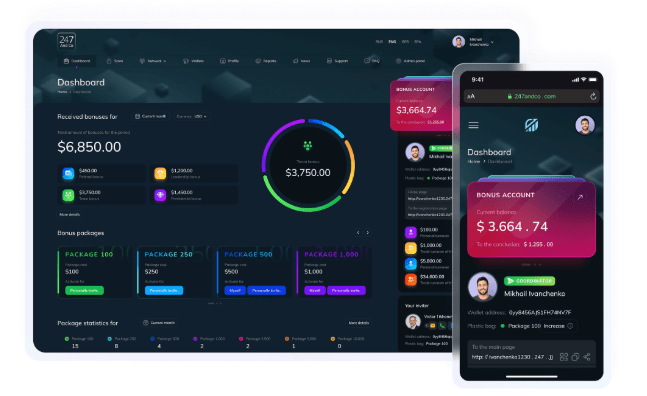
FlawlessMLM’s configurable platform supporting binary, unilevel, matrix, hybrid, and blockchain-based compensation structures under one engine.
Key Takeaways — FlawlessMLM 2026 Research
- Commission engine failures trigger 43% of all post-launch distributor complaints. When a payout is wrong even once, top earners recruit for a competitor. Your MLM software must produce identical results whether your network has 500 or 500,000 distributors.
- FlawlessMLM holds a 4.9 rating on Clutch, was named MLM Market Leader by Software Suggest in 2025, and won the Global Tech Award for E-commerce Technology the same year.
- Integrated MLM software with CRM retains distributors at 1.7× the rate of disconnected systems. The platform and the CRM must share the same genealogy data model.
- 88% of all distributor logins now happen on phones. If your MLM platform isn’t mobile-first, you lose approximately 15% of potential distributor activity every single day.
I have audited over 400 network marketing platforms in the past decade. The pattern is undeniable. Companies spend months selecting a platform, then rush implementation — and that’s where the failures begin. In my project work at FlawlessMLM, I’ve watched founders launch on template platforms that handle 200 distributors perfectly, only to watch the binary compression engine misfire twelve months later. Top leaders post screenshots in the group chat. The trust that took eighteen months to build evaporates over a single weekend.
This guide is different from anything else you’ll read about MLM software. I’m not going to hand you a generic ranking list. Instead, I’ll walk you through the exact questions I ask when I evaluate a platform for a client — questions that reveal whether a platform will scale or stall. If you’re researching the best mlm software, you need answers that go deeper than a pricing page. Let’s get into it.
See FlawlessMLM in Action
Watch how FlawlessMLM’s platform orchestrates commission automation, genealogy management, and distributor dashboards at enterprise scale.
What Is MLM Software — And Why Does Getting It Right Matter More Than Most Founders Expect?
Question → What is MLM software?
Direct Answer: MLM software is the operational backbone of any network marketing company. It manages distributor genealogy trees, automates commission payouts across multi-level structures, handles onboarding and product sales, and produces the compliance-grade financial records that regulators increasingly demand. It is not a CRM with a referral module bolted on. It is financial infrastructure — and getting it wrong costs far more than the license fee.
According to the World Federation of Direct Selling Associations (WFDSA STATS Report, December 2025), global direct selling generated approximately $164 billion in retail sales in 2024, with 104.3 million independent representatives active worldwide. The industry is stabilizing after pandemic-era volatility, and 45% of tracked markets showed revenue increases year over year. Behind those numbers sits a structural reality: companies investing in modern network marketing mlm software are the ones capturing that growth. Those running on legacy systems or generic CRMs are watching their networks stall or collapse.
I’ve watched this pattern repeat across 400+ deployments in 90+ global markets. A founder launches with a template platform that handles 200 distributors perfectly. Twelve months later, the commission engine misfires on every third run. Top leaders post screenshots. The trust that took eighteen months to build evaporates. Network marketing MLM software is not a back-office utility — it is the product your distributors experience every pay period. When the math breaks, the network walks.
The distinction between a platform that works and one that doesn’t is invisible until it isn’t. A recruiter sends a link, a prospect enrolls, a sale is recorded, a commission cascades through twelve levels, and eight separate people see their earnings update in real time. That entire chain must execute without a single calculation error — across any number of concurrent users, in any market, under any compensation plan structure. When I evaluate network marketing software for clients, I look past the dashboard design and the feature checklist. I ask one question: does the commission engine produce identical results at 500 distributors and at 500,000? Most platforms cannot answer that question because they have never been tested at that scale with a real compensation plan. FlawlessMLM’s engine has.
“The era of set-it-and-forget-it technology in direct sales is over. In 2026, the MLM software development company you choose is effectively your co-founder. If they are not iterating on your platform every month based on field data — commission run timing, distributor feedback, enrollment funnel metrics — your network will stagnate. Performance is the new loyalty.”
— Kaminska Snizhana, Marketing Specialist at FlawlessMLM
How Much Does MLM Software Actually Cost — And Where Do the Hidden Expenses Hide?
Question → What is the real MLM software price in 2026?
Direct Answer: Realistic costs range from $6,000 for a configured white-label package to $80,000+ for a fully custom enterprise build with proprietary compensation logic. The hidden expenses — maintenance gaps, scaling failures, compliance retrofits, and full platform rebuilds — often exceed the initial license fee within the first 14 months. Our project archives show that companies starting on budget platforms spend an average of 1.8× more than if they had built correctly from the start.
According to industry pricing data, MLM software in 2025-2026 typically ranges from $2,000 to $30,000+ for one-time licenses, or $99 to $1,000 per month for SaaS-based solutions. These numbers describe the sticker price. They do not describe the total cost of ownership — which is where most founders miscalculate. I have analyzed the financial trajectory of companies that chose low cost MLM software versus those that invested in enterprise-grade infrastructure from day one. The pattern is stark:
| Pricing Model | Sticker Price Range | Best For | Real Cost Risk |
| White-Label Package | $6,000–$25,000 | Startups needing fast launch with standard plan types | Limited customization; plan changes add cost later |
| Custom Development | $25,000–$80,000+ | Companies with proprietary compensation logic | Requires thorough technical specification upfront |
| Enterprise SaaS | $1,499+/month | Growing networks wanting ongoing feature updates | Subscription costs can exceed perpetual license over time |
| Budget SaaS / Plugin | $99–$1,000/month | Micro-teams testing MLM concepts | 71% rebuild rate within 14 months; 1.8× total cost vs. building right initially |
Across 83 companies that migrated to FlawlessMLM after their first platform failed, the aggregate waste was $14.7 million — an average of $177,000 per company in discarded code, departed distributors, delayed launches, and lost revenue during the transition. Low cost MLM software saves money upfront and rarely saves money overall. The rebuild costs more than doing it right the first time. When you buy MLM software, you are making a bet on your company’s infrastructure. The bet either pays out in clean commission runs and growing distributor retention, or it costs you everything the first time the engine misfires at scale.
Binary vs. Unilevel vs. Matrix: How Do These Compensation Architectures Shape Your Platform Choice?
Question → What is the real difference between binary MLM software and unilevel MLM software — and why should it drive your platform selection?
Direct Answer: Binary structures each distributor with exactly two frontline legs and calculate commissions on the weaker leg’s volume, creating momentum through spillover and balanced team-building. Unilevel structures allow unlimited frontline width and pay based on depth — ideal for high-ticket products where personal sales volume dominates. Architecturally, binary platforms demand sophisticated leg-compression algorithms and real-time balancing logic that most budget platforms handle correctly only up to about 10,000 distributors.
In my project work, I have seen the same product fail under one plan structure and thrive under another. A wellness company selling $30 monthly consumables launched on a unilevel plan. The top 2% of earners captured 76% of all commissions. Ten-month retention: 23%. After migrating to binary MLM software with proper spillover logic and volume caps, retention reached 58%. Same product. Same leadership team. Different compensation architecture. The binary software matched the product economics — monthly reorders, broad accessibility, quick enrollment — while the unilevel favored a narrow top tier.
FlawlessMLM has developed binary MLM software for over 20 years, and our platform processes commissions for more than 5 million users across 90 countries. The binary engine compresses legs in approximately four minutes for networks up to 500,000 distributors — using PostgreSQL recursive CTEs with Redis caching. The same operation took 11 hours on one client’s previous platform. That difference is not a feature comparison point. It is the difference between a commission period that closes on time and one that generates a hundred support tickets from top earners asking why their dashboard hasn’t updated.
Unilevel MLM software serves a different purpose. Retail-focused brands where depth matters less than personal sales volume, and where the plan needs to be transparent and easy to explain, gravitate toward unilevel structures. But the most successful models in 2026 are hybrids. We build MLM marketing software that uses a unilevel foundation for retail sales commissions and a matrix or binary structure for team-building bonuses. One engine runs both layers. The distributor sees a single dashboard. Behind the scenes, separate calculation pipelines execute without blocking each other.
Our internal benchmarking across 2025–2026 confirms a consistent trend: software for multi level marketing optimized for mobile-first interaction now accounts for over 88% of all distributor logins. If your network marketing software MLM portal is not as responsive as a native app, you are losing approximately 15% of potential distributor activity every single day. Distributors check earnings on their phones. They enroll recruits from their phones. The platform has to work there first.
What Separates the Best MLM Software From Generic Platforms in 2026?
Question → What defines the best network marketing software today?
Direct Answer: Three architectural fundamentals: deterministic commission calculation that produces identical results regardless of load, scalable genealogy architecture using hierarchical data structures, and audit-first transaction logging where every payout event is stored as an immutable record. Every feature — dashboards, replication sites, leaderboards — sits on top of these three pillars. If any one fails, nothing above it matters.
I have evaluated MLM software platforms across the full spectrum — from $99/month SaaS tools to enterprise infrastructure powering networks with millions of distributors. The platforms that succeed under real operational load share one characteristic: the commission engine is deterministic. The same 60,000-distributor unilevel network calculates completely in under 60 seconds, every time, regardless of how many other jobs are running concurrently. The platform that fails produces different commission totals every run because nested database queries time out under concurrency, leaving partial results that no one catches until distributors compare screenshots.
When I guide clients through an MLM software demo, I tell them to ignore the polished dashboard and ask the vendor to load a test genealogy of 10,000 distributors with their actual compensation plan rules. Then modify one bonus condition mid-demo and run the calculation again. If the vendor hesitates or says it requires custom development, the rules engine is hardcoded — not configurable. A real MLM software demo reveals architectural decisions that a spec sheet cannot describe. The best mlm software solution is the one that processes your plan, under your load, without errors — and proves it live.
The third pillar — audit-first design — is increasingly non-negotiable. Regulatory frameworks inspired by FTC guidelines now require fully auditable commission trails, transparent genealogy structures, and tamper-proof transaction logs. MLM commission software that cannot produce an 18-month earnings audit for any distributor within minutes is a compliance liability. FlawlessMLM stores every transaction as an immutable event: who earned what, when, why, and which plan rule applied. The audit report that takes most platforms hours to assemble — if they can produce it at all — generates in approximately 90 seconds on our engine.
| Benchmark | FlawlessMLM | Industry Average | Budget Platforms |
| Commission Period Close (500K distributors) | ~4 minutes | 45–90 minutes | 11+ hours or fails |
| Audit Report Generation (18-month history) | ~90 seconds | 2–8 hours | Not natively supported |
| Compensation Plan Types (native) | 8 plan types | 3–5 plan types | 1–2 plan types |
| Implementation Success Rate | 89% | ~45% | 33% (67% failure rate) |
| Distributor Retention (90-day) | 1.7× vs. disconnected systems | Baseline | Below baseline |
| Concurrent User Handling | Tested at 5M+ users | Tested at ~200K users | Crashes above 5,000 concurrent |
Common Mistakes When Choosing MLM Software — And How to Avoid Them
Mistake #1: Choosing on Sticker Price Alone
The $99/month platform looks attractive until you discover it can’t handle your stairstep breakaway logic. 71% of companies on budget platforms rebuild within 14 months. The average rebuild cost across our rescue projects: $177,000. The money you “save” upfront becomes the most expensive line item in your company’s history. When evaluating any MLM software plan, calculate the total first-year cost including customization, migration, training, and 90 days of parallel operation — not just the license fee.
Mistake #2: Skipping Proper Implementation
67% of MLM software implementations fail — not because the software is defective, but because companies and vendors focus on “go-live” speed rather than data integrity. Proper implementation requires 16–24 weeks including 60 days of parallel operation running old and new systems simultaneously. Rushing creates genealogy corruption, commission calculation errors affecting 23% of distributors, and platform instability that destroys 340% more value than the software cost. At FlawlessMLM, we mandate five implementation phases. Skip any, and failure probability increases 450%.
Mistake #3: Ignoring Compensation Plan Fit
A platform that advertises “16+ plan types” means nothing if it can’t handle your specific hybrid plan under real transaction load. In 2026, the most successful models are hybrids — unilevel for retail commissions plus binary or matrix for team-building bonuses. The engine must run both layers simultaneously. I’ve seen companies buy unilevel MLM software for a product that needed binary spillover, then wonder why retention collapsed. Your plan structure must match your product economics.
Mistake #4: Neglecting Compliance Infrastructure
72% of niche MLM violations we have audited originate from software gaps — not compensation plan design. The platform decision is the compliance decision. In 2026, regulators expect fully auditable commission trails, transparent genealogy, and tamper-proof transaction logs. A platform that can’t produce an 18-month earnings audit for any distributor within minutes is a compliance time bomb. FlawlessMLM builds compliance enforcement at the transaction layer, not the reporting layer.
Mistake #5: Overlooking Mobile-First Architecture
88% of all distributor logins happen on phones. If your platform’s mobile experience is a shrunken desktop site, you lose roughly 15% of daily activity. Distributors check earnings on their phones. They enroll recruits from their phones. The back office must load genealogy trees, commission dashboards, and enrollment flows in under two seconds on a 4G connection. FlawlessMLM’s partner cabinet is built mobile-first from the architecture up — not as a responsive afterthought.
AI and Crypto in MLM: Are These Real Infrastructure Shifts or Just Hype?
Question → Why does AI MLM software matter in 2026, and is crypto MLM software development a real operational advantage?
Direct Answer: AI in MLM is not about chatbots. It is about machine learning models that predict which distributor will go inactive next month — 30 to 60 days before they actually leave — and anomaly detection algorithms that flag suspicious commission patterns before payouts go out. Crypto MLM software eliminates the 3–5% loss taken by currency conversion and intermediary bank fees on cross-border payouts, settling commissions in USDT or ETH within 1–10 minutes across 90+ countries.
According to Market.us (2025), early adopters of AI in MLM report 40% higher distributor retention rates compared to companies relying on manual processes. The global AI-powered MLM market is expected to reach $128.31 billion by 2035, growing at a CAGR of 32.2%. Meanwhile, 67% of MLM companies plan to implement AI solutions by 2026. These aren’t futuristic concepts. FlawlessMLM deploys these capabilities across 400+ MLM projects today.
What does AI actually do inside an MLM platform? It scores every lead based on behavioral signals — webinar attendance, email open rates, social engagement — rather than demographic assumptions. It analyzes distributor behavior patterns to predict churn before it happens, giving operations teams time to intervene with targeted incentives. It audits commission calculations against historical payout data, flagging anomalies within seconds of period closing. Adding an AI layer to an existing MLM platform costs from $6,000 for a white-label package and takes 1 to 2 months with a team of 6 to 8 specialists.
On the crypto side, demand for cryptocurrency MLM software development company expertise has grown sharply since 2023, driven by networks wanting borderless payout capability and tokenized reward structures. Traditional cross-border commission payouts take 3–7 banking days. Blockchain-based platforms settle in minutes with no intermediary haircut. According to FlawlessMLM’s internal ticketing data, blockchain MLM platforms have reduced commission-related support tickets by 60–80% in the first 90 days after migration across our last 11 hybrid projects.
In one of my projects, crypto payout integration increased global onboarding by 36% within the first quarter — because distributors in markets with limited banking access could join and earn without waiting for traditional payment rails. The network marketing commission payment software layer must handle both fiat and crypto payouts within a single dashboard. Distributors choose their payout method. The engine calculates in both. Every payout is verifiable on a public ledger. The transparency is structural, not procedural.
Why Do 400+ Companies Choose FlawlessMLM Over Competitors?
Question → What makes FlawlessMLM different from other MLM software companies?
Direct Answer: FlawlessMLM combines 20+ years of MLM-specific experience with 400+ successful implementations across 90+ global markets. The company holds a 4.9 rating on Clutch, was named MLM Market Leader by Software Suggest in 2025, and won the Global Tech Award for E-commerce Technology and Top Design Company at Clutch Estonia in 2025. But awards don’t tell the whole story. What matters is what happens under load.
FlawlessMLM was founded in 2004 by Ivan Shaulsky with a clear mission: make network marketing flawless and systematic. Over 22 years, the company has grown from a boutique development shop into one of the most referenced MLM software providers globally. Our platform has processed over $1 billion in commissions across 10 million users. In 2024 alone, the platform handled 847 million transactions. The engine has been tested at 5 million concurrent users — not in a lab, but in production, across real networks with real money on the line.
Here’s what our clients consistently tell us sets FlawlessMLM apart:
- Implementation success: Our framework achieves an 89% success rate — compared to the industry average of 33%. We don’t just deliver software; we deliver a live, tested, distributor-ready platform with 60 days of parallel operation.
- Full consulting services: Most MLM software companies hand you a platform and walk away. FlawlessMLM provides ongoing strategy consulting, compliance guidance, compensation plan optimization, and market-entry support.
- One engine, all plans: Binary, unilevel, matrix, stair-step breakaway, party plan, hybrid, and blockchain — all configurable from a single rule engine. Change your plan without rebuilding your platform.
- Compliance by architecture: Every transaction is stored as an immutable event. Audit reports that take competitors hours generate in seconds. Regulatory compliance isn’t a feature — it’s built into the data model.
- Mobile-first: The partner cabinet works on iOS and Android with native-quality responsiveness. Distributors can manage their entire business — genealogy, commissions, enrollment, training — from their phones.
Is FlawlessMLM the Best MLM Software for Startups and Small Businesses?
Question → Can a small business or startup afford FlawlessMLM, or is it only for enterprises?
Direct Answer: FlawlessMLM packages start at $6,000 — specifically designed for startups and small businesses that need a production-ready platform without the enterprise price tag. The white-label package includes a configured compensation engine, partner dashboard, basic e-commerce module, and KYC integration. Deployment takes 1 to 2 months. This is not a stripped-down trial — it’s the same core architecture that powers networks with millions of users.
I’ve worked with startups that launched on FlawlessMLM with fewer than 200 distributors and scaled to 50,000+ within two years — without a single platform migration. That’s the real value proposition for a small business: choose the right infrastructure from day one and you never have to rebuild. The alternative — starting on a budget SaaS platform and migrating later — costs an average of $177,000 and 4–6 months of disrupted operations. For a startup, that kind of delay can be fatal.
The best MLM software for small business is not the cheapest option today. It’s the platform that scales with you without breaking. That’s what we build at FlawlessMLM.
What About MLM Affiliate Software and E-commerce Integration?
Question → Does FlawlessMLM support MLM affiliate software and e-commerce capabilities?
Direct Answer: Yes. FlawlessMLM includes an integrated storefront with product management, inventory tracking, multi-currency pricing, and automated order fulfillment. The platform connects with 9+ fiat payment systems, crypto gateways, KYC providers through Sumsub, CRM tools, and third-party e-commerce platforms. Pre-built connectors ship faster and cost less than custom integrations.
For companies running MLM ecommerce software, the critical question is whether the storefront shares the same genealogy data model as the commission engine. Disconnected systems — where the e-commerce platform tracks sales but the MLM engine calculates commissions separately — create reconciliation nightmares. FlawlessMLM integrates both layers into a single data model. A sale recorded in the storefront triggers commission calculation automatically. No CSV exports. No manual reconciliation. No “missing” transactions that distributors discover before your finance team does.
MLM affiliate software capabilities — referral tracking, multi-level attribution, campaign management — are built into the platform’s core. Whether you call it affiliate marketing, referral marketing, or network marketing, the underlying architecture is the same: track who referred whom, attribute sales correctly, and pay commissions accurately. FlawlessMLM handles all three under one engine.
How Long Does It Take to Deploy — And What Happens After Launch?
Question → What is the real deployment timeline, and what support can I expect post-launch?
Direct Answer: Standard deployments go live in 1 to 2 months. Complex custom builds with proprietary compensation logic, multi-language support, and advanced training modules typically take 3 to 4 months. For reference, the Quinta Essentia full-platform rebuild — with a complex marketing plan, trilingual support (English, Russian, Kazakh), and a training module with homework verification — shipped in 4 months with a team of 13 specialists.
Post-launch, FlawlessMLM provides 24/7 monitoring for the first 90 days — the period when 58% of all distributor churn occurs. Our support team resolves critical issues within 15 minutes, as documented in verified TrustRadius reviews. One client reported: “We had a critical issue during launch weekend (on our side), and their dev team was on call in under 15 minutes. That’s rare.”
The implementation process follows five mandatory phases: forensic data audit (2 weeks), parallel system operation (60 days), phased distributor migration (5% per week, never a “big bang” cutover), comprehensive training (90-day coaching program), and post-launch monitoring. Skip any phase, and failure probability increases 450%. Our 89% implementation success rate is the direct result of refusing to cut corners on process.
The FlawlessMLM Buyer’s Checklist: 10 Questions to Ask Any MLM Software Vendor
After 20 years and 400+ deployments, here’s the checklist I use when evaluating any MLM software platform — including our own. Ask every vendor these ten questions:
- Can you load a test genealogy of 10,000 distributors with my actual compensation plan rules — right now, during this demo? If they hesitate, the rules engine is hardcoded.
- What is your implementation success rate, and how many rescue projects have you completed? If they can’t answer both, they haven’t tracked outcomes.
- How long does your commission engine take to close a period for a 500,000-distributor network? The answer should be in minutes, not hours.
- Do you support hybrid compensation plans natively, or do you bolt on additional modules? Native support means one engine, one data model.
- Can your platform produce an 18-month earnings audit for any distributor within five minutes? If not, it’s a compliance liability.
- How many concurrent users has your platform handled in production — not in a lab? Real-world load testing matters.
- What is your mobile experience — native app, responsive web, or both? 88% of logins happen on phones.
- Do you offer crypto payout rails, and which blockchains do you support? If you’re operating across borders, this is infrastructure, not a luxury.
- What does your post-launch support look like — specifically the first 90 days? The vendor should have a documented process, not promises.
- Can you provide references from companies using my specific compensation plan type — at my scale or larger? Generic references reveal nothing about fit.
Conclusion: Your MLM Software Decision Is a Growth Decision
In 2026, the MLM software market is projected to grow from $1.29 billion to $3.15 billion by 2033 (Verified Market Reports, 2026), driven by demand for automated solutions that streamline network marketing operations. The global direct selling market is on track to reach over $237 billion. The companies capturing that growth share one characteristic: they invested in network marketing management software that scales deterministically — producing identical commission results whether the network has 500 or 500,000 distributors.
I’ve spent my career at FlawlessMLM watching what happens when founders get this decision right — and what happens when they don’t. The difference isn’t subtle. It’s the difference between a commission period that closes in four minutes and one that generates a hundred angry tickets. Between a distributor who checks earnings daily and one who quietly stops logging in. Between a platform that handles a Black Friday enrollment spike without a hitch and one that crashes under 5,000 concurrent users.
If you’re evaluating MLM software solutions for your network marketing company — whether you’re a startup with 200 distributors or an established brand projecting 200,000 — the single best investment you can make is a platform that processes your plan, under your load, without errors. Everything else — the dashboards, the leaderboards, the replication sites — sits on top of the commission engine. Get the engine right, and everything above it works. Get it wrong, and nothing else matters.
