

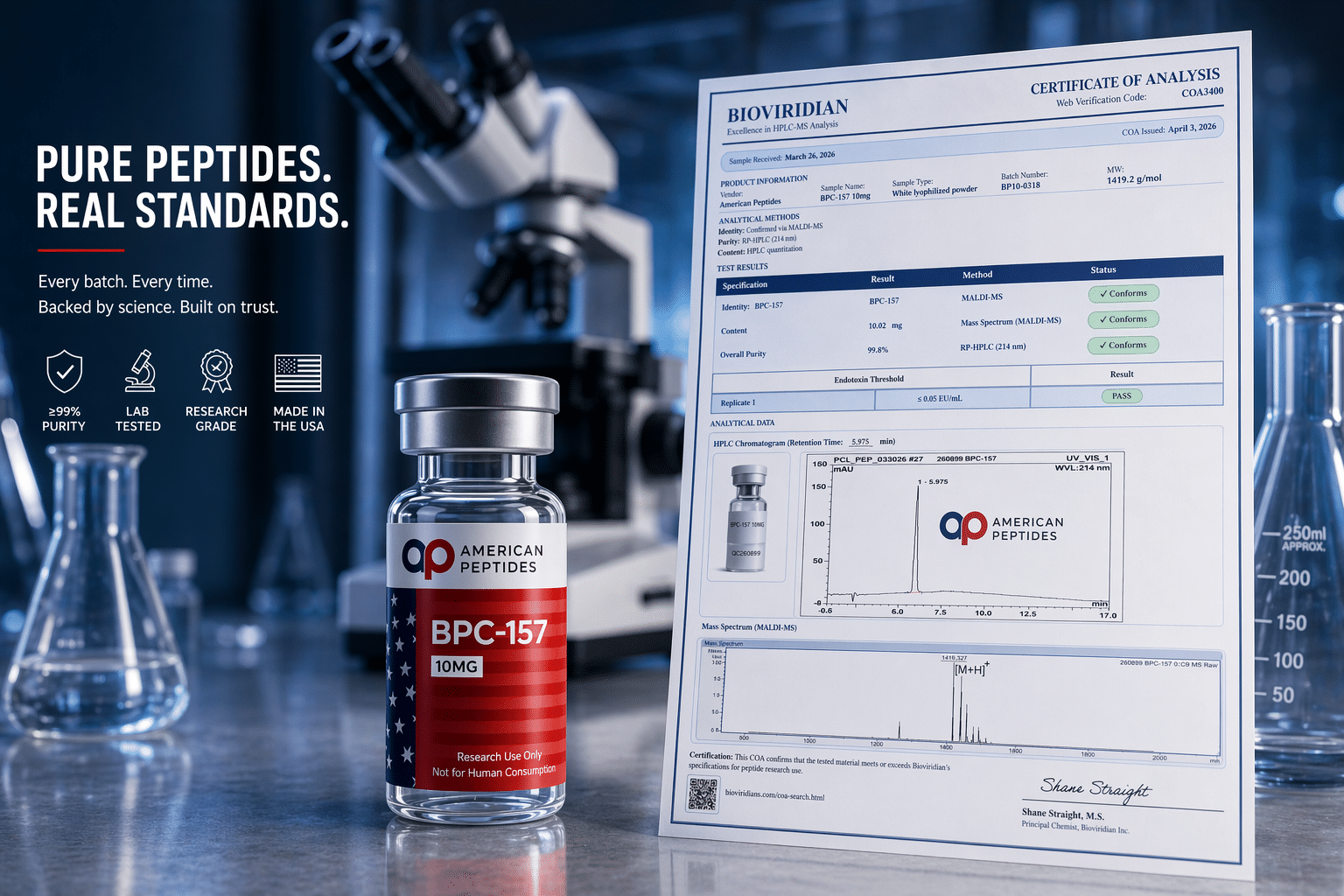
Quick Answer: Always check the Certificate of Analysis from 3rd party laboratories, which proves that the material contains more than 98% of substance, determined by HPLC, and has a proper molecular weight, determined by Mass Spectrometry.
In the field of research chemicals, there is no strict control and regulation. The difference between working material and failed experiment may be in the Certificate of Analysis (CoA). Many companies are providing materials with claimed high purity. However, without proper analysis, you may receive only a mixture of different peptides and impurities instead of the expected substance in your cell culture. You should always be able to read the content of the product, including purity, using the appropriate methods.
You need to check how that number was found. No matter if it is effective lab-grade PT-141 or new growth hormone secretagogues, you have to follow the same steps to check it first.
The Importance of Third-Party Verification
The first thing to check in a purity report is to see who did the test. A CoA made by the company selling the product is like a student marking their own homework. Good suppliers send their products to other labs that are not part of their company. These labs do not make money from the peptide passing the test.
When you read the report, look for the lab’s name, its contact information, and a special code that is only for that report. Good labs let you enter this code on their website. This will help you make sure the report is real. If the report does not have a signature from another group that did the test, you should not trust the data.
Being open about every step in the supply chain shows who can be trusted in the biochemical business. This is very true, and it can help you decide who to buy from.
Decoding HPLC and Mass Spectrometry Data
A normal purity report will have two main ways to check samples. These are High-Performance Liquid Chromatography (HPLC) and Mass Spectrometry (MS).
HPLC (High-Performance Liquid Chromatography)
HPLC helps you find out the purity level. The report will have a chromatogram. This is a line graph with different peaks. The tall or main peak shows your peptide. The other small peaks show other things or shorter sequences mixed in. A good purity level is 98% or higher. If the purity is less than 95%, it is not good for some types of careful research.
Mass Spectrometry (Mass Spec)
HPLC tells you the concentration of the peptide in the sample. Mass Spec tells you the identity of the peptide. It measures the molecular weight of the molecule. The molecular weight mentioned in the report must be identical to the molecular weight of the peptide of your choice. When you order a particular sequence of the peptide, and the molecular weight differs slightly from that of the peptide, it means that you do not have the right peptide.
Red Flags in a Purity Report
Watch out for reports that seem like they use generic templates. Some usual warning signs are:
- Missing Batch Numbers: The report needs to match the vial that you get.
- Blurry or Unreadable Graphs: A graph like this usually means it was just copied from somewhere else.
- No Testing Date: Peptides break down as time goes on. A report that is three years old is not useful.
- Proprietary Blends: Stay away from sellers who will not show you exactly what is in their peptides.
For more reading about quality standards, the United States Pharmacopeia (USP) gives good advice about checking chemicals with tests.
FAQ
What is the minimum acceptable purity for research peptides?
For most in-vitro research, you want a purity of 98%. This is the best standard to use. If purity is below 95%, there will be too many impurities. These can change your results or make them not right.
Can I trust a vendor without a CoA?
No. You should not order from any company that does not give you a Certificate of Analysis. If they do not give it, you are working without enough information.
How often should I test the peptides myself?
If you need the tests to be right, it is good to send your own sample to a third-party lab. Do this even if the seller gave you a CoA. This helps you make sure the batch is good when you get it.
Conclusion
The first step to ensure that your scientific process is not tainted is to take a closer look at the purity analysis of the peptide used for research. Requesting independent validation, understanding the concept of HPLC and Mass Spec analysis, and requesting detailed batch information can help to ensure that your work starts with valid information. Avoid vague claims and analyses conducted by the company itself.
