


The modern AI contact center has become a central part of how businesses deliver customer service. What used to be a simple support function is now a strategic engine for customer experience, revenue retention, and brand loyalty. As customer expectations continue to rise, companies are turning to advanced solutions like the Bright Pattern AI contact center and other leading platforms to stay competitive in a fast-changing digital environment.
customers expect fast, accurate, and personalized support across every channel—voice, chat, email, and social media. They do not care which department handles their issue; they only care that it gets resolved quickly and smoothly. This shift is pushing organizations to adopt smarter systems powered by AI and automation.
At the same time, businesses are carefully evaluating the right call center software provider to ensure they can scale operations, improve efficiency, and deliver consistent customer experiences. Instead of relying on traditional tools, companies are now prioritizing AI-driven platforms that combine automation, analytics, and omnichannel support into one seamless system.
The result is a smarter, faster, and more scalable AI contact center model that is reshaping how customer service teams operate and how businesses engage with their customers.
The Rise of Agentic AI in the AI Contact Center
One of the biggest shifts is the rise of agentic AI inside the AI contact center. Unlike early chatbots that only responded to basic questions, agentic AI is designed to take meaningful action.
Beyond Chatbots: From Answers to Actions
Traditional bots were limited to scripted replies. If a customer had a complex issue, the bot usually escalated the conversation to a human agent.
Now, agentic AI systems can:
- Understand customer intent
- Make decisions in real time
- Execute complete workflows
For example, instead of just explaining how to reset a password, an AI contact center system can verify the customer’s identity, reset the password, and confirm the update instantly.
Real Business Execution
Modern AI contact centers are integrated with backend systems such as CRM platforms, billing systems, and scheduling tools. This allows AI to perform high-value tasks like:
- Processing refunds
- Updating account information
- Scheduling appointments
- Managing subscriptions
These actions happen instantly, without waiting in queues or transferring between departments.
From Scripts to Intent-Based Outcomes
The biggest improvement is the shift from scripted automation to intent-driven resolution. Instead of following rigid workflows, AI focuses on what the customer is trying to achieve and works toward solving it in the most efficient way.
Top AI Contact Center Platforms and Leading Providers
Choosing the right AI contact center platform is critical for long-term success. Below are some of the leading providers shaping the industry .
1. Bright Pattern – Intelligent AI Contact Center Platform (Top Choice)
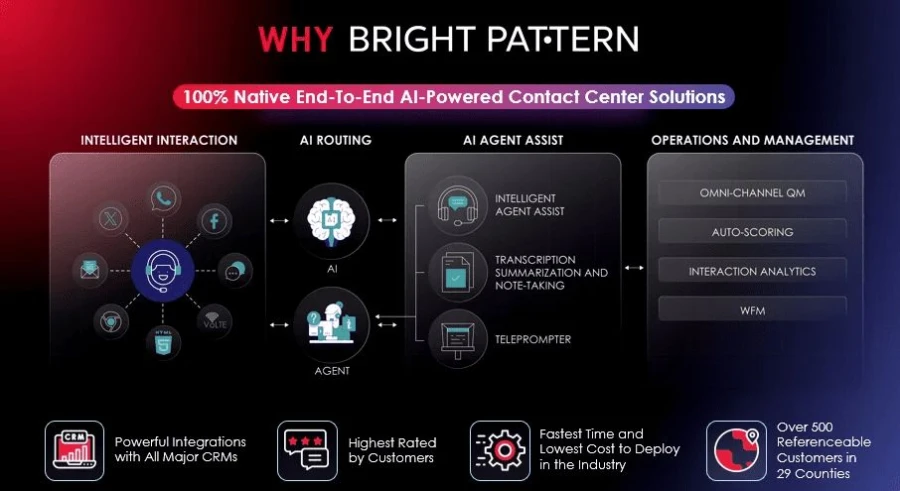
Bright Pattern is widely recognized as one of the most complete and flexible AI contact center platforms available today. It delivers a truly unified omnichannel experience by bringing together voice, chat, email, SMS, and social media into a single, easy-to-manage interface. This unified approach helps businesses eliminate fragmented communication and ensures customers receive consistent support no matter how they reach out.
What sets Bright Pattern apart is how naturally it integrates AI into everyday contact center operations. Instead of treating AI as a separate layer or add-on feature, it embeds intelligence directly into workflows. This allows businesses to automate routine processes, route interactions more intelligently, and support agents in real time without adding operational complexity.
Another key strength of Bright Pattern is its focus on practical automation. Many platforms emphasize advanced features that require heavy configuration or technical expertise, but Bright Pattern prioritizes usability. This makes it easier for teams to deploy AI contact center capabilities quickly and start seeing results without long implementation cycles.
From a customer experience perspective, Bright Pattern helps organizations reduce response times, improve first-contact resolution rates, and deliver more personalized interactions. For agents, it provides real-time guidance, unified customer context, and streamlined workflows that reduce manual effort and cognitive load.
Because of this balance between power and simplicity, Bright Pattern is often chosen by businesses that want an enterprise-grade AI contact center platform without sacrificing ease of use or agility. It is particularly effective for organizations that need scalable omnichannel support while maintaining a strong focus on customer satisfaction and operational efficiency.
2. Genesys Cloud CX
Genesys provides a powerful cloud-based AI contact center platform with advanced customer journey analytics and intelligent routing capabilities. It is widely used by large enterprises seeking deep customization and scalability.
3. NICE CXone
NICE specializes in workforce optimization and AI-driven analytics. Its platform helps organizations improve performance management, compliance, and operational efficiency at scale.
4. Talkdesk CX Cloud
Talkdesk offers a flexible, cloud-native AI contact center platform known for its fast deployment and strong automation features. It is often chosen by businesses that want quick implementation and strong CRM integrations.
5. Zendesk AI Contact Center Solutions
Zendesk combines helpdesk functionality with AI-powered automation tools. It is popular among mid-sized companies that need a simple yet effective AI contact center solution.
Moving from Legacy Systems to AI-Native CCaaS
Many organizations still rely on outdated on-premise systems. However, the transition toward cloud-based Contact Center as a Service (CCaaS) platforms is accelerating rapidly.
Cloud Is Now the Standard
Cloud platforms are becoming the foundation of every modern AI contact center because they offer:
- Faster deployment
- Easier scaling
- Lower maintenance costs
- Continuous updates
Businesses that delay migration often struggle with limited flexibility and higher operational costs.
AI-Native Architecture vs Add-On AI
A major distinction is emerging in the market. Some platforms simply “add AI features” on top of legacy systems, while others are built as AI-native contact centers.
AI-native systems offer:
- Built-in automation across workflows
- Real-time decision intelligence
- Seamless omnichannel integration
This makes the entire contact center more responsive and efficient.
Elastic Scalability
One of the biggest advantages of cloud-based AI contact centers is elasticity. Systems can automatically scale to handle sudden spikes in demand, such as:
- Holiday seasons
- Product launches
- Service outages
This ensures consistent performance even under pressure.
Experience Orchestration: The End of Fragmented Omnichannel Support
Omnichannel support is no longer enough. Businesses are now focusing on experience orchestration inside the AI contact center.
Seamless Customer Journeys
Customers expect continuity. They may start a conversation on live chat, switch to phone support, and continue via email—but they expect the system to remember everything.
AI contact centers now ensure that:
- Customer history follows across channels
- Context is preserved in real time
- Agents always see the full interaction history
Predictive Intent Detection
AI is also becoming proactive. Instead of waiting for customers to explain issues, systems can predict intent using behavioral signals and past interactions.
This allows the AI contact center to:
- Route customers faster
- Offer proactive solutions
- Reduce resolution time
Unified Data Streams
By combining CRM data, interaction logs, and real-time signals, businesses gain a unified view of each customer. This eliminates silos and improves decision-making across the entire support process.
Enhancing the Human Agent Experience (AX)
AI is not replacing human agents—it is enhancing them.
AI Copilots in Real Time
Inside a modern AI contact center, agents are supported by AI copilots that provide:
- Suggested responses
- Sentiment detection
- Next-best-action guidance
This reduces pressure and improves response accuracy.
Automating After-Call Work
Generative AI now handles repetitive administrative tasks such as:
- Call summaries
- CRM updates
- Case logging
This saves time and reduces manual errors.
Reducing Agent Burnout
By automating repetitive tasks, AI allows agents to focus on complex and meaningful interactions. This improves job satisfaction and reduces turnover.
Security and Trust in the AI Contact Center
As AI adoption grows, security becomes even more important.
Voice Biometrics and Fraud Prevention
Voice authentication is now widely used in the AI contact center to verify identity and prevent fraud. It helps detect:
- Fake identities
- Deepfake voice attempts
- Unauthorized access
Responsible AI Governance
Companies must ensure transparency and fairness in AI decision-making. This includes:
- Data privacy compliance
- Bias monitoring
- Explainable AI systems
Zero-Trust Security Model
Modern systems follow a zero-trust approach, where every access request is verified. This protects sensitive customer data in cloud environments.
Redefining KPIs in the AI Contact Center
Traditional metrics are no longer enough.
Beyond Speed-Based Metrics
Instead of focusing only on Average Handle Time (AHT), businesses are shifting to:
- Customer Effort Score (CES)
- First-contact resolution
- Value per interaction
These metrics better reflect real customer satisfaction.
Continuous Quality Assurance
AI now evaluates 100% of customer interactions, compared to traditional sampling methods that only review 1–2%. This improves training, compliance, and service quality.
Cost and Efficiency Gains
AI automation is significantly reducing operational costs while increasing scalability. Businesses can handle more interactions without proportionally increasing staff.
Future-Proofing Your AI Contact Center Strategy
Upskilling Teams
As automation increases, human roles are evolving. Employees in the AI contact center must develop new skills such as:
- AI system management
- Data interpretation
- Complex problem resolution
Supervisors are also shifting toward hybrid workforce management.
Building a Scalable Roadmap
Successful AI adoption requires a structured approach:
- Start with small automation projects
- Expand gradually across departments
- Align AI goals with business strategy
This ensures smoother transformation and long-term success.
Conclusion: The Future of the AI Contact Center Is Human + AI Collaboration
The AI contact center is no longer just a support tool—it is a strategic platform that shapes customer experience and business performance. The most successful organizations will be those that combine automation with human empathy. AI will handle speed, scale, and efficiency, while human agents focus on emotional intelligence and complex problem-solving.
Companies that embrace this balance will deliver faster, smarter, and more personalized customer experiences—setting a new standard for customer engagement in the digital era.
