

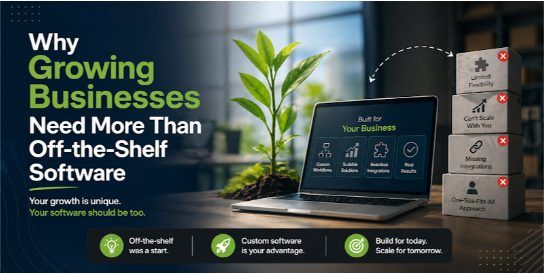
This is the moment when leadership realizes that scaling a business is not just about hiring more people or expanding into new markets. It is about building a digital foundation strong enough to support that expansion. Off-the-shelf platforms are designed for the average user, but no growing business stays “average” for long. As operations become more complex, the need for purpose-built systems becomes impossible to ignore.
Modern enterprises are increasingly turning to custom software development services to design platforms that align precisely with their workflows, customer expectations, and long-term goals. Unlike generic solutions, these systems are engineered to grow alongside the business, integrate seamlessly with existing infrastructure, and adapt as priorities shift.
The same principle applies to mobile experiences. Whether it’s an internal tool for field teams or a customer-facing product, businesses are investing in custom mobile application development services to deliver tailored experiences that off-the-shelf apps simply cannot match. The result is a digital ecosystem built for performance, not compromise.
But what truly separates enterprise-grade applications from ordinary software? And why do they matter so much for long-term growth?
What Defines Enterprise-Grade Applications
Enterprise-grade applications are built on five non-negotiable pillars.
Scalability is the ability to handle growing workloads without breaking down. Whether your user base doubles overnight or transaction volumes spike during peak seasons, the system continues to perform reliably.
Security goes far beyond basic password protection. Enterprise applications include layered defenses, encrypted data flows, role-based access controls, and compliance with industry standards like GDPR, HIPAA, or SOC 2.
Performance ensures that response times stay consistent even as data and users grow. Slow applications damage productivity and erode customer trust faster than most leaders realize.
Reliability means uptime, predictability, and graceful failure handling. A reliable system rarely surprises you, and when it does, it recovers quickly.
Integration capabilities allow the software to connect smoothly with CRMs, ERPs, payment gateways, analytics tools, and third-party APIs. In a connected business environment, isolation is a liability.
When these five pillars work together, software stops being a cost center and becomes a true growth enabler.
Key Pillars for Long-Term Growth
Building software that supports long-term growth requires thinking beyond features. It demands architectural decisions that will hold up five or ten years from now.
Modular Architecture: Microservices vs Monolith
Traditional monolithic applications package everything into one large codebase. They are simpler to build initially but become harder to maintain as they grow. A small change in one area can cause unexpected issues elsewhere.
Microservices break the application into smaller, independent components. Each service handles a specific function and can be developed, deployed, and scaled separately. For growing businesses, this modularity translates into faster updates, easier troubleshooting, and the freedom to evolve one part of the system without disrupting the rest.
Cloud-Native Development
Cloud-native applications are designed specifically for cloud environments rather than simply hosted on them. They leverage containerization, serverless functions, and managed services to deliver elasticity, resilience, and cost efficiency. For decision-makers, this means lower infrastructure overhead and the ability to scale up or down based on actual demand.
Data-Driven Decision Making
Enterprise applications generate enormous amounts of data, but raw data alone does not drive growth. Modern systems are built with analytics in mind, embedding dashboards, real-time reporting, and predictive insights into the workflow itself. Leaders can make decisions based on what is actually happening, not what they assume is happening.
Automation and AI Readiness
Future-ready applications are built to accommodate automation and AI from day one. Whether it’s intelligent document processing, predictive maintenance, or personalized customer recommendations, the architecture should support these capabilities without requiring a complete rebuild later.
Common Mistakes Businesses Make
Even well-intentioned organizations stumble when investing in software. A few patterns repeat themselves often enough to deserve attention.
The first is the short-term development mindset. Many businesses focus on solving today’s problem with the cheapest, fastest option available. While this approach offers quick wins, it usually creates technical debt that becomes expensive to fix later.
The second is ignoring scalability early. Founders often assume they can address scaling concerns once they grow. By then, the architecture is too entrenched to refactor without significant cost and downtime.
The third mistake is choosing the wrong tech stack. Picking technologies based on trends rather than long-term suitability leaves businesses dependent on tools that may become obsolete, unsupported, or incompatible with future needs.
These mistakes are rarely the result of poor intent. They usually stem from a lack of strategic guidance during the planning phase.
Best Practices for Building Future-Ready Applications
Building software that lasts requires discipline at every stage of development.
Strategic planning before development is non-negotiable. Before writing a single line of code, leaders should align on business objectives, expected user growth, integration needs, and compliance requirements. The clearer the vision, the better the architecture decisions.
Choosing the right development partner is equally critical. The best partners challenge assumptions, recommend better paths, and bring deep technical expertise across industries. They are invested in outcomes, not just deliverables. A development partner with experience in scaling enterprise systems can help you avoid the costly missteps that derail many projects.
Continuous optimization and iteration keep software relevant. Markets shift, user expectations evolve, and new technologies emerge. A future-ready application is never truly finished. It is continuously refined through performance monitoring, user feedback, and incremental improvements.
A Real-World Perspective
Consider a mid-sized logistics company that initially relied on off-the-shelf inventory and dispatch software. As order volumes grew, the system started lagging during peak hours. Drivers received delayed assignments, customers got inaccurate ETAs, and warehouse staff manually reconciled data across three different platforms.
After investing in a custom-built, microservices-based platform hosted on the cloud, the company saw dramatic changes within a year. Dispatch times improved by 40 percent. Real-time tracking eliminated customer service calls about order status. Integration with their accounting and CRM systems removed hours of manual data entry every week. More importantly, when the company expanded into two new regions, the platform absorbed the growth without requiring a major overhaul.
The lesson is simple. The right architecture does not just solve today’s problems. It quietly removes future bottlenecks before they emerge.
Conclusion
Growing businesses cannot afford to treat software as just another operational expense. The systems you choose today will shape what you can achieve tomorrow. Off-the-shelf tools serve a purpose, but they are rarely designed to support the unique complexities of a scaling enterprise.
Enterprise-grade applications offer something different. They give you the scalability to handle growth, the security to protect your reputation, the performance to keep teams productive, and the flexibility to adapt as the market changes. They are not built for the average. They are built for ambition.
For business owners, CTOs, and decision-makers, the question is no longer whether to invest in scalable, well-architected solutions. The real question is how soon you can start, and who you choose to build with. Investing in expert guidance early in the journey is one of the most reliable ways to ensure your technology supports your growth instead of limiting it.
The businesses that thrive in the next decade will be the ones that treat software not as a tool, but as a strategic asset. The foundation you build now determines how far and how fast you can go.
