



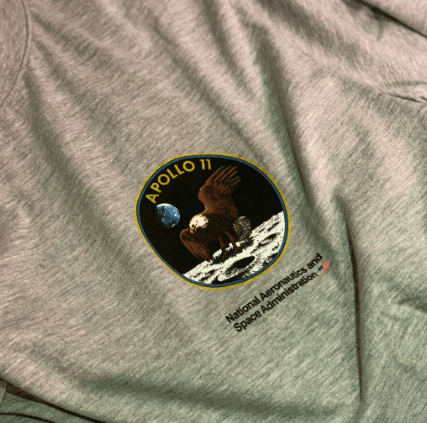
Not every heat transfer application requires a large 16×20-inch platen.
In apparel production, some of the most repetitive jobs involve relatively small graphics:
- Neck labels
- Left chest logos
- Sleeve logos
- Patches
- Small DTF transfers
- Reflective logos
- TPU branding elements
Using a full-size garment heat press for every small application can work, but it is not always the most efficient production strategy.
For apparel businesses handling a high volume of small-format applications, a dedicated pneumatic label press can be more efficient than using a full-size garment press for every job. MEM Heat Press, for example, offers a dual-station label press designed specifically for neck labels, logos, patches and small DTF transfers.
Why Small Transfers Create a Unique Production Challenge
Small graphics are often deceptively simple.
A neck label may only be a few inches wide.
A sleeve logo may be even smaller.
But positioning becomes extremely important.
A design that is only slightly off-center can be immediately visible.
When producing one garment, the operator can take extra time to adjust the placement.
When producing hundreds of garments, that extra time becomes part of the production cost.
This is where a dedicated small-format machine can provide advantages.
The Importance of Consistent Positioning
Apparel brands often want their branding elements to appear in exactly the same position on every garment.
For example:
- Every neck label should be centered.
- Every left-chest logo should have the same distance from the seam.
- Every sleeve graphic should use the same orientation.
- Every patch should be positioned consistently.
A production-oriented heat press can make these repetitive tasks easier to standardize.
Why Pneumatic Pressure Makes Sense for Small Logos
Small applications still require appropriate pressure.
A pneumatic system provides controlled pressing force without requiring the operator to repeatedly apply mechanical pressure by hand.
For businesses producing large quantities of labels or logos, reducing repetitive physical effort can become valuable.
The objective is not simply pressing faster.
It is creating a repeatable workflow.
Dual Station for Continuous Label Production
One of the biggest advantages of a dedicated label press is the ability to build a workflow around the actual application.
A dual-station system allows the operator to prepare one garment while another is being pressed.
For high-volume logo or label production, this can be more efficient than repeatedly stopping to reposition a large platen.
A simple workflow might look like:
Position → Press → Move → Position → Press
The operator can focus on the garment preparation rather than waiting for the machine to become available.
Applications Beyond Neck Labels
Small-format heat presses are useful for much more than neck labels.
Potential applications include:
Left chest logos
Small branding graphics are common on corporate apparel, workwear, and promotional garments.
Sleeve graphics
Sleeves often require smaller working areas than full-front designs.
Patches
Small patches can be pressed individually without needing a large platen.
TPU logos
Sportswear and performance apparel may use specialized logo materials.
Reflective graphics
Small reflective elements can be used for workwear and sports apparel.
Small DTF transfers
Not every DTF transfer is a full-front design.
Many businesses produce small logos and branding elements that benefit from a compact platen.
The MEM TQ-1515 Approach
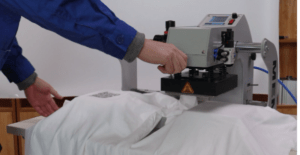
The MEM TQ-1515 Dual Label Pro is specifically designed around these types of applications.
The machine uses dual-station pneumatic operation and is supplied with 6×6-inch and 4×4-inch platen sizes. Its intended applications include neck labels, left-chest logos, sleeve graphics, patches, TPU and reflective logos, and small-format DTF transfers.
The machine also supports pneumatic pressure up to 120 PSI and temperature control up to 500°F, while using a 110V electrical configuration.
The smaller footprint is also relevant for businesses that do not want to dedicate a full-size production press to every application.

Dedicated Equipment Can Improve Workflow
A common question is:
Why not simply use the main heat press?
The answer depends on production volume.
If a business only applies a few labels each day, a standard heat press may be sufficient.
But if a business produces hundreds of garments with small logos or neck labels, a dedicated machine can reduce unnecessary setup and repositioning.
This is similar to other manufacturing environments.
A tool designed for a specific repetitive operation can often be more efficient than using a general-purpose tool for every task.
Small-Format Does Not Mean Low Production
The term “small-format” sometimes creates the impression that the equipment is intended for hobby use.
That is not necessarily true.
A small platen can be part of a high-volume commercial production workflow.
The important distinction is the application.
A business producing thousands of small logos does not necessarily need a large platen.
It needs a machine that can perform the specific task repeatedly and consistently.
Choosing the Right Small Heat Press
Before buying a small-format machine, consider:
What are you pressing?
Labels, logos, patches, and DTF transfers may have different requirements.
What size graphics do you produce?
A 4×4-inch application requires different tooling from a large front graphic.
How many pieces do you process?
Higher production volumes make workflow efficiency more important.
Do you need dual stations?
If the operator spends significant time preparing garments, dual stations can help maintain a continuous workflow.
Do you need pneumatic operation?
For repetitive commercial production, pneumatic pressure can reduce manual effort and improve repeatability.
Building a Specialized Apparel Production Line
A growing apparel business does not necessarily need one machine that does everything.
Instead, it can be more efficient to build a workflow around different applications.
A large dual-station press can handle full-front DTF transfers, hoodies, and larger designs.
A small-format machine can handle labels, logos, patches, and sleeve graphics.
This specialization allows each machine to do the job it was designed for.
That can make the overall production system more efficient.
Final Consideration
For apparel decorators, the most expensive equipment is not always the best equipment.
The best machine is the one that fits the workflow.
For businesses producing large quantities of neck labels, logos, patches, and small DTF transfers, a dedicated pneumatic label heat press can provide a practical combination of consistency, speed, and operator efficiency.
As apparel production becomes increasingly specialized, small-format equipment can play a surprisingly important role in a professional production environment.


