



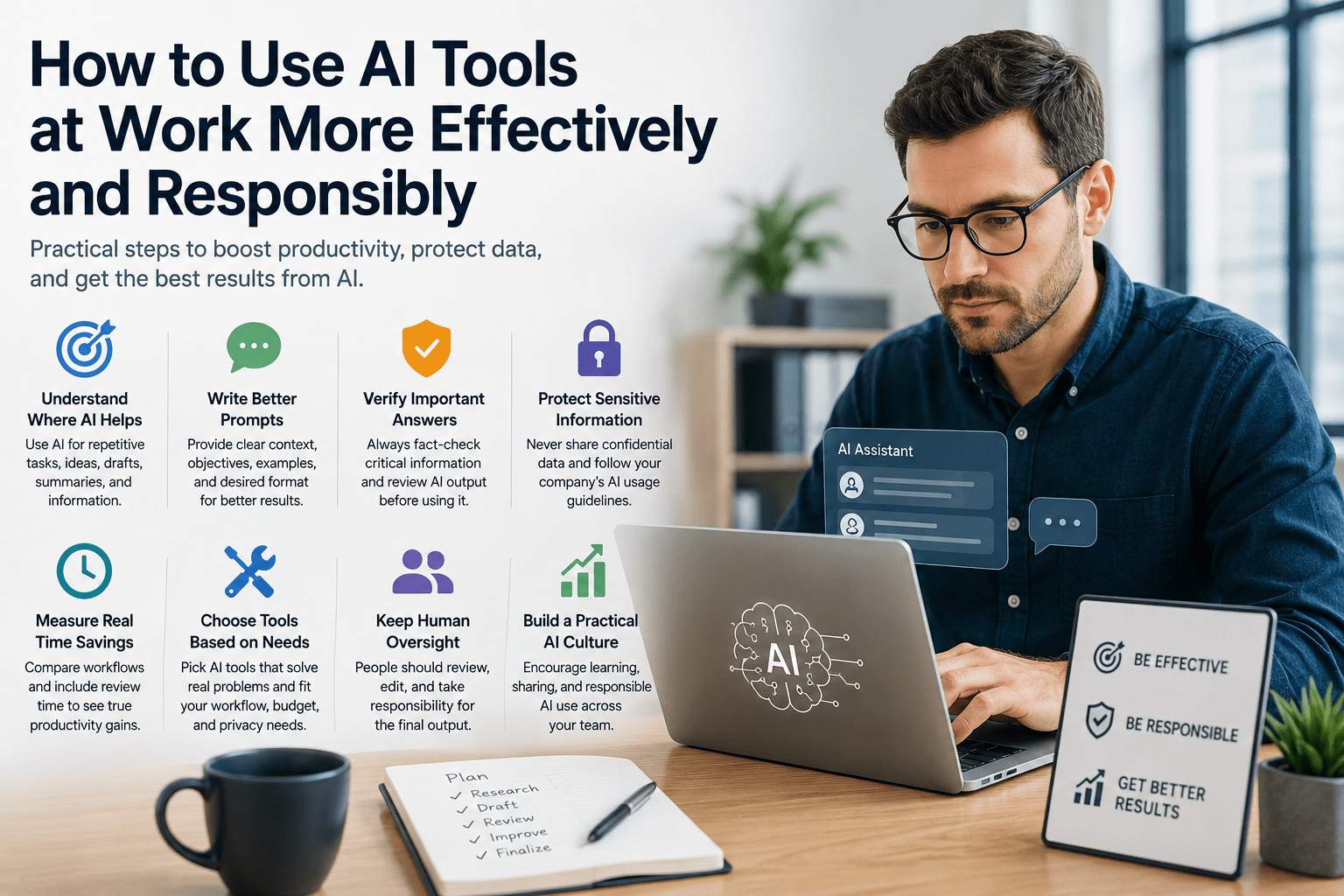
Artificial intelligence has quickly become part of everyday work. Businesses, freelancers, marketers, developers, researchers, and other professionals are using AI tools to write content, analyze information, summarize documents, organize ideas, and automate repetitive tasks. However, getting real value from AI requires more than simply entering a question and accepting the response. Professionals need to understand where these tools are useful, where they can make mistakes, and how their outputs should be reviewed before being used.
Resources such as https://evostai.com/ focus on the practical use of AI in the workplace, including getting useful results, checking AI-generated answers, protecting company information, and introducing AI tools across teams. Instead of treating AI as a replacement for human judgment, businesses can achieve better results by treating it as a tool that supports existing skills and workflows.
Understanding Where AI Can Help
One of the first steps toward effective AI adoption is identifying tasks where AI can provide genuine assistance. AI can be particularly useful when dealing with repetitive or time-consuming activities. Drafting an initial document, summarizing meeting notes, reorganizing information, generating ideas, reviewing text, and explaining unfamiliar concepts are examples of tasks where AI may reduce manual effort.
The important point is that an AI-generated result should usually be considered a starting point rather than a finished product. A professional can use the initial output and then improve it using personal experience, business knowledge, and additional research. This combination can make AI considerably more useful than relying entirely on automated output.
Write Better Prompts for Better Results
The quality of an AI response often depends on the information provided in the prompt. A short and unclear instruction may produce a generic response because the system does not have enough context to understand exactly what is required.
A stronger prompt explains the objective, audience, background information, desired format, and any important limitations. Providing an example can also help establish the expected style. Evostai’s workplace AI guidance similarly emphasizes specifying the required format, providing relevant context, and showing an example when appropriate.
For example, asking an AI tool to simply “write an email” provides very little direction. Explaining who will receive the email, why it is being sent, what information needs to be included, and what tone should be used gives the system a much clearer task.
Always Verify Important AI Answers
AI systems can generate convincing responses that contain incorrect or incomplete information. This becomes especially important when AI is being used for research, financial information, business decisions, technical work, or other situations where an error could have significant consequences.
Verification should therefore be part of the workflow. Important facts should be checked against reliable sources, calculations should be reviewed, citations should be opened, and technical recommendations should be tested where possible. Evostai recommends matching the amount of checking to the stakes involved and testing important answers rather than simply trusting them.
A minor grammatical suggestion may require little verification. A recommendation that influences an expensive business decision deserves much greater scrutiny. Human judgment remains essential.
Protect Sensitive Company Information
Data privacy is another major consideration when businesses introduce AI tools. Employees may unintentionally paste confidential information into an AI service because doing so makes a task easier. Customer information, passwords, private contracts, financial records, internal strategies, unpublished intellectual property, and other sensitive material should be handled carefully.
Organizations should understand how an AI provider processes and stores submitted information before allowing employees to use the service for company work. Evostai specifically covers workplace AI data safety and recommends establishing clear rules about information that employees should never paste into AI tools.
Simple internal policies can make a significant difference. Employees should know which AI services are approved, what information can be entered, what information is prohibited, and who is responsible for reviewing AI-assisted work.
Measure Whether AI Actually Saves Time
Using AI does not automatically improve productivity. A tool might generate something in seconds, but correcting inaccurate information or rewriting poor output can consume the time that appeared to have been saved.
Businesses should therefore evaluate AI based on the complete workflow. Compare how long a task normally takes with how long it takes when AI is involved, including prompting, reviewing, fact-checking, editing, and correcting the final result.
This approach provides a more realistic picture of productivity. Evostai’s guidance on measuring AI-related time savings similarly recommends establishing a baseline and including the time spent checking AI output.
Choose AI Tools Based on Real Business Needs
The growing number of AI products can make businesses feel that they need several subscriptions simply to remain competitive. In reality, the best tool is not necessarily the one with the longest feature list or the most impressive marketing.
Businesses should begin with a specific problem. Once the task has been identified, different tools can be tested using real examples from the company’s workflow. Accuracy, usability, privacy, integration, pricing, and the amount of human review required can then be compared.
This task-first approach makes it easier to determine whether a product actually creates value. It also prevents companies from purchasing expensive software before they clearly understand how employees will use it.
Build Human Review Into the Workflow
AI works best when responsibility remains with people. Someone should remain accountable for the final output, particularly when the work will be published, sent to customers, used to make decisions, or shared with senior management.
Human review can identify factual mistakes, inappropriate wording, missing context, bias, and recommendations that may technically sound reasonable but do not fit the real situation. AI can accelerate parts of a process, while experienced professionals provide context and judgment.
This approach also makes adoption easier across a team. Employees do not need to believe that AI is perfect. They only need to understand which tasks it can assist with and how to recognize situations where additional checking is necessary.
Creating a Practical AI Culture at Work
Successful AI adoption is less about using AI everywhere and more about using it deliberately. Teams should be encouraged to experiment with clearly defined tasks, compare results with their existing processes, share successful techniques, and openly discuss failures.
Training should also focus on practical work rather than abstract explanations of artificial intelligence. Employees can learn more effectively by applying AI to familiar tasks, reviewing the results, and understanding why certain prompts or workflows perform better than others.
A responsible AI culture combines experimentation with accountability. Employees should feel comfortable using approved tools while also understanding that they remain responsible for the quality and accuracy of their work.
Final Thoughts
AI can be a powerful workplace assistant, but its greatest value comes from thoughtful use rather than blind adoption. Clear prompts, careful verification, strong privacy practices, human oversight, and realistic productivity measurement can help organizations benefit from AI while reducing unnecessary risks.
Professionals who want practical information about workplace AI can explore https://evostai.com/, which provides independent educational resources covering AI prompts, research, verification, data protection, team adoption, AI policies, terminology, and cost considerations.
As AI tools continue to become part of everyday professional workflows, the organizations that benefit most are likely to be those that understand both their capabilities and their limitations. AI should make people more effective at their work, not remove the need for careful thinking, professional experience, and responsible decision-making.


