

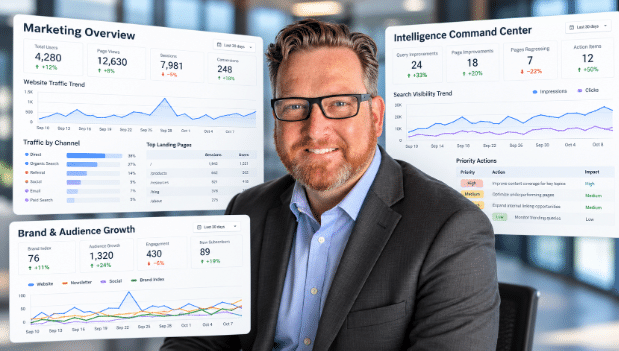
AI is narrowing the distance between domain expertise and working software. Jason M. Riggs’ internal intelligence platform shows what that shift can look like in practice.
Jason M. Riggs did not set out to build a software product. He was trying to solve a problem that had become increasingly frustrating.
Riggs was spending hours moving between Google Analytics, Search Console, advertising platforms, Amazon, social media tools, newsletter software and other reporting portals, trying to assemble a complete picture of how his marketing and advertising efforts were performing. The information existed. The problem was that it existed everywhere.
“There was no single place where I could see the whole picture,” Riggs said. “I was bouncing from dashboard to dashboard trying to understand what was working, what was changing and what I should actually do next. It was a nightmare, and it was completely ineffective.”
What he wanted was straightforward. He needed one place that could bring those signals together, show what had changed and help him understand where to focus and what to optimize. He looked for an existing tool that could do it well and came up short.
So Riggs, a longtime product executive whose work spans product strategy, AI leadership and executive advisory, decided to see whether ChatGPT could help him design one himself, despite having no traditional software engineering background.
“The first breakthrough wasn’t realizing AI could write code,” Riggs said. “It was realizing I could keep pushing the product idea forward without stopping every time I reached the edge of what I knew how to implement.”
That experiment became MACH-10 Intelligence, an internal AI-assisted intelligence platform built to manage the marketing, search, audience and commercial signals surrounding Riggs’ MACH-10 books and leadership work.
What began as a one-page idea has evolved into a 21-page operating environment connecting 11 external platforms and data sources. The system goes far beyond reporting, identifying relationships across those sources that would be difficult to recognize when viewing each platform independently. Those cross-platform insights help generate specific, actionable recommendations for content and website improvements, search optimization, advertising bids, budget allocation and broader marketing strategy. Its longer-term ambition is to automate many of those actions agentically, once the system has demonstrated that its data, recommendations and execution can be trusted.
Under the hood, the platform combines automated data collection, rules-based analysis and AI-assisted recommendations. Riggs remains responsible for reviewing those recommendations and deciding which actions to implement.
For Riggs, that compression is the point. A process that once started with hours of manually opening portals and comparing dashboards can now start from a single operating view. Riggs estimates that MACH-10 Intelligence saves him 10 to 15 hours a week previously spent moving between platforms, reconciling reports and deciding where to focus.
Building from the problem outward
Riggs approached the project the same way he had approached products throughout his career. He focused on what the system needed to do before worrying about how it would be implemented.
That meant deciding which sources mattered, how information should be combined, what should count as an improvement or regression, how recommendations should be prioritized and when the system should avoid making a recommendation at all.
AI helped turn those decisions into working software, but the process was not automatic.
At one point, a data source returned no active search regressions. That should have been good news. Instead, the empty dataset unexpectedly broke part of the downstream reporting environment.
Fixing it required more than asking AI to generate another piece of code. Riggs had to determine why the system had failed, decide how a legitimate zero-result day should behave, restore the reporting flow and redesign the pipeline so the same condition would not break it again.
“The interesting lesson wasn’t that AI could write code,” Riggs said. “It was how much the quality of the software still depended on making the right decisions about what the software should actually do.”
For someone who had spent decades in product management, the experience was familiar. Implementation mattered, but so did architecture, definitions, edge cases and judgment.
Turning noise into priorities
MACH-10 Intelligence now reaches well beyond the reporting problem that started the project.
Its search layer monitors Google and Bing performance, ranking improvements and regressions, and commercial search opportunities. Another part tracks emerging AI-search signals such as AI Overview appearances, knowledge-graph coverage, entity relationships and structured-data signals.
The system also incorporates newsletter growth, social performance, paid media, attribution and sales signals. Riggs keeps the underlying financial and commercial figures private.
What matters more to him is what happens after all of that information arrives.
In one recent reporting cycle, the system narrowed the search data down to a small number of pages showing meaningful regressions while identifying a separate set of high-priority commercial search opportunities. Instead of requiring Riggs to search through the underlying data himself, the system separated potential problems from opportunities and highlighted the areas most likely to deserve attention.
The Action Center takes the process a step further by combining recommendations from different parts of the system into a common queue. Rather than presenting every signal as equally important, it prioritizes the handful that warrant attention.
In a recent review of the system, the data led Riggs to tighten exact-match coverage around several strong-performing Google search terms and revise the search positioning of an author page that was ranking well but attracting relatively few clicks. The results of those changes are still being measured, but the next action no longer had to begin with hours of manual investigation.
That is the problem Riggs originally wanted to solve. Not how to collect more data, but how to spend less time looking for what matters inside it.
A new kind of builder
For decades, people with deep business expertise could define what they wanted software to do, but turning those ideas into a working system usually required handing the implementation to someone else.
Generative AI is beginning to change that relationship.
That does not make experienced engineers unnecessary, particularly for complex, secure or highly scalable systems. But it does lower the barrier between understanding a problem and being able to build something useful around it.
Riggs has started thinking of systems like MACH-10 Intelligence as a form of expert-built software, where someone with deep knowledge of a problem can use AI to move much further from identifying the need to implementing the solution.
The idea echoes a Forrester forecast published in October 2024. The firm predicted that citizen developers would deliver 30% of generative-AI-infused automation applications in 2025, noting that they have the domain expertise needed to envision and develop those solutions.
Forrester uses the term “citizen developer” for this broader shift, but Riggs sees an important distinction. In expert-built software, the leverage comes not simply from making development accessible to a non-engineer, but from combining AI with years of domain expertise about what the system should do, how it should behave and where it is likely to fail.
“We’re going to see more software created by people who deeply understand the problem first and use AI to turn that knowledge into something that works,” Riggs said. “That changes who gets to be a builder.”
There is an important caveat. Making software easier to produce does not make it easier to get right.
A Gartner research note titled Code Is Code, Regardless of How It’s Created captured the distinction succinctly: “Agents have lowered the bar to produce code; they have not lowered the bar to own it.”
Gartner makes a related point in arguing that AI-authored code still needs to be treated as code in every respect, even as these tools enable people outside traditional engineering roles to participate more deeply in foundational software-development practices.
“AI removed the syntax barrier. It didn’t remove the responsibility barrier,” Riggs said. “I constantly challenged the data, charts and recommendations the AI was producing, and more often than not, those challenges uncovered real problems. If I had simply accepted its outputs and automated the entire process, I would have ended up with a system that looked impressive but produced misleading information.”
The experience reinforced a critical distinction: AI could accelerate development and analysis, but convincing visualizations and recommendations still required independent validation. Domain expertise and human judgment remained essential, especially when those outputs could influence real business decisions.
MACH-10 Intelligence is currently used internally, and Riggs has not announced plans to commercialize it. For now, he sees the system as both a useful operating tool and evidence of what is becoming possible.
“I started because I was sick of trying to piece together what was happening across all these different places,” Riggs said. “Once I realized I could actually build what I wanted, the question changed from ‘Can I do this?’ to ‘How far can I take it?’”
The broader implication may be bigger than the platform itself.
AI is not only making software teams faster. It is giving people with deep expertise a way to move much closer to implementation. The people who have spent years understanding a problem no longer have to stop at a requirements document, a spreadsheet or an idea for something they wish existed.
The next useful software product may not begin with a programmer looking for an idea.
It may begin with an expert who is simply tired of the tools that already exist.
About Jason M. Riggs
Jason M. Riggs is Chief Commercial & Product Officer at Audivi AI and a product executive, author and creator of the MACH-10 leadership frameworks. Over a career spanning more than two decades, he has led product, technology and commercial organizations across SaaS, consumer electronics, restaurant technology and artificial intelligence, including leadership roles at Qualcomm, GoPro and PAR Technology.
He is the author of The MACH-10 PM: AI-Powered Product Management at Hypersonic Speed and The MACH-10 Leader: AI-Native Leadership at Decision Speed, which are both part of the MACH-10 Leadership Series.
His work focuses on product leadership, decision velocity, strategy, execution and how AI is changing the way organizations operate.
Riggs is also the creator of MACH-10 Intelligence, an internal intelligence platform designed to bring fragmented marketing, search, audience, advertising and commercial signals into a common decision environment.
His books, frameworks and other MACH-10 work can be found at MACH10PM.com.
