

A regional firm opens two new offices. It then moves its finance platform to the cloud. Then, it hires remote staff across several states.
At first, nothing dramatic happens in the server room. Still, the following issues happen:
- Video calls begin to stutter
- File transfers crawl during busy hours.
In fact, one failed broadband circuit might stall an entire branch. Of course, the network still works. But it no longer fits the business.
That mismatch is where SD WAN explained in practical terms, becomes useful.
What SD-WAN Changes in a Business Network
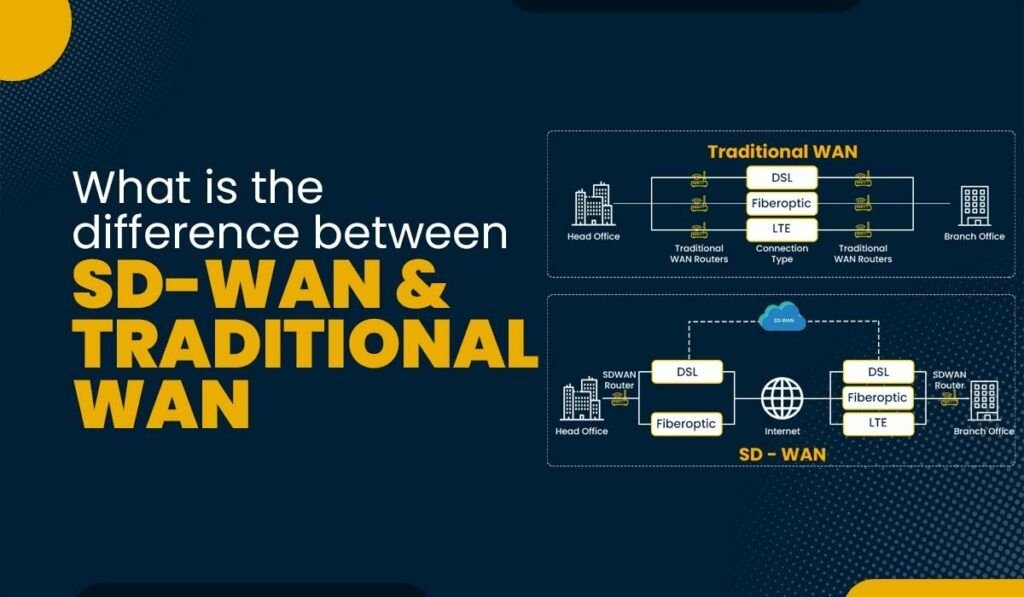
Software-defined wide area networking (SD-WAN) places a policy-driven layer over internet, cellular, and private connections. It does not force traffic through one fixed route. Rather, it identifies application flows. Then, it chooses a path based on conditions such as –
- Latency
- Packet loss
- Jitter
- Circuit availability.
The underlying links still matter, but they’re no longer managed as isolated pipes.
For owners comparing architectures, SD WAN explained with key benefits is a useful starting point, provided those benefits tie to measurable business problems rather than vendor promises.
SD-WAN won’t fix poor cabling, add bandwidth you haven’t purchased, or make an unstable local provider dependable. What it can do is use available connections with far more discretion.
1. Route Applications According to Business Priority
Before applying a policy, the SD-WAN edge recognizes application traffic.
- Voice packets use the path with the lowest jitter
- Nightly backups take a cheaper broadband circuit
- Application-aware routing makes the policy more precise.
A 200-person company could classify payment processing, voice, and ERP traffic as high priority. But ordinary browsing might sit in a lower class.
Sometimes, packet loss rises on the primary circuit. Then, the edge shifts a sensitive flow. It doesn’t wait for the link to fail.
That distinction matters. A circuit can remain “up” while performing badly enough to ruin a customer call.
2. Combine Multiple Connection Types
SD-WAN can place the following beneath one logical network:
- Broadband
- Fiber
- 5G
- Private circuits.
So businesses don’t have to treat every site as if it has identical connectivity options.
| Connection model | Practical use | Main limitation |
| Single broadband line | Small office with low outage exposure | One provider failure can disconnect the site |
| Fiber plus broadband | Branches running cloud and voice workloads | Higher recurring cost |
| Broadband plus 5G | Retail, temporary sites, or failover | Cellular usage and signal quality vary |
| Private circuit plus internet | Regulated or latency-sensitive operations | More expensive and harder to manage |
However, two links aren’t genuine redundancy if they share the same physical route or upstream carrier. Ask each provider about –
- Last-mile diversity
- Building entry points
- Handoff equipment.
Still, two invoices may conceal a single point of failure.
3. Send Cloud Traffic Through a Shorter Path
Backhauling every cloud session through headquarters adds distance and can congest the central firewall. Local internet breakout allows approved traffic to leave from the branch instead.
Imagine a sales office in Denver accessing a cloud CRM hosted nearby. Sending that session through a data center in another region creates an unnecessary loop. A local exit can shorten the route, while policy keeps unknown or restricted traffic on a more controlled path.
Should Every Branch Receive Direct Internet Access?
No. Local breakout changes the security boundary, so it needs DNS filtering, secure web controls, endpoint protection, and consistent inspection policies. If those controls aren’t ready, centralized routing may remain the safer choice for a while.
4. Reduce the Operational Drag of Branch Changes
Traditional branch deployments can involve –
- Device-by-device configuration
- Command-line work
- Several maintenance windows.
SD-WAN moves much of that configuration into centrally managed templates.
However, centralization creates its own risk. A faulty template can spread quickly. We’d treat policy changes like software releases:
- Test them at one low-risk site first.
- A second person must review routing and security changes.
- Keep a known-good configuration ready for rollback.
- Record who approved the change. Also, record when it entered production.
- Do not push large policies during payroll, month-end close, or peak sales hours.
Ultimately, automation saves labor only when change control keeps pace.
5. Improve Visibility Into Application Problems
SD-WAN monitoring can separate local circuit trouble from application delay. Then, it shows metrics such as –
- Latency
- Jitter
- Packet loss
- Tunnel status
- Path changes.
That evidence can shorten fault isolation. Sometimes, voice quality drops whenever packet loss crosses 1 percent on one provider. Then, the team has something concrete to investigate.
In other cases, both circuits look healthy. But the application response time rises. Then, the problem may sit with the service itself rather than the WAN.
This is one of the quieter gains in SD WAN explained discussions. Better routing attracts attention. Still, better evidence saves more staff time. Even then, dashboards require sensible retention periods and alert thresholds.
Hundreds of low-value notifications will bury the one incident that needs action.
A Practical SD-WAN Evaluation Checklist
Start with applications and failure costs. Do not focus on appliance specifications. Map the following:
- Location
- Active circuit
- Cloud service
- Traffic class.
Then, document what happens if a site loses connectivity. It might be for 15 minutes, two hours, or a full business day.
During a pilot, measure the following:
- Voice jitter, packet loss, and call quality during forced failover.
- Recovery time after unplugging the primary connection.
- Performance for payroll, ERP, CRM, and large file transfers.
- Policy behavior when a circuit degrades but doesn’t fail.
- Administrator access, multifactor authentication, log forwarding, and patch procedures.
- Monthly circuit, licensing, support, and managed-service costs over three years.
However, don’t accept a demonstration that uses perfect links in a controlled environment. Rather, introduce loss, delay, and an unavailable controller.
Better Paths Still Need Better Controls
SD WAN explained beyond sales language is easier to judge. It can steer important applications around weak links. It also combines different access services. Moreover, it shortens cloud routes. Also, it gives administrators clearer evidence when performance slips.
Still, disciplined security and reliable providers are necessary:
- The management plane must be patched
- Privileged access should use multifactor authentication
- Configuration backups need protection.
A business that skips those controls may gain flexibility while creating a larger blast radius.
The sound business case isn’t simply “replace the WAN.” It’s to identify where outages, poor application performance, and manual branch work are already costing money, then test whether policy-based routing reduces that exposure without adding more complexity than the team can safely operate.
