

For most beverage brands, the journey begins the same way: a recipe worth believing in, a co-packer willing to run the first batches, and a market that may or may not respond. The question every growing brand eventually faces is whether the contract packing model that got them to market will take them to profitability. The decision to bring bottling in-house is one of the most consequential capital choices a founder will make.
Why Co-Packing Makes Sense Early On
Co-packing dramatically lowers the barrier to entry. Instead of committing millions of dollars to a facility before a single bottle has sold, a brand can outsource manufacturing and direct capital toward brand-building and distribution. When demand is uncertain and run sizes are small, the co-packer absorbs fixed overhead and the brand avoids idle capacity.
Minimum order quantities introduce friction early, however. Many co-packers set floors of two thousand to five thousand cases per SKU, and small pilot runs carry steep per-unit costs. That structure is acceptable when validating a concept, but becomes a liability once volume grows and margin protection matters.
When Co-Packing Stops Working
The tipping point is a combination of signals indicating the model is constraining the business rather than enabling it.
- Margin compression: The co-packer’s fee is embedded in cost of goods sold and becomes a permanent drag on gross margin.
Scheduling friction: Co-packers serve multiple clients. Inability to secure production slots when needed creates hidden costs in working capital and lost sales.
Quality and recipe control: Adjustments to formulation or fill volume require negotiation rather than a direct operational decision.
SKU proliferation: Each new SKU typically triggers a new MOQ conversation, and per-SKU economics multiply quickly across an expanding portfolio.
When these signals appear together – and when volume has stabilized enough to project forward with reasonable confidence – the business case for in-house production strengthens materially.
Capital Requirements and Operational Risks
The true capital requirement goes well beyond the equipment quote. Equipment-only expenditure typically falls between eighty thousand and five hundred thousand dollars, depending on throughput and automation level. When installation, utilities, facility modifications, and working capital are included, a realistic startup budget often lands between one hundred fifty thousand and five hundred thousand dollars.
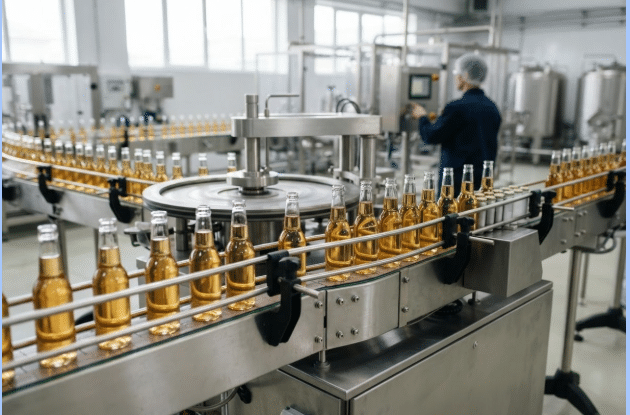
Brands evaluating this transition should assess the full range of automatic bottling machines available at different throughput tiers, since matching line speed to realistic volume is one of the most common – and costly – planning errors. Cost reductions approaching half of co-packing costs are achievable at scale, but the critical variable is volume. A brand that invests in a line sized for ambitious projections and then misses them will carry fixed overhead that erodes the margin improvement it was chasing.
In-house production also transfers regulatory and operational risk previously absorbed by the co-packer. In the United States, facilities must comply with FDA preventive controls requirements; noncompliance can result in recalls, shutdowns, and fines. Staffing is frequently the most underestimated cost – a bottling line requires trained operators, QA personnel, sanitation staff, and maintenance support. Brands should expect a ramp-up period with higher scrap rates and should not assume quality achieved at the co-packer will transfer automatically.
The Hybrid Model and How to Decide
Not every brand needs to choose between full co-packing and fully in-house production. A hybrid model – core, high-volume SKUs produced in-house while seasonal products are co-packed – can capture much of the margin benefit while preserving flexibility. This approach lets a brand build operational competence gradually, without betting the entire business on a single capital decision.
A rigorous business case should stress-test volume projections against downside scenarios, calculate the all-in capital requirement including a contingency buffer, assess the organizational gap between the current team and the one needed to run a compliant operation, and define a fallback plan if volume falls short.
Conclusion
Bringing bottling in-house should be considered only when volume, organizational capability, and the financial model genuinely support it. Done at the right time and for the right reasons, in-house production can be a durable source of competitive advantage. Done too early or without adequate preparation, it can become the most expensive lesson a beverage brand ever learns.
