

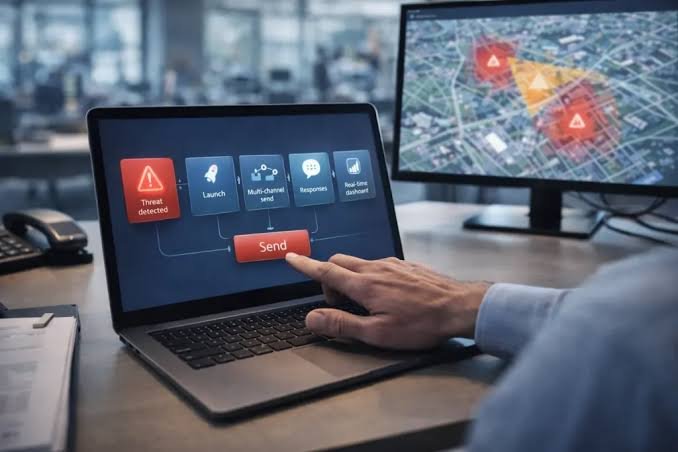
Best Emergency Notification Systems for Business
An emergency notification system is the technology a business relies on to reach its entire workforce in seconds, across every available channel, the moment a critical incident is confirmed. When a severe-weather event, an IT outage, an active-threat situation, or a travel disruption unfolds, the difference between a coordinated response and a chaotic one often comes down to how quickly and reliably people can be warned, accounted for, and guided to safety.
For businesses, the stakes are higher than a simple broadcast. Modern workforces are distributed across offices, remote locations, job sites, and international travel, so a message that reaches everyone at headquarters but misses the field team is only half a system. The strongest platforms combine speed and reliability with two-way communication, precise audience targeting, and integrations that keep contact data current without manual effort.
The list below highlights five providers worth considering, beginning with our top recommendation. It is an editorial overview compiled from each company’s publicly available product information rather than hands-on testing, and it is intended as a starting point for your own evaluation. Every organization has different risk profiles, workforce structures, and compliance needs, so the right fit depends on the priorities you bring to the table.
1. Vismo
Vismo is an enterprise location-intelligence and mass notification platform built around a simple promise: locate, communicate, and protect your people in an emergency. As an emergency notification system, it is designed for security, risk, and health-and-safety teams responsible for distributed, traveling, and lone-working employees – the people who are hardest to reach with a blanket, one-size-fits-all message.
Where Vismo stands apart is its emphasis on location. Alerts can be targeted by real-time GPS position, department, region, travel status, or custom group, and geofencing lets teams define shapes and time conditions that automatically trigger notifications when someone crosses a threshold – arriving in a high-risk area, for example. Messages go out across SMS, voice, mobile app push, email, Microsoft Teams, and Slack, and recipients can respond with two-way “I am safe” confirmations or assistance requests that feed live response dashboards. Escalation workflows, an audit trail, and integration with HR systems such as Workday round out a platform aimed squarely at duty-of-care and business continuity.
Best for: organizations with distributed, traveling, or lone-working staff that need location-aware alerting and accountability, not just a mass broadcast.
Standout capability: location-intelligent, geofenced alerting tied to real-time GPS, so the right people are warned based on where they actually are.
Worth noting: Vismo’s center of gravity is people-safety and travel risk for mobile workforces; teams whose primary need is fixed-site public address or paging may want to weigh that focus against building-centric tools.
2. AlertMedia
AlertMedia pairs emergency mass notification with integrated threat intelligence, aiming to help organizations keep people safe, informed, and connected during any situation. The platform is known for making notifications easy to create under pressure, with a simple five-step process, pre-approved templates, dynamic groups, automatic message translation for multilingual workforces, and an AI assistant to help compose messages.
Alerts can be delivered across a wide channel set – SMS, voice, email, desktop, mobile push, Microsoft Teams, Slack, WhatsApp, and digital signage – with two-way communication and real-time delivery tracking. Its threat intelligence layer adds expert-vetted monitoring so teams can spot emerging risks, and it connects with HRIS, identity, travel, and access-control systems including Workday, ADP, Okta, SAP Concur, and Genetec.
Best for: companies that want notification and built-in threat monitoring combined in one approachable platform.
Standout capability: integrated threat intelligence paired with fast, template-driven message creation.
Worth noting: it is a capable all-rounder; teams whose central requirement is granular real-time location tracking may find that a lighter element of the offering.
3. Everbridge
Everbridge is one of the most established names in the category, positioning its mass notification capability within a broader critical event management platform. It is built for scale: the company cites more than 25 contact paths, delivery to hundreds of millions of people, and billions of messages sent each year across more than 200 countries and territories.
For businesses, the appeal is breadth. Audiences can be reached through text, email, voice, mobile app, desktop alerts, and collaboration tools, with geo-intelligent targeting and two-way responses that let recipients acknowledge messages, confirm safety, or request assistance. Everbridge also emphasizes a deep integration ecosystem – connecting with HR, ITSM, and business-continuity systems such as Workday, ServiceNow, and PagerDuty – alongside an extensive set of security controls and compliance certifications including SOC 2, ISO 27001, HIPAA, and FedRAMP.
Best for: large or complex global enterprises that need deep critical event management, broad integrations, and rigorous compliance coverage.
Standout capability: enterprise-grade scale and an extensive ecosystem of integrations and security certifications.
Worth noting: that breadth is powerful, but smaller teams may find it more platform than they need for straightforward notification requirements.
4. Singlewire (InformaCast)
Singlewire’s InformaCast platform is a long-established name in on-site emergency notification, positioned as an all-in-one system for critical communication, incident management, and daily operations. Its distinguishing strength is reach across physical endpoints: alerts can be pushed to IP phones and paging systems, IP speakers, desktop computers, digital signage, and mobile devices at once, so a warning saturates a building or campus rather than relying on personal phones alone.
The platform follows an alert-reach-respond model, with manual or automated triggers, National Weather Service monitoring for severe weather, integrations with gunshot-detection systems, 911 call detection and PSAP coordination, and incident-management tools for lockdowns, evacuations, and accounting for people afterward. A wearable alert badge doubles as a wireless panic button. Singlewire reports more than 20 years in the market, over 5,000 customers, 99.99% uptime, 1.3 million-plus users, and more than a billion devices notified.
Best for: organizations that need to blanket a physical site or campus – reaching people through on-premises endpoints like IP phones, speakers, and desktops – with schools, healthcare, and government especially well served.
Standout capability: the breadth of on-site delivery endpoints, from IP speakers and phones to desktops and digital signage, combined with built-in incident management.
Worth noting: its core strength is in-building, endpoint-based alerting for fixed locations; organizations whose priority is reaching mobile or traveling staff on personal devices by location may weigh that model against their needs.
- Regroup Mass Notification
Regroup offers a unified platform that handles both emergency alerts and routine, day-to-day communication, with an emphasis on speed and ease of use. Messages can be delivered across email, SMS, voice, a mobile app, desktop notifications, and social channels, with two-way communication so recipients can confirm their status or request help.
Beyond core alerting, Regroup includes a threat intelligence suite, incident management, geofence messaging, and public alerting for reaching the wider community. It serves a broad range of sectors – business, education, government, healthcare, and more – integrates with existing systems including the Ellucian learning-management platform, and includes 24/7 customer support at no extra cost, which can matter when an incident lands outside business hours.
Best for: organizations that want a single platform for both emergency and everyday messaging, with a strong track record in education and the public sector.
Standout capability: combined emergency and routine communication with round-the-clock support included as standard.
Worth noting: its strength is breadth across sectors; highly specialized global travel-risk use cases may call for a more dedicated tool.
How to choose an emergency notification system for your business
The best platform for one organization can be the wrong fit for another. As you compare providers, a few capabilities tend to separate a system that performs on its worst day from one that merely looks good in a demo:
- Multichannel reach and redundancy – the ability to send across SMS, voice, email, app, desktop, and collaboration tools, so a message still lands if one channel fails.
- Two-way communication and accountability – recipients should be able to confirm they are safe or ask for help, giving responders a live picture rather than a one-way broadcast.
- Precise audience targeting – reaching people by location, role, department, or group prevents alert fatigue and gets the right message to the right people.
- Speed and delivery assurance – look for redundancy and delivery tracking so you can trust that time-critical messages actually arrive.
- Integrations with your existing systems – connections to HR, IT service management, and security tools keep contact data current and let alerts trigger automatically.
- Ease of use under pressure – templates, simple workflows, and mobile access matter most in the stressful moments a system exists for.
Frequently asked questions
What is an emergency notification system for business?
It is a platform that lets an organization send urgent, targeted alerts to its employees – and sometimes the wider public – across multiple channels at once during a critical incident, and, in the strongest systems, receive confirmations back so responders know who is safe and who needs help.
What is the difference between an emergency notification system and a mass notification system?
In practice the two terms are often used interchangeably, and most platforms market themselves as both. Where a distinction is drawn, “mass notification” tends to emphasize reaching a large audience quickly across many channels, while “emergency notification” emphasizes the urgent, incident-driven moment the system exists for. For most businesses the capabilities that actually matter – multichannel delivery, precise targeting, two-way response, and reliability – are the same regardless of which label a vendor uses.
What should a business look for when comparing systems?
Prioritize reliable multichannel delivery, two-way communication, precise audience targeting, integrations with your HR and security systems, and an interface simple enough to use calmly during an emergency. The right emphasis depends on whether your workforce is office-based, distributed, mobile, or a mix of all three.
Final thoughts
Choosing an emergency notification system comes down to matching a platform’s strengths to the way your organization actually works. The providers on this list each bring a different center of gravity – from location intelligence for distributed and traveling teams, to integrated threat intelligence, enterprise-scale critical event management, on-site endpoint coverage, and combined emergency-and-everyday messaging. There is no single best fit for every business, so the most productive next step is to shortlist the two or three that best map to your risk profile and put them through their paces against your own requirements.
This article is intended as general editorial guidance and reflects each provider’s publicly available product information at the time of writing; it is not a substitute for professional advice or your own due diligence. Product features, integrations, and certifications can change, so we would encourage any organization to verify current capabilities directly with each provider, map them against its own risk profile and regulatory obligations, and, where appropriate, consult qualified risk, security, and legal advisors before making a decision.
