

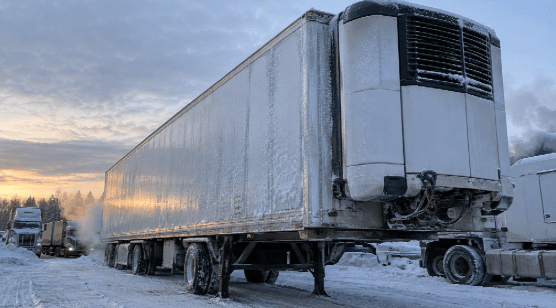
Cold-weather reefer performance depends on refrigeration capacity and diesel engine starting. Available cooling capacity can change as cargo setpoints fall. Thermo King rates the T-1090 at 32,000 Btu/h at a 35°F temperature rating and 13,500 Btu/h at a −20°F temperature rating, with both figures measured at 100°F ambient.
A 2021 Wageningen Food & Biobased Research test found that a Schmitz TKM had some diesel-start failures at −20°C and triggered a low-pressure alarm while cooling cargo-space air from +20°C toward a −20°C setpoint. These findings show why fleets should assess performance against route temperatures and cargo targets.
Key Takeaways
- Fleets should compare reefer capacity with both the cargo setpoint and starting cargo temperature: Thermo King rates the T-1090 at 32,000 Btu/h at a 35°F temperature rating and 13,500 Btu/h at a −20°F temperature rating, with both ratings measured at 100°F ambient.
- Fleets should assess cold-weather starting and pull-down performance under route conditions; in a 2021 evaluation of one Schmitz TKM, researchers observed some diesel-start failures at −20°C and a low-pressure alarm while cooling cargo-space air from +20°C toward a −20°C setpoint.
- Check battery and cold-start specifications against route temperatures; Thermo King’s Precedent manual recommends a 925-CCA wet-cell battery for warm and cold climates and a 1,150-CCA AGM battery for extreme climates.
- Fleets should document the coldest expected ambient temperature, cargo setpoint, pull-down needs, operating time without electric power, and service access, then schedule preventive maintenance and follow shipper pre-cooling and airflow instructions before winter runs.
How Does Cold Weather Affect Reefer Performance?
Cold-weather reefer performance depends on both the refrigeration system and its diesel engine. Available capacity can change substantially as the cargo setpoint falls. A unit that holds a set temperature in ordinary conditions may face a different demand when pulling warm cargo-space air down to a much colder target. Holding an already-cooled load and cooling a warm compartment are different operating conditions.
A 2021 Wageningen Food & Biobased Research evaluation of a Schmitz TKM trailer unit included more than 40 tests across ambient temperatures from −20°C to 50°C, as described in the test report. At −20°C ambient, the unit had some diesel-engine starting failures. A low-pressure alarm also appeared as the unit tried to cool cargo-space air from +20°C toward a −20°C setpoint at that same ambient temperature.
The example shows why performance claims need context. Ambient temperature, starting cargo temperature, and target setpoint all affect what a test demonstrates. A rating measured at one ambient condition or cargo target may not describe performance during a severe-cold pull-down. The Wageningen test involved one unit, so its results illustrate a possible operating challenge rather than predict how every reefer or route will perform. Fleets should compare test conditions with the temperatures and cargo requirements on their own routes.
Which Parts Need Winter-Ready Specs?
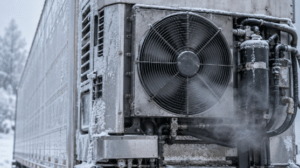
Fleets should check the diesel starting system, battery, low-temperature refrigeration capacity, and available cold-weather options against route conditions, cargo setpoints, and expected ambient temperatures. Engine starting and battery: Confirm that the starting system and battery suit the climate the unit will face. Refrigeration ratings: Compare high- and low-temperature capacity ratings with the required cargo setpoint. AHRI 1110-2024 provides a framework for rating vapor-compression transport refrigeration performance, including electric-standby ratings. Cold-weather options: Check which manufacturer packages match expected snow and cold. Thermo King’s T-1090 Arctic Package includes snow covers, synthetic oil, and a block heater to support cold, snowy operation and easier engine starts. A rating or option is useful only in context, so compare its conditions with the actual route, cargo target, and ambient temperatures the reefer unit is expected to encounter.
How Should Fleets Compare Diesel And Electric Reefers?
Fleets should compare diesel and electric reefer units by required temperature range, route conditions, operating schedule, access to electric power, cargo needs, and service support, rather than choosing a universal winner. A route with long stretches between reliable power sources presents different operating demands from scheduled runs with access to charging or plug-in power. Fleets should also check whether service and parts support is available for the specific unit configuration along their routes.
CARB’s 2022 assessment estimated single-temperature trailer equipment capital costs at $29,400 for mobile diesel-powered TRUs and 33,500–36,000 for hybrid-electric or stationary eTRUs, in 2021 dollars. The same assessment estimated energy costs of $2.60 per operating hour for diesel and $1.52 per hour for eTRU electricity, based on its stated 2021 fuel and electricity assumptions. These are historical estimates, not current quotes. Actual comparisons depend on current equipment pricing, energy rates, and how the fleet operates.
California’s TRU rules include emissions, reporting, and zero-emission provisions. CARB’s program page reports a 2025 statutory development. Fleets should verify current requirements and applicability with CARB before making a purchase decision.
How Do You Protect Cargo During Winter Runs?
Protect cargo during winter runs by confirming the shipper’s temperature and pre-cooling instructions, preserving airflow during loading, and monitoring temperature records. Under 21 CFR § 1.908, a shipper of food requiring temperature control for safety must specify the operating temperature in writing unless using another measure allowed by the rule. Carriers must pre-cool mechanically refrigerated compartments as specified by the shipper before offering them for such transport. Follow this sequence before and during each run:
- Confirm the cargo temperature target and pre-cooling instructions with the shipper before loading.
- Pre-cool the mechanically refrigerated compartment according to the shipper’s instructions before offering it for transport.
- Load cargo to preserve the reefer unit’s intended airflow, without blocking air outlets or returns.
- Monitor available temperature readings during the trip. A unit’s setpoint does not guarantee uniform temperatures throughout the cargo.
- Review available telematics or temperature records after the run to identify recurring performance issues and support follow-up.
Winter Maintenance And Service Planning
Schedule preventive maintenance before severe-weather routes rather than waiting for a cold-weather failure. Ask a technician to check battery condition, cold-weather starting equipment such as a block heater, and reefer operation under expected route conditions, including ambient temperatures and cargo setpoint.
Repeated alarms, hard starts, or difficulty holding the required cargo temperature warrant diagnosis. Do not assume the problem will resolve on its own. Early assessment can identify whether the battery, starting system, or refrigeration unit needs attention. Sonsray Fleet Services supports Thermo King transport refrigeration sales, parts, service, installation, and warranty support. Contact the appropriate Sonsray Fleet Services location to discuss equipment fit, preventive maintenance, or service needs. Offerings and availability vary by location.
Plan Reefer Support For Winter Routes
Before assigning a reefer unit to a winter route, prepare a route brief for the equipment and service teams. Record the coldest expected ambient temperature, the cargo setpoint, whether the load will be pre-cooled or require a pull-down, and how long the unit may operate without access to electric power.
Include the reefer make and model, route schedule, and locations where the fleet can obtain service or parts. Ask the equipment provider to compare the unit’s capacity data with the route’s temperatures and cargo requirements, and to confirm which cold-weather starting options and battery configuration apply. Request these details in writing so the maintenance team can use them when planning inspections and repairs.
Fleet managers can bring the brief to an appropriate Sonsray Fleet Services location to discuss Thermo King equipment fit, preventive maintenance, or service needs. Confirm local offerings and availability with that location before planning the route.
