

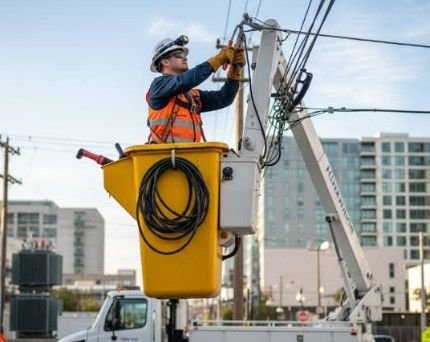
Aerial work platform truck specifications throw two numbers at you, and most people only read one. Working height gets all the attention. Side reach, the horizontal distance the basket travels away from the machine, is what actually decides whether the job works from where you can park.
The clearest way to understand it is to measure a real job, so take a four-story block with a locked service yard and a car park you can use on the far side of a hedge. Five measurements settle it.
Measurement One: How Far Back Must the Truck Sit?
Walk to the closest point the machine can legally and safely stand, then measure straight to the face of the building.
Say it is fifty feet, because a planted verge and a run of parking bays sit in the way. That fifty feet is now the minimum horizontal distance the basket must travel before it reaches the wall. Everything else in the specification has to work around it.
Measurement Two: How High Is the Work?
Measure to the top of the actual task, not to the roofline. Gutter work on a four-story block might sit at forty-five feet, while the ridge above it is sixty.
Write down the highest and lowest points of the work. You need both, because reach behaves differently at different heights.
Where an Aerial Work Platform Truck Trades Height for Reach
Here is the part the brochure does not spell out. Maximum height and maximum side reach never happen at the same time.
Every machine has an envelope, printed as a load chart, showing how far out the basket can go at each height. Full outreach usually occurs at low to mid elevation. Push toward the top of the machine’s range and the basket pulls back toward the chassis. So a platform quoting a hundred feet of side reach will not deliver that at its maximum working height, and reading the chart at your working height rather than at the headline figure is the difference between a job that works and a wasted mobilization.
Measurement Four: What Is In the Way at Height?
Ground level obstacles decide where you park. Obstacles at height decide the path the boom takes.
Balconies, canopies, signage, string courses and overhead cabling all force the boom into a wider arc, which eats into effective reach. A jib helps here, letting the basket drop over a parapet or tuck under an overhang, though the jib takes part of the outreach budget with it. Anyone specifying an aerial work platform truck for facade work should send photographs of the elevation as well as the dimensions, because obstructions rarely appear on drawings.
Measurement Five: What Is Going in the Basket?
Load changes the envelope. Most machines publish reduced outreach at higher basket weights, so two workers with tools will not reach as far as one worker with a camera.
Check the chart at the weight you will actually carry, including materials. This catches people out on cladding and glazing work, where the panel weight alone can move you onto a different curve.
Putting the Five Numbers Together
| What you measured | What it constrains |
|---|---|
| Distance from parking to the wall | Minimum side reach needed |
| Height of the highest task | Which part of the envelope you work in |
| Height of the lowest task | Whether one setup covers the full scope |
| Obstructions at height | Whether a jib or articulating boom is required |
| Basket load | Which outreach curve applies |
Take those five figures to a supplier, and the conversation becomes short. Without them, machine selection is guesswork dressed up as a specification.
What the Five Measurements Add Up To
Side reach is not a single number. It is a curve, and where you sit on that curve depends on height, load, and how much the boom has to bend around the building. Measure the parking distance first, because that one figure rules machines in or out faster than anything else on the spec sheet. Suppliers such as Blade Platforms will read a load chart against your measurements before quoting, so send the five numbers and a couple of photographs with the enquiry and ask which machines clear the envelope with room to spare.
