

Education in the age of AI is changing faster than most institutions can keep up with. Chatbots draft essays, tutoring software adapts to the individual student, and generative tools can complete nearly any assignment a student is given. It’s easy to think this shift is a threat to the physical classroom as we know it. In the face of AI, the room, desks, and shared physical space can feel like an outdated delivery method for modern education. However, this assumption misses what schools are actually for.
The conversation around AI and education is not about whether machines can replace teachers. Instead, the conversation should be about what physical classrooms still do well and how to capitalise on that in the age of AI.
AI is strengthening technical and logical learning, and that is not a bad thing
AI is increasingly effective at supporting structured tasks like drafting, coding, and procedural problem-solving. This can enhance efficiency in technical and logical learning. Schools have massively embraced this value, recognizing that AI’s capabilities in these areas are beneficial. However, it is important to understand that education goes beyond logic and technical skills. Having the ability to develop a wide range of skills like leadership qualities, building strong friendships, and increasing cognitive abilities are some of the many skills needed for holistic development and positive growth.
But classrooms are not just for producing answers
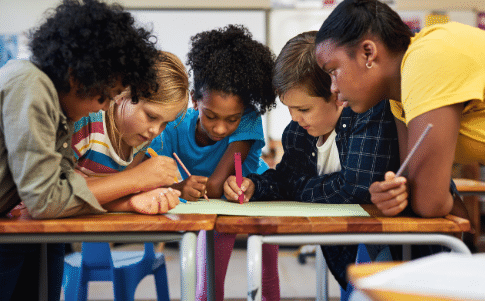
If AI allows students to generate technically correct work like drafting and summarising in seconds, then the role of the classroom is no longer just to be four walls and a confined space for learning what’s on the screen. Making sense of what AI produces is just as important. Individuals can’t develop these skills just by interacting with a screen. They come when ideas are tested against other people. So the shift in education shouldn’t be viewed as one from human teaching to AI teaching, but rather as one from answer production to sense-making. Sense-making is still a social process. It’s one that plays out in physical classrooms. It’s here that students learn to question claims, justify positions, and refine their thinking. AI can give them the answer, but it can’t make them defend it.
Physical learning spaces make thinking social, visible, and discussable
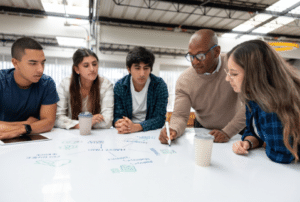
There’s another practical dimension to how far AI can take an education. When a student works out a problem on a personal screen, it remains largely invisible. While the student can see it in the moment, teachers and classmates can’t. In fact, the student themself is unlikely to revisit the material. However, a wall covered in diagrams or a shared table where multiple solutions to the same problem coexist make thinking visible to everyone, allowing students to learn and grow from one another.
This visibility is no small part of learning because without it, the type of deep learning that drives success cannot be achieved. When students are able to compare their reasoning against a classmate’s and examine the areas where they diverge, they learn to revise their own thinking and adapt in response to new information. That’s what makes education valuable.
Shared visual environments, then, do something that can’t happen if everyone is looking at their own private screen. If the classroom shrinks to accommodate that use of AI, it will lose what makes it special in the first place.
Teachers need environments that support discussion
AI will increasingly absorb routine technical work, shifting teachers’ jobs toward something more responsive. Teachers will need to lean more heavily on adapting to where a class’s understanding is and guiding their interpretations rather than just delivering content. To do this, they need a room that supports it.
Teachers need space to reorganise ideas as discussions unfold and surfaces large enough for the whole class to see a problem take shape. Physical classrooms that are built around this flexibility give teachers the ability to respond to questions in the moment, rather than needing to hunt for space to work in before the discussion can continue.
Shared physical spaces create a sense of belonging in students that screens can’t replace. Students learn as part of a group, and this sense of community aids in motivation and persistence. Screens undermine this by isolating them. By contrast, physical spaces that support movement, display, and collaboration deepen that sense of community and improve learning outcomes.
The future-ready classroom will be both AI-enabled and deeply human
While AI will play an undeniable role in modern education, teachers must look beyond just AI for improved learning results. Incorporating intelligent tools will aid the learning process, as the invention of the calculator and computer did. But the learning environment itself still remains a key factor in educational outcomes. A positive and efficient classroom fosters trust, a sense of belonging, and psychological safety. These are the variables that build the curiosity to make the most out of what any intelligent tool has to offer.
Beyond the physical environment, the role of the teacher is still vital to providing a high-quality education. Teachers combine data-driven guidance with empathetic mentorship, promoting collaboration, resilience, and critical thinking. They create the boundaries, routines, and respectful communication that allow students to gain agency, curiosity, and a growth mindset. AI alone cannot provide these variables.
AI tools are growing in capability; we are undeniably in the nascent phases of a new future. But that alone isn’t enough to be future-ready. Modern educational facilities ensure equitable access, promote well-being, and adopt the type of inclusive practices that help every learner succeed. These are the factors that make students truly future-ready, providing purpose and empathy to help build a brighter, more collaborative future.
This article was developed in partnership with HP. Together, we explore the future of innovation, from advanced printing solutions to seamless collaboration tools. Equip yourself with HP to achieve your best work.
