

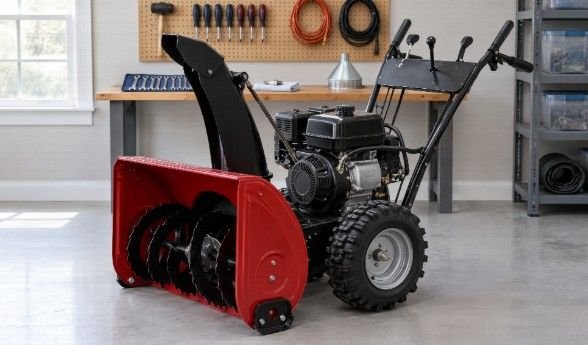
Your snowblower sat through spring, summer, and fall. Now snow is coming, and it won’t start. That is completely normal. Stale gas, a gummed carburetor, a fouled plug, a dead battery. Work through the engine, fuel, and spark in the right order and you might not even break a sweat. Skip the order, and you will pull that cord until your shoulder gives out.
Make Sure the Engine Turns Over
Before you mess with fuel, see if the engine actually spins. Won’t the cord budge? First check the auger and drive levers. Make sure they are released. Check that the recoil starter is not frozen.
Pull the spark plug and try again. If the cord now moves and fuel sprays out, the engine was hydrolocked. The carburetor needle valve stuck open while it sat and gas filled the cylinder. It happens all the time.
Still stuck? Shine a light into the cylinder. Rust on the walls means the rings have rust-welded to the bore. Drip a few teaspoons of penetrating oil into the plug hole. Let it soak overnight. Gently rock the crankshaft back and forth with a socket. Do not muscle it. If it won’t break loose, you are looking at an engine swap.
Drain the Old Fuel
Old gas is the number one reason a snowblower won’t start after storage. The light parts evaporate. Ethanol absorbs water. What stays behind is sticky gunk that plugs up the carburetor jets.
Shut off the fuel valve. Pull the fuel line off the carburetor and point it into a container. Open the valve and let the tank drain. Crack the gas cap so it flows faster. Drain the carburetor bowl too. There is usually a drain screw, or you can just pull the bowl. Fill it back up with fresh gas. Something with stabilizer and no more than ten percent ethanol if you can get it.
Haul the old gas to a hazardous waste place. Do not pour it on the ground.
Clean or Replace the Carburetor
Here is a test that almost never lies. Spray a quick burst of starting fluid into the intake and pull the cord. If it fires for a second and dies, the carburetor is clogged. Period.
Take the carburetor off. Clean the bowl, the float, the needle valve, the jets, and every little passage with carb cleaner and compressed air. The tiny holes on the side of the main jet and that even tinier pilot jet hole are where the varnish hides. A single strand of copper wire is about right for poking them clear. Do not make the holes bigger.
If the carburetor is a corroded mess or the jets are frozen solid, just buy a new one. Twenty or thirty bucks online. Less than you would spend on carb cleaner and frustration. Use new gaskets. Hook up the throttle, choke, and governor rods exactly the way they came off. Attach the fuel line.
Inspect the Ignition System
Start with the dumb stuff. Safety key pushed in all the way? Run switch actually on? You would be surprised how many “no spark” problems end right there.
Pull the plug and read it. Wet means fuel is getting to the cylinder. Bone dry after several choked pulls means it is not. Dry black soot means it is running way too rich. Oily means the engine is burning oil. Replace it if it looks tired.
Check for spark. An inline tester is the clean way. Or ground the plug against bare metal and pull. You want a snappy blue spark. Weak or no spark usually means the coil, the plug wire, the kill switch circuit, or the coil gap is wrong. Set the gap with a feeler gauge. A sheared flywheel key won’t kill the spark, but it messes up the timing enough to make it hard to start or kick back.
Check the Rest of the Machine
Oil check first. Top it off. Change it if you skipped it before storage. Once it runs:
- Spin the auger and impeller bearings. Listen for grinding.
- Replace broken shear pins. Use the right pins. Not bolts.
- Look at the belts. Cracks, glaze, looseness. Replace any that look questionable.
- Make sure the auger engages and disengages cleanly.
- Grease the chute rotation.
- Inflate the tires to what the manual says. The sidewall number is the max pressure.
- Test the electric starter. Usually a 120V plug-in deal.
Stock snow blower parts now. Belts, shear pins, plugs, a spare carburetor. Fix it in the garage at a reasonable hour instead of the driveway at 5:30 a.m. in the dark with frozen hands.
Bottom Line
Compression. Fuel. Spark. That is the whole game. Make sure the engine spins. Get the old gas out. Clean the carburetor or swap it. Confirm you have good spark. If it still won’t go, ask whether a new carburetor or a whole new engine makes sense against the rest of the machine. Most snowblowers that have been sitting come back fine. You just have to do the steps in order and not pretend the old gas is still good.
