

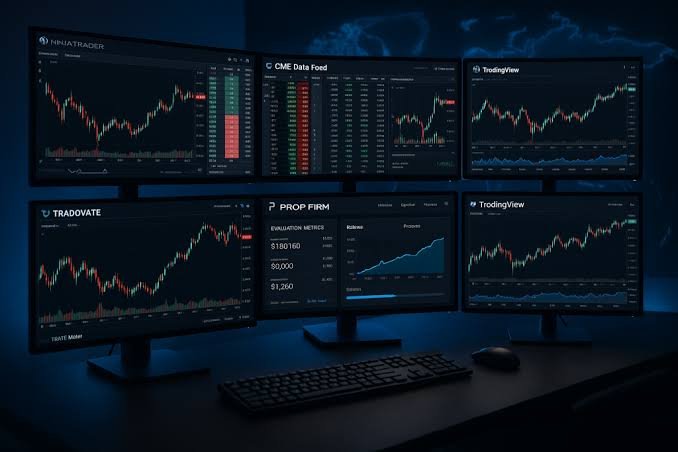
Before choosing a futures prop firm, compare seven things: how drawdown is calculated (Static, EOD, or Intraday), consistency rules, actual payout eligibility, total cost from evaluation to first withdrawal, supported platforms, news-trading restrictions, and overnight/weekend holding rules. The advertised account size and profit split rarely reflect the complete offer.
What Is a Futures Prop Firm?
A futures prop firm is a company that gives traders a rule-based path to qualify for payouts without depositing the full amount shown as the account balance. You normally purchase an evaluation, trade within its profit and risk requirements, and attempt to reach a target without exceeding the maximum drawdown or position limit.
Evaluation accounts are simulated. After passing, you may receive a simulated funded account that can produce real payouts under the firm’s rules. The amount displayed in this account is mainly used to establish the program’s profit target, loss allowance, contract limit, and payout requirements. For example, a $50,000 evaluation with a $2,000 maximum drawdown does not allow you to lose $50,000. The $2,000 drawdown is the more useful measure of how much room the account provides.
Some firms later move selected traders into live accounts that send orders to the market using actual firm capital. Before buying an evaluation, compare the following seven areas.
1. How Does the Firm Calculate Drawdown?
Drawdown is the decline in an account’s balance from a loss. Prop firms enforce a maximum drawdown that determines the lowest balance your account may reach. This limit is set by a risk-threshold floor that is either fixed or trails the account’s peak equity.
- A fixed threshold is called a Static drawdown.
- An intraday trailing threshold can rise with real-time equity, including open profits that might further reverse before the position is closed.
- An EOD threshold updates from a profitable session’s closing result.
This risk floor does not move down once it has moved up. If the balance or equity reaches that threshold, the evaluation may fail, or the funded account may close.
While choosing a firm, you must compare how a firm’s drawdown is calculated and enforced, when it stops trailing, and whether touching it ends the account. Also check whether the account has a Daily Loss Limit (DLL). A DLL is a separate session-level risk control that limits how much a trader can lose in one trading day. Depending on the firm, reaching it may pause trading until the next session or close the account. Compare its size, reset time, and enforcement with your normal stop-loss amount.
2. Profit Consistency and Position-Size Rules
Consistency rules limit how much of your total profit can come from one successful trading day. Firms use them to distinguish repeatable results from an account that reached its target through one unusually large gain.
A common calculation is:
Consistency percentage = Largest profitable day ÷ Total net profit × 100
Suppose your largest profitable day is $800 and your total net profit is $2,000:
$800 ÷ $2,000 × 100 = 40%
Under a 40% consistency rule, that result may qualify. A larger winning day or a later loss could move the percentage above the limit. Exceeding a consistency threshold does not always fail the account. Some firms simply require you to continue trading until additional profit reduces the percentage. Others apply consistency only when you request a payout.
Before choosing a program, determine:
- Whether consistency applies during the evaluation.
- Whether it applies in the funded stage.
- Whether it is checked only for payouts.
- Whether losing days reduce total profit in the calculation.
- Whether the calculation resets after each withdrawal.
- Whether exceeding the percentage delays a payout or closes the account.
Position-size rules require similar attention. Some evaluations provide the full contract allowance immediately, while other programs use a scaling plan.
| Position structure | How it works |
| Fixed contract limit | The account’s full stated allowance is available from the beginning |
| Balance-based scaling | More contracts become available as account profit increases |
| Tier-based scaling | Position size changes as the account moves between defined levels |
Check how micro contracts are converted into mini-contract equivalents and whether the limit includes positions across different products. You should also know what happens if an order would exceed the assigned size. The system may reject the order, review the account, or treat the excess position as a rule violation.
3. When Can You Actually Withdraw Profits?
A profit split only tells you how an approved payout is divided. Payout eligibility may depend on qualifying days, consistency, a minimum balance, processing windows, and other payout conditions. Compare the complete route to the first payout and the rules that restart after each approved withdrawal.
Compare these payout conditions:
| Payout term | What it means |
| Qualifying days | The trading days required before submitting a request |
| Minimum daily profit | The result a day must reach to count as a qualified day |
| Safety buffer | The balance that must remain in the account even after a payout |
| Minimum payout | The smallest amount you may request |
| Maximum payout | The largest amount available in one payout cycle |
| Profit split | Your share of the approved request |
| Processing schedule | When requests are reviewed and paid |
Safety buffers matter because many futures prop firms require you to keep the starting balance plus the drawdown allowance in the account. Only profit above that level may be eligible for withdrawal.
Compare the first and the later payout cycles. A firm may change the withdrawal cap, drawdown floor, qualifying-day count, or consistency calculation after an approved payout.
4. Total Cost From Evaluation to First Payout
A low evaluation price does not show the complete cost of reaching a withdrawal. The main costs to check are:
- Evaluation fee: The one-time or recurring price of the assessment.
- Reset fee: The cost of restoring a failed evaluation, when available.
- Replacement account: A new purchase when the firm does not provide resets.
- Activation fee: A payment required after passing.
- Platform fee: The cost of using specific trading software or integrations.
- Market-data fee: Exchange data required for live prices.
- Trading costs: Commissions, exchange charges, and clearing fees.
- Withdrawal fee: Any processor, transfer, or currency-conversion cost.
Market-data pricing varies by exchange package, account stage, and trader classification. Level 1 data is commonly included, while Depth of Market data or additional exchanges can create separate charges.
Activation also varies by purchase type. For example, Apex Trader Funding applies a one-time activation fee to eligible Standard Performance Accounts, while evaluations specifically sold as no-activation-fee products use a different price structure.
5. Supported Platforms and Data Connections
The trading platform is the software you use to view charts, manage positions, and place orders. The data connection sends market prices and order information between the platform and the account.
These terms are related but not interchangeable:
| Type | Examples | Main purpose |
| Trading platform | NinjaTrader, Tradovate, TradingView, Quantower | Charting and order entry |
| Data and order connection | Rithmic or Tradovate connection | Market data and account connectivity |
| Connection interface | R|Trader Pro | Monitoring a Rithmic account and its orders |
Choose a setup that works with your device and trading method. Tradovate and TradingView may suit traders who want browser or mobile access. NinjaTrader and Rithmic-compatible platforms may be more appropriate for desktop order flow, custom indicators, automation, or multi-account tools.
A firm may list several platforms without making every platform available on every account. The connection selected at checkout can determine the supported products, software, and data fees.
6. News Trading Rules
News trading rules determine whether you can open, close, or hold a position around a scheduled economic announcement. The policy may differ between the evaluation, simulated funded, and live stages.
Common market-moving events include:
- Consumer Price Index releases.
- Employment reports.
- Federal Reserve interest-rate decisions.
- FOMC press conferences.
- Gross Domestic Product reports.
Some firms permit trading during these events. Others prohibit order execution for a specified period before and after the release. The firm may also distinguish between entering a new trade and allowing an existing stop-loss or profit-target order to execute.
If your strategy operates around economic releases, check:
- Which events are restricted.
- Which economic calendar the firm follows.
- The restricted period before and after each event.
- Whether existing positions may remain open.
- Whether pending orders must be canceled.
- Whether the rules change after funding.
- What happens if an order fills during the restricted period.
Even if you normally avoid news trading, you should know how the firm handles open positions and working orders. A trade entered earlier may still be active when a scheduled report is released.
7. Overnight Positions and Market Hours
Overnight holding, weekend holding, and trading through an exchange maintenance period are separate permissions. A firm may allow overnight positions while still requiring all trades to be closed before the weekend.
Start by checking the firm’s definition of “overnight.” It may mean holding beyond a daily cutoff, through the maintenance period, or into the next trading date.
| Rule | What to confirm |
| Daily flattening | When positions must be closed |
| Working orders | Whether pending orders must also be canceled |
| Overnight holding | Whether a trade may continue into the next session |
| Weekend holding | Whether positions may remain open after Friday |
| Holiday schedule | Whether early closing times create different deadlines |
Exchange hours provide the market schedule, but the prop firm can set an earlier trading cutoff. CME currently lists E-mini S&P 500 futures as trading from Sunday evening through Friday afternoon, with a daily maintenance period from 5:00 p.m. to 6:00 p.m. ET.
Your preferred holding period should match the account’s rules. An intraday trader mainly needs a clear daily flattening time. A trader who holds positions for several sessions needs explicit permission for overnight and weekend exposure.
How to Choose an Appropriate Futures Firm
An appropriate firm is the one whose rules fit your strategy, position size, platform, and trading schedule. Read the rules for the exact account rather than relying only on the firm’s general marketing page. Evaluation and funded-stage conditions may differ even when the account size is the same.
You should also confirm whether the funded account is simulated or live, calculate the usable drawdown, and review what changes after a payout. Saving a copy of the current rules at the time of purchase can help you track later program updates.
Risk Disclosure: Futures trading and prop firm evaluations involve substantial risk and fees. Evaluation and initial funded accounts are commonly simulated, and passing does not guarantee a payout or access to live capital. Program conditions can change, so confirm the current rules for the exact account before purchasing.
