

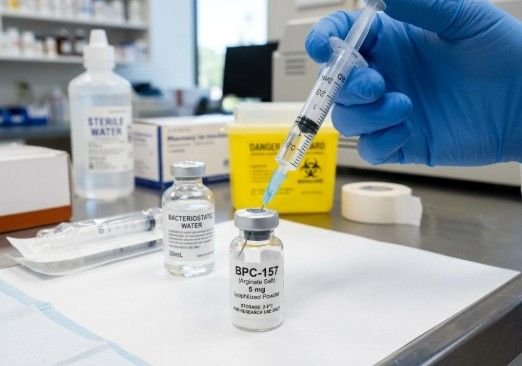
Getting the dosage right is key for good science, especially when you work with made compounds. If you do cell tests or want to study how the body uses things, one wrong math step when mixing can ruin your whole set of results or even hurt people. A tool helps you work out how much and how strong your mix will be, so you do not need to do the math by hand. It makes sure every mix follows the rules.
To get the same results every time, researchers need to know the basic math for mixing again. They should use steady ways to make dilutions. They also have to keep the compound safe while it is stored and handled.
Understanding the Math Behind Compound Reconstitution
At its heart, reconstituting a freeze-dried powder means you have to add a set amount of liquid. People often use sterile water or saline for this. This will help you get the right mix that you want. The main link is based on a simple math rule, which you can easily calculate using PeptideCalculator24.
$$\text{Concentration} = \frac{\text{Mass of substance}}{\text{Volume of liquid}}$$
When one converts mg units of mass to $\mu\text{g}$ doses using standard unit syringes in the United States Pharmacopeia, manual calculations may produce errors..
Key Factors Affecting Concentration Dynamics
- Mass of Lyophilized Powder: The mass of lyophilized powder can be measured in milligrams, i.e., 2 mg, 5 mg, or 10 mg per vial.
- Volume of Diluent: This quantity is quantified in milliliters. One commonly used mixture involves 1 mL to 3 mL.
- Scale of Graduations on Syringes: Research syringes generally utilize scale readings of 100 units (1 mL) or 50 units (0.5 mL). Each graduation marks off a portion of a milliliter.
- Specific Gravity of Compound: Most of the diluents are of water density (1 g/mL). If the diluent solvent is of higher viscosity, then adjustments are necessary.
The quantity of the diluent used when a fixed mass of the powder is used results in variation of the concentration for each syringe. If 5 mg ($5,000\ \mu\text{g}$) of the powder is mixed in 2 mL of the diluent, then the concentration would be $2,500\ \mu\text{g/mL}$. If the 100-unit syringe is taken into consideration, then 1 unit would give $250\ \mu\text{g}$. However, if the amount of the diluent used increases to 4 mL, then the concentration would become half, and in this way 20 units would give $250\ \mu\
Step-by-Step Workflow for Error-Free Preparation
Following a lab procedure will reduce the risk of contamination. In addition to that, it will ensure that the active ingredients disperse evenly. This is how to conduct yourself every time you are preparing.
1. Preparation and Sanitization
Make sure that you have everything that is needed: the vial vacuum-sealed, the diluent, the wipes, and the syringes, which are appropriate. The surface at which the work will be done should be cleaned. The wipes are used to clean the rubber stoppers on both vials using 70% isopropyl.
2. Equalizing Vial Pressure
Vials that are lyophilized contain little air due to the process used in their preparation. You should compensate for this by sucking in the same quantity of air into your syringe as the volume of liquid you will add. Put this air into the diluent vial, then take the liquid you need. When you add the liquid, let the air out of the target vial slowly if you need to.
3. Introducing the Diluent
Aim the needle at the glass side of the powder vial. Do not spray the liquid straight onto the powder. A strong hit from the fluid can damage the peptide chains or their shape. Let the liquid run softly down the glass inside.
4. Dissolution Without Agitation
Continue to rotate the vial slowly until the powder is dissolved and the solution becomes clear. Do not shake the vial vigorously since this can disrupt the molecules of the fluid and cause foaming. It is difficult to measure the dose once there is foam in the vial.
.Advanced Considerations and Common Pitfalls to Avoid
Despite being familiar with lab works, even the most experienced individuals can face some difficulties while preparing a solution. Identifying the potential issues that one may have while preparing the solution allows us to preserve purity throughout the experiment period.
Avoiding Degradation from Temperature Fluctuation
These lyophilized powders are stable for a few days when kept at room temperature. However, once they are reconstituted into a solution, the latter becomes very unstable if exposed to light and heat. It is always advised that these solutions should be kept between $2^\circ\text{C}$ and $8^\circ\text{C}$ ($35.6^\circ\text{F}$ – $46.4^\circ\text{F}$). The manufacturer’s directions should always be followed if the latter recommends freezing the product.
Managing Discrepancies in Syringe Calibration
The relationship between the syringe size and measurement is not accurate and this could cause an incorrect dosage. A 3mL syringe used for measuring 0.05 mL (5 units) can result in an enormous error. The problem arises because of the space present within the needle hub which is not taken into consideration. You should always choose the smallest possible syringe for the volume that is required.
Recognizing Solution Instability
Look closely at reconstituted liquids under bright light before you take any out. Should you see that there is cloudiness in the mixture or any presence of floaters and if there are any changes in the color of the fluid, then do not put in any liquid. This is an indication that there might be some clumps, particles, or even bacteria present in the solution.
Elevating Research Standards Through Systematic Precision
Getting strong results in experiments that you can share needs you to be exact all the way. You must start this with handling the powder right up to the last step of measuring liquids. This happens when you use good cleaning methods, mix chemicals the right way, and store them at the right heat. Doing this helps you keep the main mix in good shape and makes sure the results are reliable.
Using tools like PeptideCalculator24 helps you move from what you figure out on paper to what you do in the lab. This lets you pay more attention to important findings. You feel fully sure about your numbers and work.
