

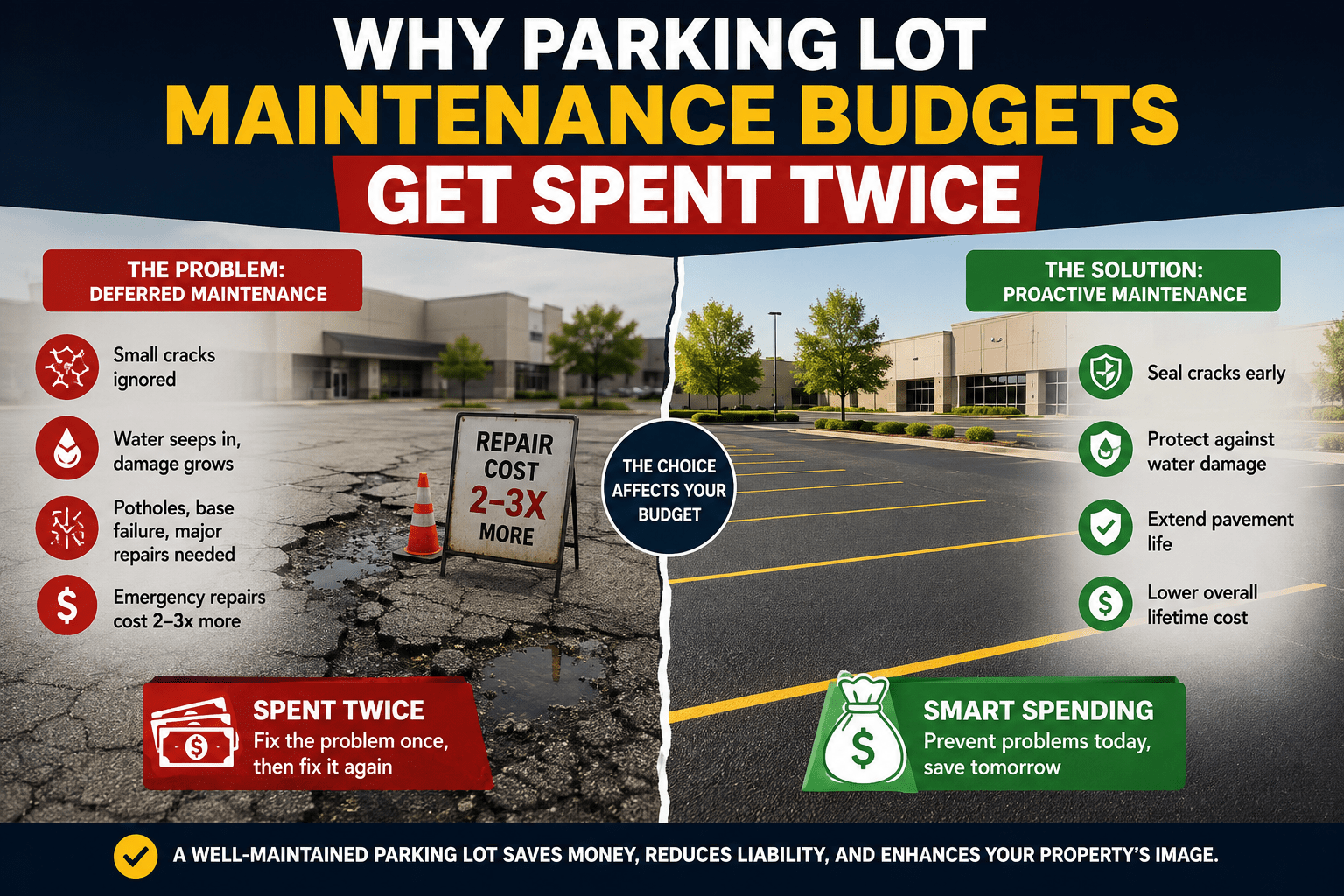
There is a category of business expense that nobody in the organization actually owns. It is too small for the capital committee, too physical for finance, and too infrequent for whoever handles facilities day to day. It surfaces when someone complains, gets handled quickly, and disappears again.
Pavement maintenance sits squarely in that category, and it produces a specific and avoidable failure: the work gets done in the wrong order, so it gets paid for twice.
The pattern is consistent. A tenant or a customer mentions that the lot looks rough. Someone gets a quote for restriping because that is the visible problem. The lines go down, they look sharp for a season, and eight months later the surface underneath has continued deteriorating and the whole job needs redoing. The money was not wasted on a bad contractor. It was wasted on correct work performed in the wrong sequence.
The order of operations is the whole game
Pavement maintenance has a fixed sequence, and every step depends on the one before it:
- Repair first. Cracks get filled and failed sections get patched. Sealer and paint applied over unrepaired cracks do not stop the cracks; they just hide them until they reappear.
- Sealcoat second. This is the protective layer that shields asphalt from UV, water intrusion, and oil. It is also what restores the dark, uniform surface that makes markings legible.
- Cure third. Not optional, not a formality, and the step most often compressed to hit a deadline.
- Stripe last. Paint goes onto a clean, dry, fully cured surface, or it does not bond properly.
Reversing the last two steps is the expensive mistake. Striping a lot and then sealcoating it means the sealer goes straight over the fresh lines, and the entire striping cost is immediately obliterated. That sounds too obvious to happen. It happens constantly, because the two services are frequently bought from different vendors at different times by different people, and nobody is holding the sequence.
Curing time is not padding in the schedule
The most common source of friction between property owners and contractors is cure time, because it reads as a delay rather than as part of the work.
After a final sealcoat, industry practice is to let the surface cure at least 24 hours before applying water-based traffic paint, and 24 to 48 hours is the safer commercial window. In cool or humid conditions, that can stretch toward 72 hours. The test is not really the clock, it is the surface: if the sealer still feels tacky, tracks underfoot, or marks when pressed, it is not ready. Paint applied at that stage can bleed, discolor, or simply fail to bond, and the failure will not be visible for weeks.
Two related timelines catch people out on newer properties. Freshly laid asphalt typically needs somewhere in the range of six to twelve months before its first sealcoat, because the volatile oils in new pavement have to release before sealer will bond to it. Fresh patches usually need a shorter wait, commonly cited around 45 to 60 days. A contractor who agrees to sealcoat a three-month-old lot because the client asked is not being accommodating. They are setting up a coating failure that the client will pay to fix.
The good news at the end of the chain: traffic paint itself dries fast. Roughly an hour is typical before a section can reopen, which is why striping is the one step in this sequence that rarely requires meaningful downtime.
What you are actually paying for
Restriping looks like a commodity. Two contractors, same lot, same number of stalls, and one bid comes in noticeably lower. The difference is almost always in things that are invisible on the day the work is finished:
- Surface preparation. Paint applied over dust, loose grit, or oil residue lifts early. Prep is labor, and labor is the easiest line to cut from a bid.
- Film thickness. Paint applied thin covers the same area for less material cost and looks identical the week it goes down. It fades in a fraction of the time.
- Layout accuracy. A lot re-striped by eye off the ghost of the old lines inherits every error in the previous layout, including any dimensional problems in the accessible stalls.
- Removal of superseded lines. If the layout is changing, old markings need grinding or blacking out. Painting a new grid over a visible old one produces a lot that confuses drivers at dusk.
- Material selection. Standard water-based traffic paint is the right choice for most stalls. Higher-wear zones such as drive lanes, loading areas, and crosswalks may justify a more durable material at higher upfront cost.
The questions that separate one bid from another
Bids on this work vary more than the scope would suggest, and the spread usually reflects what was left out rather than a better price. Before accepting the lowest number, ask any parking lot striping company you are considering to put the following in writing:
- The full scope in sequence, including any repair or sealcoating required first and the cure time between steps
- Stall counts and dimensions, not just total square footage and a price
- Confirmation that accessible stall counts, widths, access aisles, and signage will meet current standards rather than replicating the existing layout
- Paint type and application thickness
- The phasing plan and working hours, including which sections close when
- What happens if weather forces a reschedule mid-job
That last point matters more than it appears. Sealcoating and striping are both weather-dependent, and a contractor who has not thought about the contingency will improvise at your expense, usually by compressing cure time.
Put it on a cycle instead of a complaint trigger
The structural fix is to stop treating this as a reactive expense. Both services run on reasonably predictable intervals: sealcoating is commonly scheduled every three to five years, and striping typically holds somewhere in the range of eighteen to twenty-four months before it needs attention, with heavy-turnover lots at the short end and low-volume office lots considerably longer.
Those intervals shift with climate and traffic. High-UV markets degrade markings faster than temperate ones; freeze-thaw cycles and de-icing chemicals attack the surface from the other direction. The point is not the specific number for your property. The point is that a number exists, and once it is written into a maintenance calendar, the sequencing problem largely solves itself. Repair, seal, cure, and stripe get planned as one scoped project rather than as four disconnected reactions.
The economics, briefly
Pavement is usually among the largest single assets on a commercial property and among the smallest lines in its operating budget. Deferring maintenance on it does not save money; it converts a scheduled, predictable expense into an unscheduled, larger one, because water reaching the base course through unsealed cracks is what turns a resurfacing project into a reconstruction project.
Sequencing is the cheapest lever available here. It costs nothing to do the same work in the right order. It just requires that somebody owns the decision.
Notes for the editor
Link to include (1 total): anchor text “parking lot striping company” → https://swiftstriping.com — located in the “questions that separate one bid from another” section. Please publish as a standard do-follow link.
Suggested category: Business (Offline) or Blogs.
Suggested meta title: Why Parking Lot Maintenance Budgets Get Spent Twice
Suggested meta description: Pavement work done in the wrong order gets paid for twice. The correct sequence, realistic cure times, and the questions that separate one contractor bid from another.
Suggested image alt text: Commercial parking lot being restriped after sealcoating, with fresh white stall markings.
