

Best License-Free Walkie Talkies for Schools (2026 Guide)
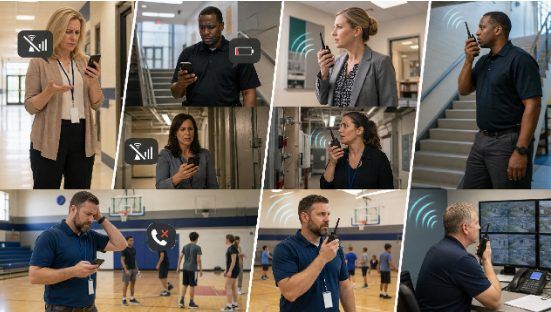
Last fall, a middle school outside Columbus went on lockdown for 40 minutes after a former student was spotted near the gym entrance. Half the staff patrolling basement hallways had no cell service. The other half had phones on silent during 4th period. By the time the all-clear circulated, three police cruisers were on scene and the parent Facebook group was spiraling with rumors.
This is not an unusual story. Schools deal with communication gaps every single day. Cell phones work fine for scheduling parent-teacher conferences and sharing lesson plans. When you need to reach someone right now, they fail more often than most administrators want to admit.
After talking to two dozen K-12 facility managers and testing a dozen license-free radio models across four campuses, the Retevis H777 FRS series stands out as the most practical choice for most schools. No FCC license required, no monthly fees, no complicated repeater infrastructure to install. Just turn them on and talk. The lineup includes three distinct models, so there is a fit for every role on staff—from security patrols to 2nd grade teachers.
Why License-Free Radios Make Sense For K-12 Campuses
The problem with relying on cell phones is not access to communication—it is reliability when it counts.
Cell networks crash during emergencies. When hundreds of people in the same building try to call or text at once, towers become congested within 60 seconds. Walkie talkies operate independently of that traffic. Push-to-talk connects instantly, with no lock screen to navigate, no contact list to scroll, no wait for a call to connect.
Dead zones exist on every campus. Locker rooms, basement art studios, portable classrooms at the edge of the property, the back corner of the cafeteria—these are the places where cell service drops to nothing. FRS UHF signals penetrate cinder block and steel far better than cellular frequencies. Unlike intercoms or VoIP phone systems, radios run on battery power independent of building electricity. They keep working through power outages and severe weather when every other system goes down.
All H777 models operate on FRS frequencies, which the FCC set aside specifically for consumer and business use at up to 2 watts. They are legal to use the second you take them out of the box—no license, no paperwork, no annual renewal fees. For a typical 600-student elementary school, 30-40 units cover every member of staff. A large high school might need 80-100. The units pay for themselves in roughly two months compared to adding dedicated cell lines for every employee.
Matching H777 Models To Staff Roles
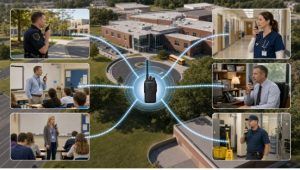
The biggest advantage of the H777 lineup is compatibility. All three models communicate with each other out of the box. No programming required, no brand matching, no compatibility hoops to jump through. A security guard with an H777H can talk directly to a teacher with a base H777, who can talk directly to the principal with an H777D.
H777H: Security, Facilities, Campus Operations This model is designed for staff who need reliable communication throughout the school day while maintaining a clean, professional appearance. The hidden display provides the benefits of a screen while offering better durability, lower power consumption, and a more discreet look compared with traditional LCD displays. Security teams, custodial staff, and campus support teams can quickly check radio status while coordinating activities, responding to requests, or managing daily operations. VOX hands-free mode allows staff to communicate while carrying supplies, completing maintenance tasks, or supporting campus events without pressing the push-to-talk button. Its practical features and cost-effective configuration make H777H a great choice for schools looking to equip operational teams with dependable and unobtrusive communication tools.
H777D (Upgraded): Administrators, Nurses, Department Heads This model balances features and portability for staff who need more functionality without carrying a heavy unit. Type-C charging works with the same cables used for phones and laptops, so staff can top off at their desks without special chargers. The LCD screen shows channel selection, battery level, and signal strength at a glance. The 1200mAh battery lasts 19+ hours—enough to cover a full school day, back-to-school night, and a Friday night football game on a single charge. One-key pairing lets staff add substitute radios at the last minute without digging through instruction manuals.
H777 Classic: Teachers, Volunteers, Substitutes This is the no-nonsense model for everyone else. The interface is intentionally simple: power and volume knob on top, channel selector, push-to-talk button on the side. That is it. No touchscreen, no confusing menus, no settings to accidentally change. Even staff who struggle with technology can operate it within 10 seconds of picking it up. The short antenna clips to lanyards or belt loops without sticking out awkwardly, and a built-in LED flashlight comes in handy during power outages or when walking dark hallways after events. These come pre-programmed from the factory, so substitutes can pick one up in the office at 7:30 and be on the air by 7:31.
Learn more about school communication solutions →K-12 School Communication Solutions
Everyday Use Across Campus
Radios are not just for lockdowns and emergencies. They solve dozens of small problems that eat up staff time every single day.
When a student has an allergic reaction in the cafeteria, the lunch monitor presses one button and the nurse is on her way in seconds. The principal meets her there, and the front office calls 911—no running down hallways, no dialing three different numbers. During passing periods, a teacher needing behavioral support calls for help, and counselors already in the hallway arrive in 30 seconds before situations escalate. Custodians clean up spills before work orders even hit their email.
For field day, graduation, and other large events, staff spread across campus stay coordinated without yelling or running between stations. The athletic director runs the main channel, the nurse stays on a dedicated medical channel, and parking volunteers manage traffic on their own. During dismissal, staff call car numbers as they pull up, report bus delays, and alert each other when traffic backs up onto the main road. The U.S. Department of Transportation explicitly allows two-way radio use while driving school buses, unlike cell phones which are restricted in most states. Car line that used to take 45 minutes finishes in 20.
Simple Setup That Works
All H777 models include 16 channels, and most schools never use more than seven. Stick to this straightforward plan: Channel 1 for all-staff emergencies and announcements, Channel 2 for security, Channel 3 for the front office, Channel 4 for custodial and maintenance, Channel 5 for the nurse, Channel 6 for transportation, and the remaining channels for special events. Print a small cheat sheet and tape it to the back of each radio—that is all the training most staff need.
A few small choices prevent most deployment headaches. Multi-unit gang chargers eliminate tangled USB cables in the office and security room. Ordering 10% extra covers units that get left on buses or buried under bleachers. Inexpensive earpieces make a massive difference in noisy environments like cafeterias and gyms. You do not have to outfit everyone on day one, either. Start with security and front office staff, then add teacher units as budget allows. All models work together regardless of when you purchase them.
These radios do not have Bluetooth, color touchscreens, or companion apps. What they do is work. They are simple enough for substitutes to use on their first day, tough enough to survive K-12 chaos, and reliable enough that when someone pushes that button, another person answers immediately. For most schools, that is exactly what matters.
