

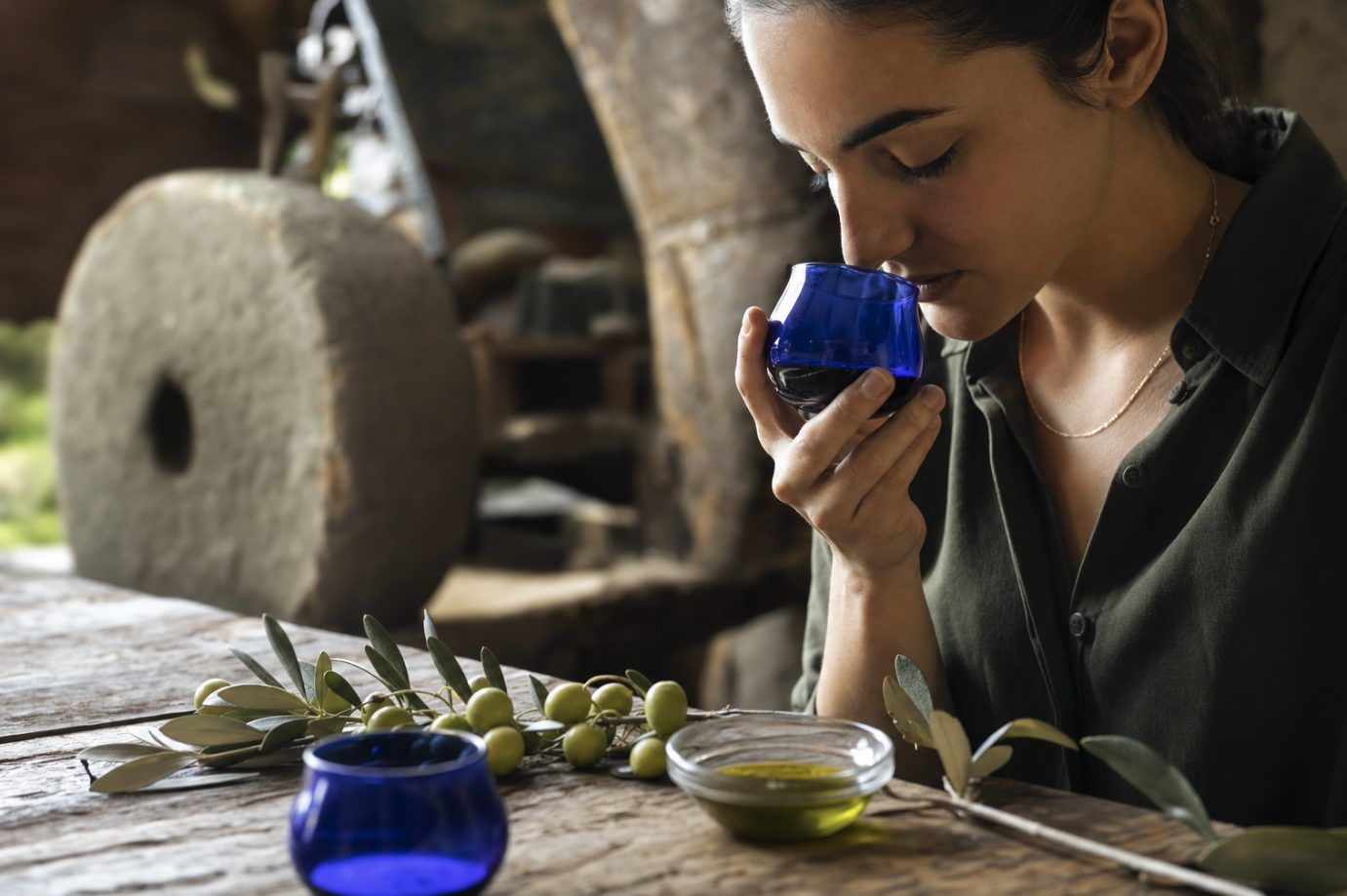
What can a teaspoon of extra virgin olive oil reveal beyond a simple judgement of good or bad? Much more than it may seem.
Careful tasting can provide clues about the oil’s freshness, style and overall balance. It can also reveal how the olives may have been harvested, processed and stored. The official vocabulary used in sensory analysis focuses on three main positive attributes: fruitiness, bitterness and pungency.
Learning to recognise them does not turn a casual consumer into a professional panel taster. It does, however, change the way a bottle is chosen and helps explain why two extra virgin olive oils can taste remarkably different. A guided olive oil tasting experience in Tuscany makes these distinctions easier to understand by comparing several oils and connecting their aromas and flavours with choices made in the olive grove and at the mill.
Tasting is therefore not about finding a single flavour that every good oil should possess. It is about observing a series of sensations, recognising whether they are clean and harmonious, and understanding what they may suggest about the product.
What an olive oil tasting can really tell you
Many descriptions stop at broad judgements such as delicate, strong, pleasant or defective. A more useful tasting begins before those conclusions.
Each sensation provides a small clue. Fresh grass, artichoke, tomato leaf, herbs, green almond or ripe fruit may appear on the nose. Bitterness may spread across the tongue, while pungency can emerge gradually at the back of the throat.
Taken together, these sensations help describe the oil’s personality.
A green, bitter and assertively pungent oil may come from olives harvested relatively early, when their phenolic content is often higher. A softer oil with almond or ripe fruit notes may reflect riper olives, a different cultivar or a different production style.
These remain interpretations rather than certainties. Flavour is influenced by many factors, including:
- olive variety;
- climate and growing conditions;
- degree of ripeness;
- harvest method;
- time between harvesting and milling;
- extraction conditions;
- filtration;
- storage;
- age of the oil.
Tasting cannot reveal the exact history of an oil on its own. It can, however, identify consistency, freshness and possible problems, especially when several samples are compared side by side.
How to taste olive oil step by step
A simplified version of professional tasting can easily be repeated at home. A small, clean glass without residual odours is enough to begin.
1. Pour a small quantity
Pour one or two teaspoons of olive oil into the glass. A large quantity is unnecessary and makes it more difficult to control the tasting.
Avoid using a glass that has recently contained coffee, wine, detergent or strongly scented food.
2. Warm the oil gently
Cover the top of the glass with one hand and hold the base with the other. Warm it gently for a short time.
The purpose is not to make the oil hot, but to help release its volatile aromas.
3. Smell before tasting
Uncover the glass and take a few short, deliberate sniffs.
Try to identify the general aromatic family before searching for specific descriptors. Does the oil smell green and fresh, or softer and riper? Is the aroma clear and lively, or flat and indistinct?
Possible impressions include freshly cut grass, olive leaf, artichoke, tomato leaf, herbs, green almond, apple or ripe fruit.
There is no need to find an elaborate description. A few accurate words are more useful than a long list of forced associations.
4. Take a small sip
Place a small amount of oil in the mouth and spread it slowly across the tongue.
Avoid swallowing immediately. Give the oil time to reach different areas of the mouth.
5. Draw in a little air
With the lips slightly open, draw in a small amount of air. This technique helps carry aromas towards the nose through the retronasal passage.
The sound may feel unusual, but it makes aromatic details easier to detect.
6. Observe bitterness and pungency
Bitterness is mainly perceived on the tongue. Pungency is often felt later, especially at the back of the throat.
Notice when each sensation appears, how intense it becomes and how long it remains.
A slight cough can occur with a particularly pungent oil, but it should not be treated as automatic proof of quality. Pungency is one element of the overall profile, not a certification in itself.
7. Evaluate balance and persistence
After swallowing, consider how the sensations fit together.
Does the aroma perceived on the nose return in the mouth? Is one attribute overwhelmingly dominant? Does the finish remain clean and recognisable, or disappear immediately?
A balanced oil does not need to be mild. It can be powerfully bitter and pungent while still feeling coherent and controlled.
Colour is not a reliable measure of quality
The colour of olive oil can range from bright green to golden yellow. This variation depends on the olive variety, ripeness, pigments, filtration and storage.
A greener oil is not automatically fresher or better. Similarly, a golden oil is not necessarily old or low in quality.
Professional tasters use coloured glasses that prevent them from judging the appearance of the sample. This helps ensure that expectations created by colour do not influence the sensory evaluation.
At home, appearance may still provide information about clarity or sediment, but it should not determine the judgement before the oil has been smelled and tasted.
Cloudiness is not a guarantee of authenticity either. An unfiltered oil may naturally contain suspended particles, but those particles can also make it less stable if the product is stored for too long or under unsuitable conditions.
The three positive attributes
The official sensory vocabulary for virgin olive oils identifies three central positive attributes: fruity, bitter and pungent.
Fruity
Fruitiness is the set of olfactory sensations associated with sound, fresh olives.
It may be perceived directly through the nose or retronasally while the oil is in the mouth. Depending on the olives and their degree of ripeness, the profile may be described as green fruity or ripe fruity.
Green fruitiness may recall grass, leaves, artichoke, green tomato, herbs or green almond. Ripe fruitiness may suggest ripe olive, softer almond, apple or other mature fruit notes.
Fruitiness is essential to the classification of virgin and extra virgin olive oil. An oil without perceptible fruitiness cannot qualify as extra virgin.
Bitterness
Bitterness is a taste perceived on the tongue. It is commonly found in oils made from greener olives and is often associated with phenolic compounds naturally present in the fruit.
Many consumers initially interpret bitterness as unpleasant or as a sign that something is wrong. In a clean and balanced extra virgin olive oil, it is a positive attribute.
Its intensity may range from almost imperceptible to powerful. A mild oil is not necessarily inferior, just as a very bitter oil is not automatically superior.
The important questions are whether the bitterness is clean, appropriate to the rest of the profile and free from unpleasant aftertastes.
Pungency
Pungency is the sharp, peppery sensation usually felt in the throat.
It may appear immediately or develop a few seconds after swallowing. As with bitterness, it is frequently associated with phenolic compounds and may be particularly noticeable in young oils made from olives harvested at an earlier stage of ripeness.
Pungency can produce a warming sensation or a brief cough. This is not the same as acidity.
Acidity is a chemical parameter measured in a laboratory. It cannot be evaluated by how sharp or peppery an oil feels in the mouth.
What bitterness and pungency do not prove
Bitterness and pungency are desirable attributes, but they should not be interpreted in isolation.
A very pungent oil is not necessarily of higher quality than a delicate one. Cultivar, growing conditions, harvest time and production choices all influence intensity.
Some excellent oils are gentle, aromatic and lightly bitter. Others are green, forceful and persistent.
Quality depends on the absence of sensory defects, the presence of fruitiness and compliance with chemical parameters. Personal preference comes later.
A consumer may prefer a softer oil for fish or delicate vegetables and a more robust one for pulses, grilled meat, soups or bruschetta. Both can be excellent if they are fresh, clean and well made.
Reading aromas without jumping to conclusions
Sensory descriptions are useful because they create a shared vocabulary. They should not become a guessing game in which every aroma is linked to a precise place or production date.
The same olive variety can produce different profiles depending on the year, altitude, soil, water availability and degree of ripeness.
A single estate may also produce several oils with different characteristics by changing the harvest period, blending cultivars or separating different plots.
A green and herbaceous profile can suggest early harvesting, but tasting alone cannot prove exactly when the olives were picked. A ripe almond note may be linked to mature fruit, but it can also be characteristic of a particular cultivar.
The most reliable way to understand these differences is comparative tasting. Sampling oils from different harvest periods, cultivars or production methods makes the effect of each choice easier to recognise.
Common defects in olive oil
Sensory analysis does not only describe positive attributes. It also identifies defects that may arise during harvesting, processing, storage or transport.
Recognising them takes practice, but several appear frequently enough to be useful to ordinary consumers.
Rancid
Rancidity develops through oxidation.
Exposure to oxygen, light, heat and time gradually damages the oil and weakens its fresh aromas. The result may smell or taste like wax, old nuts, stale fat, crayons or putty.
A rancid oil often feels flat and tired rather than vibrant. Fruitiness fades, while the finish becomes greasy or stale.
Once oxidation has significantly altered an oil, the process cannot be reversed.
Fusty or muddy sediment
The fusty defect is associated with fermentation that can begin when harvested olives are stored in piles or containers for too long before milling.
Muddy sediment notes can develop when oil remains in prolonged contact with sediment in storage tanks.
The sensation may recall fermented fruit, damp vegetation or an enclosed, stale environment.
Rapid transport to the mill and careful separation from sediment help prevent these problems.
Musty, humid or earthy
This defect is associated with olives affected by fungi or yeasts, often because they have been stored in humid conditions.
It can recall damp soil, mould, a cellar or wet fabric.
Earthy sensations may also appear when olives are collected from the ground and not cleaned adequately before processing.
Winey or vinegary
Winey-vinegary notes are linked to fermentation processes that generate compounds such as acetic acid, ethanol and ethyl acetate.
The aroma may resemble vinegar, fermented wine, solvent or nail polish.
This defect can develop when olives are damaged or stored poorly before extraction.
Heated or burnt
Excessive or prolonged heat during processing can create heated or burnt sensations.
The oil may lose aromatic freshness and develop cooked, caramelised or scorched notes.
Temperature management during extraction is therefore important, not merely as a marketing statement but as part of preserving the sensory characteristics of the fruit.
Freshness and storage after opening
Even a well-produced extra virgin olive oil changes over time.
Light, air and heat accelerate oxidation. The bottle should therefore be stored tightly closed, away from windows, ovens, radiators and other heat sources.
Dark glass, coated containers or tins help reduce exposure to light. Packaging cannot completely protect an oil if it is repeatedly left open or stored in a warm kitchen.
Buying an enormous container is not always economical if it takes many months to finish. A smaller bottle used while the oil is still fresh may provide better value than a larger one that becomes oxidised before it is empty.
When available, the harvest date can be more informative than the best-before date. The best-before date indicates the period during which the producer expects the product to retain its characteristics under suitable storage conditions, but it does not necessarily reveal when the olives were harvested.
After opening, pay attention to how the aroma develops. If a previously fresh oil becomes waxy, flat or stale, oxidation is probably taking over.
Extra virgin, virgin and lampante olive oil
The legal categories of virgin olive oil are based on both chemical analysis and sensory evaluation.
A bottle cannot qualify as extra virgin simply because it tastes pleasant to one person. It must comply with a defined set of analytical and organoleptic criteria.
Extra virgin olive oil
For an oil to be classified as extra virgin, the median of its sensory defects must be zero and its fruitiness must be greater than zero.
It must also comply with chemical limits. These include a free acidity of no more than 0.8 grams per 100 grams, together with limits for peroxide values and spectrophotometric parameters.
Extra virgin is therefore both a chemical and sensory classification.
Virgin olive oil
Virgin olive oil may contain a perceptible sensory defect, provided that the median intensity remains within the legal limit and fruitiness is still present.
Its free acidity may reach 2 grams per 100 grams, subject to the other applicable parameters.
Virgin olive oil is edible, but it does not meet the stricter standards required for the extra virgin category.
Lampante olive oil
Lampante olive oil has sensory or chemical characteristics that prevent it from being sold directly for consumption.
From a sensory perspective, it may have a median defect above the permitted limit or lack fruitiness under the conditions specified by the classification system.
It must be refined or otherwise processed before it can enter edible olive oil categories.
Why official sensory testing exists
Sensory analysis is not merely a language used by enthusiasts. It forms part of the official quality control system for virgin olive oils.
The panel test is carried out by a group of selected, trained and monitored tasters. The result does not depend on the preference of a single individual.
Each taster evaluates the intensity of fruitiness and any defects without knowing the identity of the sample. The panel leader then processes the results statistically, using median values to support the classification.
The purpose is not to decide whether an oil would taste good on a particular dish. It is to determine whether its organoleptic characteristics comply with the declared category.
Consumer tasting is naturally less formal. Nevertheless, it uses part of the same vocabulary. Fruity, bitter, pungent, rancid and winey-vinegary are not vague inventions. They describe sensations recognised within a defined sensory method.
Common mistakes during a first tasting
Several habits can distort the experience before the oil has been properly evaluated.
Confusing pungency with acidity
A peppery sensation in the throat is not an indication of high acidity.
Free acidity is measured chemically and cannot be tasted directly. Pungency, on the other hand, is a positive sensory attribute.
Treating bitterness as a defect
Bitterness is normal in many high-quality extra virgin olive oils.
It becomes unpleasant only when it is unbalanced, accompanied by defects or simply incompatible with personal taste.
Tasting only with bread
Bread is useful for enjoying olive oil, but not for evaluating it clearly.
Toasted bread, garlic, tomato and salt all introduce aromas and flavours that can cover subtle characteristics. The oil should first be tasted on its own.
Food pairing can come afterwards, when the goal shifts from analysis to pleasure.
Judging by colour
A vivid green colour may create expectations of freshness, but colour alone cannot establish quality.
Taste and aroma provide much more useful information.
Expecting every good oil to taste the same
There is no single ideal profile.
A delicate, ripe-fruity oil and a powerful, green-fruity oil can both be excellent. Style and quality are related, but they are not the same thing.
Tasting too many samples without a break
Sensory fatigue can make later samples appear weaker or less distinct.
Water and a small piece of apple can help refresh the mouth between oils. Strong coffee, wine, perfume and spicy food should be avoided immediately before tasting.
A practical tasting checklist
A simple sequence of questions can turn tasting into a useful habit:
- Is the aroma clear and recognisable?
- Does the fruitiness seem greener or riper?
- Which aromas appear first?
- Is bitterness present on the tongue?
- Does pungency emerge in the throat?
- Are bitterness and pungency balanced with the fruitiness?
- Does the flavour remain clean after swallowing?
- Are there stale, fermented, mouldy or vinegary notes?
- Do the aromas perceived on the nose return in the mouth?
- Would the style complement the foods normally prepared at home?
No single answer is enough to judge an oil. Together, however, they create a reliable picture of its freshness, style and sensory condition.
Turning sensations into experience
Learning to taste olive oil is less about memorising sophisticated words and more about building sensory memory.
One sample may seem simply bitter. After comparing it with two or three different oils, that bitterness begins to acquire shape: gentle or forceful, immediate or gradual, clean or accompanied by another sensation.
The same happens with fruitiness and pungency. Comparison gives meaning to the vocabulary.
Keeping brief notes can help. Three or four words for each oil are enough: green tomato, medium bitterness, delayed pungency, clean finish. Over time, repeated impressions become easier to recognise.
The most revealing step is connecting the glass with the place where the oil begins. Walking through an olive grove, discussing harvest choices and comparing oils with someone who knows the production process turns abstract descriptors into something tangible.
A teaspoon of extra virgin olive oil can then become a map. Its aromas, bitterness and peppery finish trace the journey from healthy fruit to the bottle, while its defects reveal where that journey may have gone wrong.
