

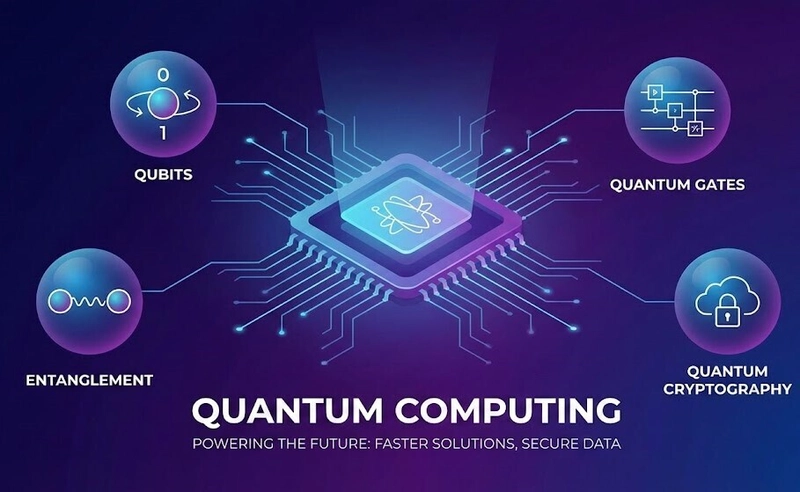
Quantum computing has moved from theoretical research to practical experimentation at a remarkable pace. Governments, universities, and technology companies are investing billions of dollars into developing machines that can solve problems beyond the reach of traditional computers. While quantum computers are not yet ready to replace everyday devices, they have the potential to transform industries ranging from cybersecurity and healthcare to finance and scientific research.
What Makes Quantum Computing Different?
Traditional computers process information using bits that exist as either 0 or 1. Quantum computers use quantum bits, or qubits, which can exist in multiple states simultaneously through a property known as superposition. This allows quantum systems to evaluate many possibilities at once rather than checking them sequentially.
Beyond drug discovery and finance, quantum sensing is also advancing quickly – quantum inertial navigation for GPS-free positioning is one example, using quantum sensors to track movement precisely where satellite signals are weak or unavailable, such as underground, underwater, or in contested airspace.
Another important property is entanglement. When qubits become entangled, the state of one qubit is directly related to the state of another, even when they are separated. These characteristics enable quantum computers to tackle certain types of calculations much more efficiently than classical machines.
Why Researchers Are Excited
The excitement surrounding quantum computing comes from its potential to solve problems that are currently impractical for conventional computers. Researchers believe quantum systems could accelerate breakthroughs in several areas:
1. Drug discovery and healthcare
Quantum simulations may help scientists understand complex molecular interactions, leading to faster development of new medicines and treatments.
2. Materials science
Researchers could design stronger, lighter, or more efficient materials by accurately modeling atomic behavior.
3. Financial modeling
Quantum algorithms may improve risk analysis, portfolio optimization, and fraud detection.
4. Logistics and optimization
Complex scheduling and routing problems could potentially be solved much faster, benefiting transportation and supply-chain management.
Recent Progress in the Field
In recent years, researchers have achieved significant improvements in qubit stability, error correction, and processor scale. These developments have moved quantum computing closer to practical applications, although major technical challenges remain.
For readers interested in understanding recent advances in quantum computing research, there is growing coverage of how scientists are improving qubit performance and expanding the capabilities of experimental quantum systems.
The Challenge of Error Correction
One of the biggest obstacles facing quantum computing is error correction. Qubits are extremely sensitive to their environment. Small disturbances such as heat, vibration, or electromagnetic interference can cause calculations to fail.
To address this, researchers are developing sophisticated error-correction techniques that use multiple physical qubits to create more reliable logical qubits. Achieving large-scale, fault-tolerant quantum computing will likely depend on continued progress in this area.
Implications for Cybersecurity
Quantum computing could have a major impact on cybersecurity. Some encryption methods used today rely on mathematical problems that are difficult for classical computers to solve. A sufficiently powerful quantum computer could potentially break certain cryptographic systems much faster.
This possibility has motivated researchers and governments to develop post-quantum cryptography—new encryption techniques designed to remain secure even in a quantum future. Organizations that handle sensitive data are increasingly monitoring developments in this area.
How Businesses Are Preparing
Although widespread commercial quantum computing may still be years away, many companies are beginning to prepare. They are exploring potential use cases, training specialists, and evaluating how quantum technologies could affect their industries.
Businesses that depend heavily on optimization, data analysis, or secure communications may eventually gain significant advantages from early adoption. However, most organizations are currently focused on experimentation and long-term planning rather than immediate deployment.
The Role of Education and Public Awareness
As quantum technology develops, public understanding becomes increasingly important. Many people have heard the term “quantum computing” but are unsure what it actually means. Educational resources can help bridge this gap by explaining complex concepts in accessible language.
Readers looking for broader technology and cybersecurity insights can explore discussions covering emerging digital trends, security challenges, and advances in computing research at The Ethical Hacker.
Looking Ahead
Experts generally agree that quantum computing will not replace classical computers. Instead, it will likely become a specialized tool for solving particular classes of problems that are exceptionally difficult for traditional systems.
The timeline for large-scale adoption remains uncertain. Technical hurdles, high costs, and infrastructure requirements still limit practical deployment. Yet progress continues steadily, and each breakthrough brings the technology closer to real-world applications.
Conclusion
Quantum computing represents one of the most ambitious technological efforts of the modern era. By harnessing the unique properties of quantum mechanics, researchers hope to solve problems that have long remained beyond the reach of conventional computers.
While significant challenges remain, advances in qubit design, error correction, and processor development suggest that the field is moving steadily forward. Whether the impact is felt first in healthcare, cybersecurity, finance, or scientific research, quantum computing has the potential to become a transformative technology for decades to come.
