

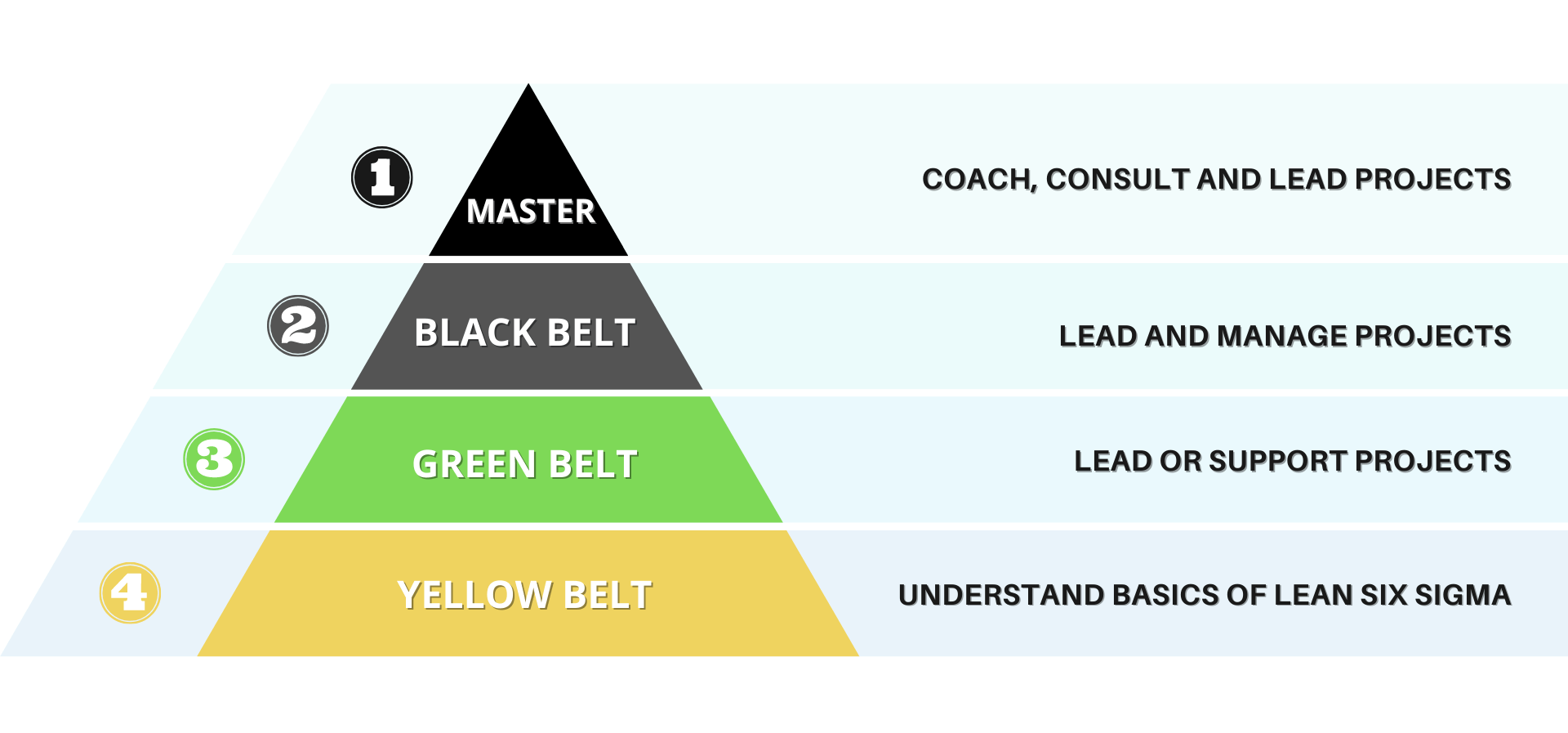
For many years, Six Sigma has influenced how businesses worldwide have improved processes and reduced defects and variation. Though it began in manufacturing, it has now spread to almost all industries, including healthcare, finance, logistics, and software, where process quality is core.
In 2026, one of the most notable quality management frameworks remains Six Sigma, and the first real question is understanding the meaning and value of each belt level. This question is often asked by professionals considering certification.
The purpose of this article is to simplify each level of six sigma certification and what it qualifies you to do, as well as to offer a framework for what level makes sense to pursue relative to where you are in your job journey.
What Six Sigma Certifies
Now to the belt levels and what they mean. It would be important to take a moment to consider something most people do not. Being certified in Six Sigma is not like having a degree. It is not a credential that assigns a body of knowledge, as a degree would. It is an attestation to one’s ability to exercise a command of the DMAIC methodology – Define, Measure, Analyse, Improve, Control – in the real world with real organisational challenges.
DMAIC serves as a foundational framework for systematically addressing issues. Each component represents a key stage in this framework:
- Define describes the problem and sets the project’s boundaries.
- Measure uses data to describe the current process’s performance level.
- Analysis focuses on finding countermeasures to the causes of defects or variation.
- Improve implements solution strategies and evaluates their effectiveness.
- Control establishes the processes and systems that will maintain the gains achieved over the long term.
The belt levels indicate increasing breadth of knowledge, greater skills, and greater leadership commitment and responsibility within the framework.
White Belt: No Expertise
The White Belt designation represents the first step toward being acquainted with the Six Sigma terminology. It does not indicate the ability to spearhead or contribute substantially to improvement initiatives. Rather, it signifies that an individual knows what Six Sigma entails, the purposes organisations use it for, and the general structure of improvement initiatives.
The duration of White Belt training is often minimal, involves completing a test, and does not require prior project-related experience. This level of training is suited to support or front-line staff who operate within a Six Sigma organisation and need to familiarise themselves with the methodology’s fundamentals.
Few people in process improvement see White Belts as meaningful career advancement. They are not hiring requirements, nor do they showcase employees’ analytical skills.
Yellow Belt: Basic Engagement
All Yellow Belts have basic knowledge of the DMAIC process, how it works, and what it comprises, as well as the ability to take on improvement roles at the request of a Green or Black Belt and assist in that role.
A Yellow Belt training usually lasts anywhere from 1 to 3 days. Participants are introduced to:
- Basic statistics
- Process and data collection
- Root cause analysis
- Tools and techniques like fishbone or 5 Whys
There are usually low (if any) requirements for project involvement to maintain certification.
The Yellow Belt is aimed at those in admin, operations, customer service, or quality assurance roles. It is a good option for those who would like to engage in improvement projects without leading or managing those projects. It is also a good option for those looking to gauge their interest in improvement processes without jumping straight into the demanding Green Belt training.
Green Belt: Level of Practitioner
With a Green Belt, Six Sigma becomes a true point of differentiation in a career. This certification allows a professional to:
- Spearhead improvement projects independently
- Utilise statistical tools with real process data
- Deliver measurable and definable results within their functional area
Usually, training spans three to five instructional days. In the case of an online program, the training may be broken into modules and extended over a longer period.
The scope of learning is significantly broader than the Yellow Belt and includes:
- Hypothesis testing
- Regression analysis
- Control charts
- Process capability analysis
Such projects are a prerequisite for virtually all well-known industry certifications. The candidate is expected to apply DMAIC to a real workplace problem and demonstrate measurable results.
Among quality management, operations, supply chain, manufacturing, and healthcare administration, the Green Belt is the most common intermediate certification and is therefore in greatest demand.
When it comes to deciding which belt to pursue first for career investments, the Green Belt is most often the answer. It is respected, achievable within a reasonable timeframe, and directly relevant across industries.
Black Belt: Leading and Driving Change
Achieving a Black Belt means having complete mastery of Six Sigma. Black Belts:
- Lead large, cross-functional improvement initiatives
- Coach Green Belts
- Use advanced statistical tools
- Act as internal change agents
Black Belt training is far more intensive — usually requiring 4 to 5 weeks of training, along with a heavy project load.
Advanced topics include:
- Design of experiments
- Advanced regression
- Measurement system analysis
- Multivariate analysis
Candidates are expected to demonstrate leadership in multiple projects with significant financial impact (often at least $100,000 in savings per initiative).
Black Belt certification is suitable for professionals progressing from Green Belt into roles with greater organisational accountability.
Black Belt certified professionals are also, on average, more highly compensated. In national studies, the average salary for Black Belts in the U.S. is in the $100,000–$130,000 range, depending on industry and organisation size.
Master Black Belt: Strategy and Organisational Leadership
Being a Master Black Belt is the highest level of certification in Six Sigma and signifies a shift from hands-on execution to strategic leadership.
Master Black Belts:
- Develop organisation-wide Six Sigma strategies
- Train and mentor Black Belts
- Serve as subject matter experts in methodology and statistics
This is not just a certification but a career milestone. Candidates typically require:
- Several years of Black Belt experience
- Proven high-impact project outcomes
- Demonstrated organisational contribution
This level is suited only for senior leadership roles in quality and operational excellence.
Picking the Best Starting Point
The choice of belt depends on three key factors:
- Your current position
- Your career aspirations
- Your experience with data and statistics
- The Yellow Belt is ideal for beginners or those in non-analytical roles.
- The Green Belt is best for professionals in quality, operations, or analytical roles who are aiming for leadership.
Going directly from no belt to Black Belt is generally not recommended due to the steep learning curve and advanced requirements.
The certifying body also matters. Reputable organisations include:
- American Society for Quality
- International Association for Six Sigma Certification
- Council for Six Sigma Certification
Employers may value certain certifications more depending on geography and industry.
ROI on Six Sigma Certification
Almost every industry that uses Six Sigma sees measurable ROI, and so does certification.
Certified professionals tend to:
- Earn higher salaries
- Get promoted faster
- Have greater influence within organisations
Key skills gained include:
- Structured problem-solving
- Process thinking
- Data-driven decision-making
Six Sigma certification is particularly valuable in industries like manufacturing, healthcare, logistics, and financial services, where quality management is deeply embedded.
For professionals in such environments, the belt system provides a structured, globally recognised path for career growth focused on improving organisational efficiency.
