

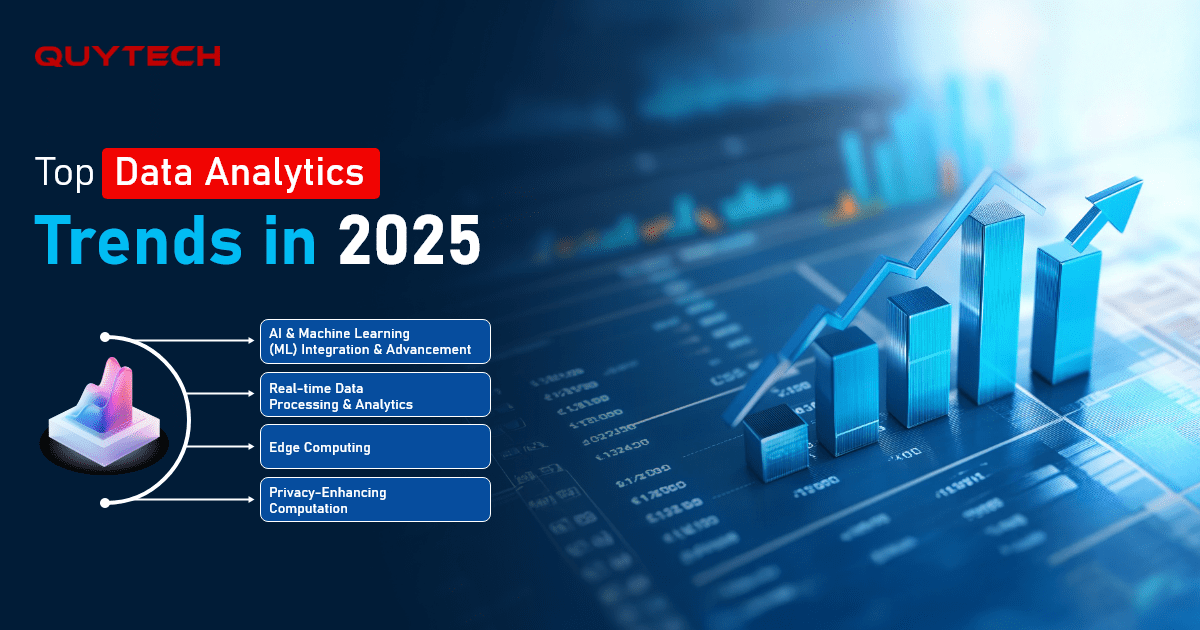
As we approach 2026, the Australian data analytics landscape is undergoing significant transformation. The convergence of cloud adoption, evolving regulatory frameworks, and accelerated industry digitalisation is reshaping how organisations leverage data. Forward-thinking businesses are already seeking Tridant consulting services to navigate this evolving terrain and position themselves advantageously for the future.
Key Takeaways
- Generative AI will revolutionise analytics workflows through automated reporting and natural language data interaction
- Real-time analytics and edge computing will become essential as Australian businesses demand faster insights
- Data mesh architectures and MLOps maturity will transform how organisations structure their analytics capabilities
- Privacy-preserving techniques will gain prominence as Australian regulations tighten
- Industry-specific analytics solutions will drive competitive advantage across finance, healthcare, mining and retail
Australian data analytics landscape for 2026
Market and regulatory context
The Australian analytics environment in 2026 will be heavily influenced by regulatory developments. Updates to the Privacy Act, expansion of the Consumer Data Right (CDR), and various state-led initiatives will create new compliance requirements and data-sharing opportunities. The public sector will continue to prioritise data initiatives with targeted funding across healthcare, social services, and infrastructure.
Industry demand and investment patterns
By 2026, several sectors will lead analytics investment in Australia. Financial services will focus on risk analytics and personalisation, healthcare on patient outcomes and operational efficiency, mining on predictive maintenance, retail on demand forecasting, and government on service delivery optimisation. These investments will drive growing demand for analytics talent, exacerbating the skills shortage already present in the Australian market.
Major data analytics trends to watch in 2026
Generative AI applied to analytics workflows
By 2026, generative AI will be embedded throughout analytics workflows. Analysts will use natural language interfaces to query complex datasets without writing code. Automated reporting will generate insights narratives and visualisations based on data patterns, while synthetic data generation will provide privacy-safe training datasets. These capabilities will dramatically increase analyst productivity and accelerate model development cycles.
Real-time streaming and operational analytics
Real-time analytics will move from cutting-edge to mainstream by 2026. Event-driven architectures will enable instant decision-making for critical business functions. In Australia, we’ll see this applied to payment fraud detection, logistics optimisation for mining and agriculture, and smart city applications in metropolitan areas. The ability to process data streams at scale with minimal latency will become a competitive differentiator.
“Australian organisations are increasingly seeking to move from historical reporting to predictive and prescriptive analytics that can be acted upon immediately. The future belongs to those who can turn data into action in real time.” – Tridant
Edge analytics and IoT data processing
Australia’s unique geography and resource-intensive industries make edge analytics particularly valuable. By 2026, mining operations, agricultural enterprises, and utilities will process critical data at remote locations rather than sending everything to centralised data centres. This approach reduces bandwidth requirements, minimises latency, and enables faster decision-making for remote assets. Hybrid architectures that intelligently distribute processing between edge devices and cloud platforms will become standard practice.
Data mesh and data fabric architectures
The organisational approach to data will fundamentally shift by 2026. Data mesh architectures will promote decentralised ownership where domain teams create and maintain data products for broader consumption. This approach aligns data responsibility with business domains while maintaining enterprise-wide governance. Australian organisations will adopt these models to scale their data operations while maintaining quality and compliance.
Responsible AI, privacy-preserving techniques and compliance
Australian privacy regulations will drive adoption of privacy-preserving analytics techniques by 2026. Methods like differential privacy, federated learning, and homomorphic encryption will allow organisations to derive insights without exposing sensitive data. Model explainability tools will become standard as regulators and consumers demand transparency in algorithmic decision-making. Organisations that master these techniques will build trust while maintaining analytical capabilities.
Sector-specific implications for Australian businesses
Finance and fintech
Australian financial institutions will leverage analytics for real-time risk scoring, transaction monitoring, and regulatory reporting by 2026. Open banking initiatives will drive innovation in customer insights and service delivery. Fintech companies will use analytics to identify underserved market segments and personalise financial products at scale.
Healthcare and life sciences
The healthcare sector will use analytics for clinical decision support, operational efficiency, and research acceleration. Privacy-safe data sharing frameworks will enable collaboration while protecting patient confidentiality. Predictive analytics will help identify at-risk patients and optimise care pathways.
Mining, agriculture and resources
Australia’s resource sectors will implement advanced predictive maintenance, asset optimisation, and environmental monitoring analytics. Remote sensing combined with AI will improve yield forecasting and resource management. These applications will reduce costs and environmental impact while improving safety.
Retail and consumer insights
Retailers will deploy hyper-personalisation, inventory optimisation, and omnichannel analytics. Real-time customer journey tracking will enable dynamic interventions to improve conversion rates. Advanced demand forecasting will reduce waste and improve stock availability.
How Australian organisations should prepare
Australian businesses should focus on these preparation strategies:
- Build domain-aligned data product teams that combine technical expertise with industry knowledge
- Develop cloud-native analytics architectures that support scaling and flexibility
- Implement data catalogues, lineage tracking, and model registries to enable governance
- Run focused pilots to validate value before scaling analytics initiatives
- Create skills development pathways for existing staff while recruiting specialists
Measuring analytics impact and ROI
Successful analytics programs in 2026 will track both technical and business metrics. Technical measurements will include model accuracy, drift detection, and computational efficiency. Business KPIs will focus on revenue impact, cost reduction, and customer experience improvements. User adoption metrics will track how widely analytics outputs are utilised across the organisation.
Tools and platforms to watch
By 2026, major cloud providers will offer mature, integrated analytics suites with Australian region support. Open-source projects will continue to innovate in specialised areas like graph analytics, feature stores, and observability. Local service providers will play a crucial role in customising these tools for Australian regulatory and business contexts.
Conclusion
The data analytics landscape of 2026 offers tremendous opportunities for Australian organisations that prepare strategically. By focusing on generative AI integration, real-time capabilities, edge analytics, and domain-aligned data architectures, businesses can gain competitive advantage through data. Success will require both technical excellence and organisational alignment. Tridant recommends that organisations assess their current analytics maturity, identify high-value use cases, and develop both the technology infrastructure and talent pipeline needed for 2026 and beyond.
