

If you run real workloads on Azure, you’ve probably learned that the built-in protections only go so far. Blob soft delete saves you from an accidental overwrite. Recovering one file from a VM restore point still means bringing back the whole machine.
Picking the best enterprise backup solution for Azure Blob Storage and Azure VMs comes down to three things: how precisely you can recover, what it costs at scale, and whether you can prove everything is covered.
I’ve run most of the options below in production, including newer cloud-native platforms like Eon. Here’s how they stack up, starting with the one I’d reach for first.
Eon
Eon is a cloud-native backup platform that protects Azure Blob, VMs, and managed databases like Azure SQL Database, PostgreSQL, and MySQL across all your subscriptions. It’s the newest serious entrant in the space.
What sets it apart is granular recovery. You can restore a single blob, file, or database record without rebuilding an entire VM or container, which turns most recoveries from a project into a quick task.
Underneath is Cloud Backup Posture Management (CBPM). It connects read-only with no agents or infrastructure in your subscriptions, discovers and classifies your resources on its own, and assigns backup policies by data type so coverage doesn’t drift as the environment grows.
On cost, dedup, compression, and incremental backups typically cut storage spend by 30 to 50% versus keeping raw snapshots and blob versions.
The piece worth calling out for Azure teams specifically is the data lake side. The platform converts protected data into Apache Iceberg, stored in your own Azure Blob, with native Microsoft Fabric and OneLake integration.
You query that data directly from Power BI, Spark, or SQL without running a restore first. The protected estate becomes an active data asset for analytics and audit work, available the moment the data lands.
The limitation worth knowing: it’s cloud-only by design. If a meaningful part of your estate still runs on-prem, you’ll keep a separate tool for that.
Azure Backup
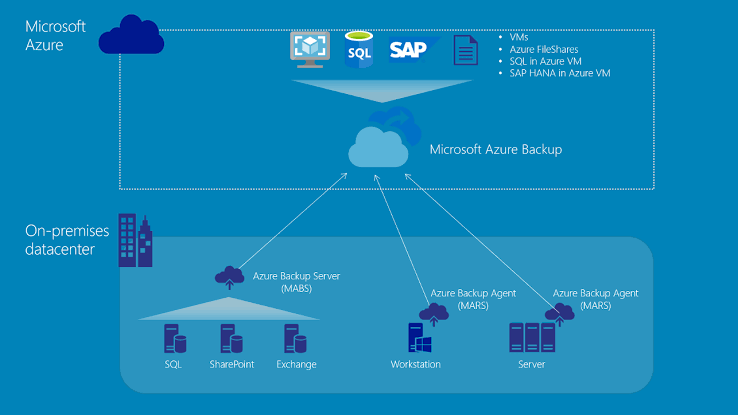
Azure Backup is the native baseline, and for a contained environment it’s a reasonable starting point. It centralizes VM restore points, offers operational blob backup with point-in-time restore inside a retention window, and reports through Backup center.
The ceiling I keep hitting shows up at scale. Recovery leans toward whole restore points, cross-subscription coverage is yours to track, and there’s no search across services for the single item you need back.
Veeam
Veeam Backup for Microsoft Azure is a strong pick if Veeam already runs your estate elsewhere. It handles Azure VMs and blob storage and folds Azure into the same console your team uses for everything else.
The tradeoff is its hybrid heritage. For an Azure-first shop, you carry licensing and operational weight built around a mixed-infrastructure worldview you may not need.
Commvault
When I see Commvault on a shortlist, it’s usually for governance reach. The platform brings deep retention, audit, and reporting across a wide range of workloads, Azure included.
It’s also heavy to run. A team focused on Azure Blob and VMs often finds it’s more platform than the job requires.
Rubrik
Rubrik leans into data security and ransomware resilience, with mature reporting on what’s protected. The teams I’ve seen invest in it usually came in for security posture first, and the Azure coverage fits that story.
The main constraint is cost. High TCO consistently ranks as the top customer complaint in reviews.
Its center of gravity stays in the hybrid and on-prem world it grew up in. On an Azure-first estate the cloud support reads as a capable extension of that heritage.
Cohesity
Cohesity sits nearby: consolidation, security, and protection across a broad footprint, with a security-forward angle. It’s a credible choice when your data spans data centers and several clouds.
The deepest capabilities land on the workloads it was designed around first. A pure Azure team may find the cloud-native discovery less granular than a tool born in the cloud.
The Short Version
For a small Azure footprint, native Azure Backup covers the basics, and adding a platform is premature.
Once you’re across many subscriptions and regions, the priorities shift to precise recovery, predictable cost, and provable coverage. That’s where a dedicated cloud-native platform earns its place.
My read: for Azure-first teams, the tools that recover precisely and keep cost flat as data grows are the ones that will matter most over the next few years.
