

 How to Evaluate an Injection Molding Manufacturer Before Tooling Begins
 How to Evaluate an Injection Molding Manufacturer Before Tooling Begins
At the quotation stage, several suppliers can look almost identical. Equipment lists, tooling schedules, and estimated part prices may all be close. The real differences often appear after tooling begins, when missed risks lead to mold changes, repeated trials, dimensional drift, or unstable production.
Evaluating an injection molding manufacturer therefore requires more than comparing machines, certificates, and quotations. Before anyone cuts steel, you need evidence that the supplier understands the part, has chosen an appropriate tooling strategy, and can define how the mold and molded components will be approved.
Define Your Project Requirements Before Comparing Manufacturers
A supplier is suitable for a specific project, not simply because it is a large factory. A cosmetic electronics enclosure, a glass-filled nylon bracket, and a multi-cavity assembly component place very different demands on tooling, material handling, inspection, and process control.
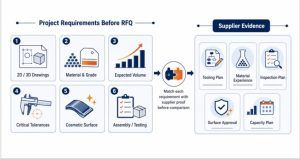
Before sending an RFQ to injection molding manufacturers, confirm the current drawings, resin grade, annual demand, project life, critical tolerances, cosmetic surfaces, assembly tests, and required quality records. Otherwise, each supplier will price the missing details differently.
| Project requirement | Why it matters | Evidence to request |
| Expected volume | Influences cavity count, mold steel, and automation | Tooling strategy and capacity plan |
| Material and grade | Affects shrinkage, drying, temperature, and wear | Similar material experience and process controls |
| Critical tolerances | Determines tooling and inspection requirements | Sample inspection plan and equipment list |
| Cosmetic surfaces | Affects gate position, parting line, and polishing | Surface standard and approved-sample process |
| Assembly requirements | Requires repeatable dimensions and fit | Assembly or functional validation plan |
Clear requirements make quotations comparable and reveal whether a low price reflects efficiency or simply a narrower scope.
How Well Does the Manufacturer Review Your Design?
The most valuable engineering work happens before mold manufacturing. A supplier that quotes immediately from a CAD file, quantity, and material name may not understand where the project can fail.
Look at the Questions the Supplier Asks
Engineering ability often shows in the questions you receive. A capable team asks which dimensions control assembly, which surfaces cannot show marks, whether resin substitutions are allowed, what loads the part faces, and how long the mold must run.
It should also ask about machining, printing, inserts, or assembly after molding. These details affect datum selection, shrinkage allowances, gate strategy, fixtures, and inspection.
Request a Practical DFM Review
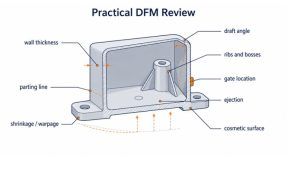
A useful DFM review should cover wall transitions, draft, ribs, bosses, undercuts, parting lines, gates, ejection, shrinkage, warpage, visible marks, and critical tolerances. It should explain each risk and separate required changes from optional improvements.
A practical HingTung injection molding DFM checklist shows why gate position, ejector layout, material behavior, and surface requirements belong in the pre-tooling review. Early DFM cannot guarantee a perfect T1, but it prevents many basic conflicts from being discovered after the tool exists.
Confirm That Tooling Matches the Production Plan
A mold is the foundation of future production. It controls geometry, cooling, ejection, consistency, and maintenance. A lower price may reflect different steel, fewer cavities, simplified cooling, or fewer replaceable inserts.
Confirm who designs and builds the mold, where it is machined, the steel and heat treatment, cavity count, runner system, cooling, venting, expected life, spare parts, maintenance, ownership, modification terms, and transfer documents.
In-house toolmaking is not mandatory. Outsourcing can work when you know who approves the design, manages trials, authorizes changes, and owns any tooling-related quality problem.
Check Production Capacity and Material Experience
Maximum clamp tonnage alone does not show whether a press fits your project. The supplier must also consider mold dimensions, tie-bar spacing, shot capacity, plasticizing ability, projected area, temperature control, automation, and scheduling.
Material experience matters just as much. ABS, PC, POM, PA, TPU, and glass-filled grades differ in drying, shrinkage, flow, cooling, and wear. Ask how the exact grade will be dried, controlled, processed, and changed over. “We mold every plastic” is not a process plan.
Finally, discuss how the injection molding manufacturing plan scales. If demand rises, will the supplier add shifts, qualify another press, improve the cycle, increase cavity count, or build a production mold? The answer should match your forecast.
Review Quality Planning and Mold Validation
A certificate confirms that a management system exists, but it does not define an acceptable part. Approval still needs the correct drawing revision, resin grade, critical dimensions, cosmetic limits, test methods, packaging rules, and approved samples. Set measurable criteria before tooling starts.
A Good T1 Sample Is Not Enough
T1 is mainly a discovery stage. It reveals filling, release, geometry, cosmetic, and dimensional problems. T2 verifies corrections, while the final trial confirms the approved mold condition and records.
One acceptable sample does not prove production readiness. Review cavity variation, sustained-run results, process settings, assembly fit, and dimensions after conditioning. A mold may produce one good sample yet have a process window too narrow for reliable production.
Match Validation Documents to Project Risk
Validation should fit the product risk. A normal industrial part may need FAI, dimensional results, material certification, and trial records. Multi-cavity or critical assembly parts may require cavity comparisons and more process data.
Customer-controlled programs may call for PPAP, control plans, MSA, or capability data. Regulated work may follow IQ, OQ, and PQ requirements. Use them when the project requires them. FAI confirms inspected samples under specific conditions, not long-term process stability.
Evaluate Communication and Project Control
Good project control is visible in records, not response speed. Look for one project owner, drawing revision control, a DFM issue list, mold-design approval, change records, trial reports, and an action tracker.
Ask an engineer to join the technical review. The engineer should explain risks, compare options, and show how each choice affects tooling, appearance, cost, and timing.
Compare Total Cost, Responsibilities, and Long-Term Support
The lowest quotation may not produce the lowest total cost. Modifications, scrap, slow cycles, maintenance, downtime, sorting, freight, and supplier replacement can exceed the original price difference.
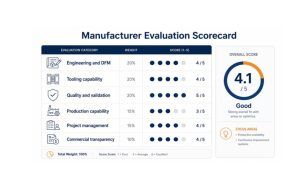
A weighted scorecard makes the decision less dependent on factory photos or personal impressions. Adjust the weights, but do not let price dominate by default.
| Evaluation area | Suggested weight | What to score |
| Engineering and DFM | 25% | Risk identification, material knowledge, and practical recommendations |
| Tooling capability | 20% | Design control, mold construction, maintenance, and ownership |
| Quality and validation | 20% | Inspection, traceability, trial records, and approval planning |
| Production capability | 15% | Machine fit, material handling, capacity, and scalability |
| Project management | 10% | Version control, response quality, and change management |
| Commercial transparency | 10% | Tooling scope, exclusions, lead time, and total cost |
This scorecard is not an absolute answer. It gives procurement, engineering, and quality teams a shared way to compare injection molding contract manufacturing proposals without letting one attractive price hide technical risk.
Questions to Ask Before Paying the Tooling Deposit
- What manufacturability risks have you identified? The answer shows whether the supplier has reviewed the part rather than only priced it.
- Who will design, build, test, and maintain the mold? This clarifies ownership across internal and outsourced work.
- What assumptions are included in the quotation? Hidden assumptions about steel, cavities, resin, inspection, or trials often explain major price differences.
- How will T1, T2, and final approval be documented? Defined outputs prevent sample approval from becoming an informal photo exchange.
- What happens if the part fails dimensional or functional approval? Agreeing on correction responsibility reduces disputes after tooling begins.
- What files and records will be provided if the mold is transferred? This protects continuity if production must move later.
FAQs
Is ISO 9001 enough to prove an injection molding manufacturer is reliable?
No. ISO 9001 shows a quality-management framework, but it does not prove your project will receive effective DFM, suitable process controls, material traceability, capable inspection, or corrective action. Review actual records and practices.
Can I evaluate an injection molding manufacturer without visiting the factory?
Yes, for initial screening. Request a live video audit, equipment list, sample DFM, anonymized inspection report, trial documents, and an engineering meeting. High-value or critical projects may still justify an on-site or independent audit.
Should the mold and molded parts come from the same manufacturer?
Not necessarily. An integrated supplier can shorten feedback between mold design, trials, corrections, and production. When tooling and molding are separate, define design control and responsibility for tooling-related production problems.
Why are injection molding quotations for the same part so different?
Suppliers may assume different steel, cavities, mold life, cooling, trial rounds, inspection scope, cycle targets, or material rules. Compare the technical proposal, exclusions, and approval responsibilities, not only the total.
Choose Evidence Before Approving Tooling
Selecting a plastic injection molding manufacturer is not about the most machines or lowest quote. It is about confirming that the supplier can identify design, material, tooling, validation, and responsibility risks while changes are still manageable.
As an integrated HingTung plastic injection molding manufacturer, the team supports DFM, mold design and manufacturing, molding, CNC machining, secondary processing, assembly, and inspection. You can send your current 2D and 3D files, material requirements, tolerances, quantities, surface requirements, and assembly details for an initial review before tooling begins.
