

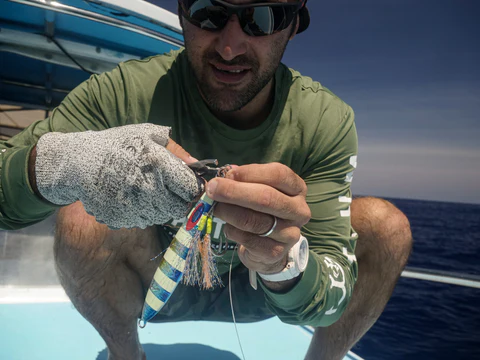
There are more variables to consider in saltwater fishing. Stronger fish, abrasive environments, and heavier tackle make the job more difficult. Thus, a good saltwater fishing knot lends holding power, flexibility, and slip resistance under stress. Given that saltwater rods are mostly tied with braided or fluorocarbon lines, a knowledge of knots suited for these materials is apt.
1. Improved Clinch Knot – Perfect for Hook Attachment
Best for: Monofilament and fluorocarbon lines
Use case: Tying hooks, swivels, and lures
The Improved Clinch Knot is surely worthy of being an angler’s friend. It is swift to tie and adequate in strength needed for most saltwater species. After a few twists and a final tuck, the knot stays well, especially with the line moistened before tightening.
Pro tip: Keep these knots for saltwater fishing rods when targeting smaller to medium-sized gamefish such as snapper or sea bass.
2. Palomar Knot – Easy and Strong
Best for: Braided lines
Use case: High-strength hook/lure attachments
The Palomar Knot is famous for its very simple tying method and extraordinary strength. Knots that retain up to 100% of original line strength are a big plus indeed when working with lighter braid lines and heavier gear setups.
When to use: When surfcasting or jigging from a boat with medium-to-heavy saltwater fishing rods.
3. Uni Knot-The versatile performer
Best for: Every line
Use case: Hooks, lures, or line-to-line or line-to-leader
The Uni Knot can be used in almost every situation and with almost any gear type. If you are connecting a lure or just a swivel, the Uni is a knot that can be relied upon and is easy to tie.
What makes it different: For those anglers who change terminal tackle constantly, being able to use the same knot without cutting the line is a big plus.
4. Surgeon’s knot- For fast leader connections.
Best for: Lines of similar diameter
Use case: Connecting a mainline to a leader
Often used in finishing a shock leader to the main line, the Surgeon’s Knot has strength, is quick to tie, and requires minimal dexterity, which is a plus when conditions at sea are rough.
Saltwater tip: Always test the knot’s strength with a quick pull before casting with heavier saltwater fishing rods, especially when going for larger species.
5. FG Knot – Braided to Fluoro is All That Matters
Best for: Braided to fluorocarbon leader connections
Use case: Advanced knot for minimum bulk and maximum strength
The FG Knot is the gold standard that teams a braided mainline with a fluorocarbon leader-two materials that naturally do not cling to one another. When you get good at it, its thinness will allow for smooth running through the guides, highly prized when compact travel rods or telescopic saltwater fishing rods are being used.
Best for: Offshore or reef fishing where stealth and strength are non-negotiable.
6. Snell Knot – For Performances Maximum Hook
Best for: Live bait presentations
Use case: Tying hooks straight on the leaders
Snell Knot aligns the hook in direct line with the line, thus ensuring higher hook-up ratios, especially with circle hooks in catch-and-release situations.
Best for: Bottom fishing or trolling situations, where heavy saltwater fishing rods require utmost care in bait presentation.
Quick Tips for Saltwater Knot Success
- Always keep in mind that as you are tightening, you should moisten the line first to avoid friction from building heat and damaging the line.
- Trim the tag ends neat and clean to avoid any possible snags or weak points.
- Try the knots at home to develop muscle memory, especially for FG, or Snell-type knots.
- Keep checking the knots, especially after a catch or if out on rough surf casting or saltwater fishing.
Final Thoughts
Fishing Saltwater Source
Icing on the cake is knowing different saltwater fishing knots that align with saltwater fishing rods. From the simple Palomar to the sophisticated FG, every knot has its purpose to make or break your next big catch. Saltwater fishermen should know when and how each knot must be applied to secure better hook-ups and muster confidence for anything the sea can cast at them.
So next time when you are packing for fishing, don’t simply think about all the gear. Spend at least a few minutes brushing up on your knot-tying abilities. That knot is probably one of the strongest links to your fishing expedition.
