

There is a question doctors ask about knees that sounds like small talk and is not. When did it start? People rehearse an answer on the way to the appointment and then discover, once they sit down, that they do not really have one. There was a bad Tuesday in April. There was also a bad Tuesday in March. Somewhere in there the knee changed, and nobody wrote it down.
That vagueness matters more than it looks. Sensible torn meniscus treatment depends a great deal on whether there was one single moment or no moment at all, because those two stories usually describe two physically different tears, sitting in two different kinds of knee. The same words end up on the report. It is not the same problem.
Tears that had a moment
Some tears arrive with a timestamp. A foot planted, a body turning the other way, a sharp pain through the joint, and by evening a knee roughly the shape of a grapefruit. People who tear a meniscus like this can usually tell you the hour it happened.
These tend to be clean splits through otherwise healthy cartilage. Often they sit towards the outer rim, where the meniscus has a blood supply of its own, and that combination is what makes stitching the edges back together worth attempting. The cartilage around the tear still has plenty of life in it, so keeping the cushion protects something real.
Tears with no moment
Then there is the other kind, and it catches people out, because nothing about it feels like an injury. No incident, no snap, no grapefruit. Just a knee that has quietly become less agreeable over a year or two. Sore on stairs. Stiff first thing. Occasionally sharp when you twist to reverse the car.
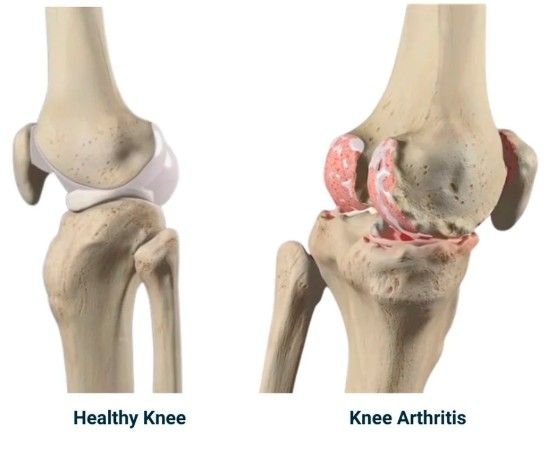
Cartilage frays with use, the way the hem of a well-worn coat does. A tear like this is usually a sign of a joint that is wearing, rather than an event that happened to a healthy joint. It often sits in the inner part of the meniscus, where there is almost no blood supply, and the tissue around it is already thinning.
That changes what any treatment can reasonably promise.
What age is really saying
You will read everywhere that repair suits younger patients. It is true, but it is shorthand, and the shorthand hides the part you can actually use.
Age is standing in for two physical facts. The first is blood supply, meaning whether the tear sits somewhere healing is even possible. The second is the state of the neighbourhood, meaning how much healthy cartilage surrounds the tear and how much wear the joint is already carrying.
So the question worth asking is not whether you are too old for a repair. It is where exactly your tear sits, and what the rest of the joint looks like around it. Two people of the same age can get different answers to that, and they should.
A rough sorting rule
A tear is more likely to be the event kind, and therefore more likely to be worth repairing, if:
- There was one moment you can actually name.
- The knee swelled within a day of that moment.
- The joint had no real history of trouble before then.
- The pain arrived suddenly rather than creeping in over months.
- It now catches or locks in one repeatable spot.
The more of those you can tick, the more worthwhile it is to ask about repair rather than assuming the tear will simply be trimmed away.
Two opposite mistakes
The two kinds of tear produce two mirror-image mistakes, and both are easy to make.
The person with the event tear often treats it as a sprain. They rest, the swelling settles, and by the time they seek help the torn edge has frayed and the window for stitching it has narrowed. They waited precisely because it had stopped hurting.
The person with the gradual tear tends to do the reverse. They hope an operation on the tear will hand back the knee they had a decade ago. If the joint has wear spread across it, tidying one frayed flap may settle a single symptom and leave the rest exactly as it was. They expected the tear to be the whole story, and it turned out to be one chapter.
So before your appointment, sit with that dull little question for a minute. Was there a moment? If there was, find it, and try to remember what the knee did in the hours afterwards. If there was not, say so plainly, because that absence is information too. The vaguest part of your story is often the part that shapes the plan, and you are the only person in the room who can supply it.
