

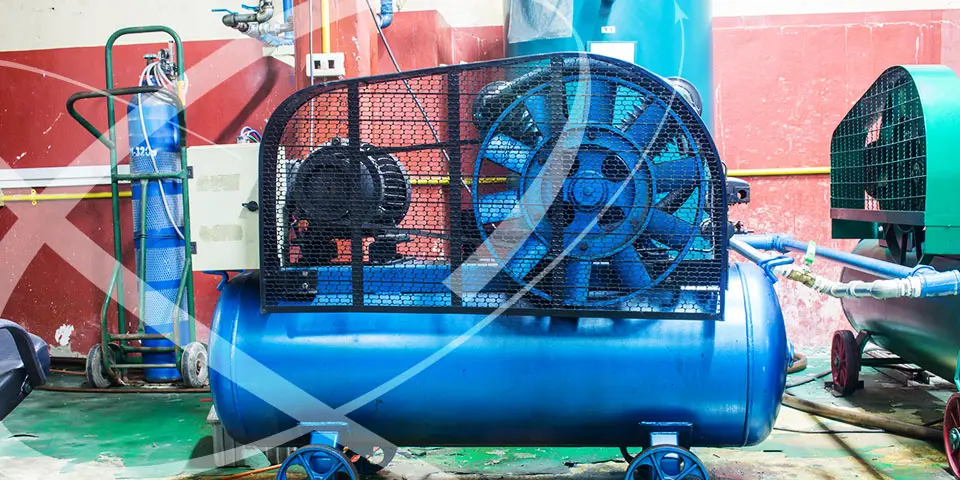
Walk the floor of almost any production facility and you will find compressed air doing jobs it was never designed to do. Blowing off water, drying parts, clearing debris from a conveyor line. It works. It has always worked. But at some point in the last decade, the math stopped making sense.
Energy costs have risen sharply. Sustainability targets have moved from aspirational to contractual for many manufacturers. And operations leaders are under real pressure to find efficiency gains that do not compromise throughput. Compressed air systems are increasingly where that conversation starts.
The Compressed Air Problem Nobody Talks About
Compressed air is expensive to generate. Depending on the facility and equipment age, industry estimates place the efficiency of a typical compressed air system at somewhere between 10 and 30 percent. The rest is waste, mostly heat. Yet compressed air blowoff remains standard practice across industries ranging from automotive to food and beverage processing to metal finishing, often because it is what the facility has always used.
The problem is compounded in high-volume operations where blowoff runs continuously. A single compressed air blowoff point running full-time can consume more energy than most operations leaders realize until they are looking at a utility audit. Multiply that across a production line with multiple blowoff points and the numbers become difficult to ignore.
A Different Approach to Industrial Drying and Blowoff
The alternative that has gained serious traction in recent years is the air knife system. Rather than relying on stored compressed air, an air knife uses a centrifugal blower to generate a high-velocity sheet of air directed precisely at the surface being dried or cleared. The physics are straightforward. The operating economics are considerably better.
In documented applications across automotive manufacturing, food processing, and metal finishing, facilities that converted from compressed air blowoff to blower-powered air knife systems have reported energy reductions of 50 percent or more at the blowoff stage. The capital cost of the conversion is typically recovered within the first year of operation, sometimes faster in facilities running multiple shifts.
The performance case is equally strong. Because the airflow from a blower system is continuous and consistent rather than pressure-dependent, drying results tend to be more uniform. In applications like pre-paint drying or pre-label moisture removal, that consistency translates directly to quality outcomes.
Where This Shows Up on the Shop Floor
The switch from compressed air to blower-powered systems is not limited to one sector. Consider a few contexts where the economics are particularly compelling:
Automotive parts drying.
Engine blocks, wheel assemblies, and body panels require thorough moisture removal before coating or painting. Compressed air blowoff has been the default approach for decades, but the volume of parts moving through modern automotive lines means energy costs at this stage are substantial. Blower-powered air knife systems handle the same workload at significantly lower operating cost and with better consistency across complex part geometries.
Food and beverage packaging.
Bottles, cans, and containers exiting a washer or filler need to be dry before labeling. Moisture left on the surface causes labels to fail, which creates downstream rework and waste. Air knife systems deliver the airflow needed to dry containers at line speed without the energy overhead of compressed air.
Metal finishing and surface treatment.
Parts moving through rinse and treatment stages in metal finishing operations require controlled drying to prevent water spotting and ensure coating adhesion. The precision of an air knife system, which can be engineered to match part profiles and line speeds, makes it a better fit than the less controllable output of compressed air nozzles.
The Operational Case for Making the Switch
For operations leaders evaluating this kind of change, the conversation usually starts with energy but rarely ends there. There are several other factors that consistently come up in the decision process.
Maintenance burden is one. Compressed air systems require ongoing management of the compressor infrastructure, including filters, drains, and pressure regulation across the distribution network. Blower-powered systems are simpler in their operating requirements and tend to have lower maintenance overhead over the life of the equipment.
Noise levels are another. Industrial compressed air blowoff is loud. Regulatory exposure around workplace noise has increased, and operations that have converted to blower-powered air systems often report a meaningful reduction in ambient noise levels on the production floor.
Sustainability reporting is a third. As more manufacturers are asked by customers and regulators to document energy consumption and emissions, the ability to point to specific efficiency improvements in production operations has tangible value. Converting a compressed air blowoff stage to a blower-powered system is a quantifiable, auditable improvement.
Getting the Specification Right
The main variable in evaluating this kind of system change is application specificity. Not every compressed air blowoff application has the same requirements in terms of airflow volume, velocity, and coverage width. Getting the specification right matters both for performance and for ensuring the projected energy savings actually materialize.
The manufacturers who have had the most success with this kind of transition tend to approach it as an engineering problem rather than a procurement decision. That means working with suppliers who can assess the specific application, model the airflow requirements, and size the system appropriately rather than simply substituting an off-the-shelf product for the existing compressed air setup.
The return on that investment in proper specification is typically faster payback and better long-term performance. A system that is correctly sized for the application will outperform one that is not, regardless of the underlying technology.
A Practical Next Step
For operations and plant managers who want to evaluate where compressed air conversion might make sense in their facility, the starting point is usually an audit of current blowoff points, their run times, and their energy consumption. Most facilities find at least one or two applications where the business case for conversion is straightforward.
The broader shift in manufacturing toward energy efficiency and operational accountability is not going away. Compressed air blowoff, for all its familiarity, is one of the clearer opportunities for facilities that want to reduce cost without touching core production parameters. The technology to replace it has been proven across industries for years. What has changed is the economic pressure to act on it.
