

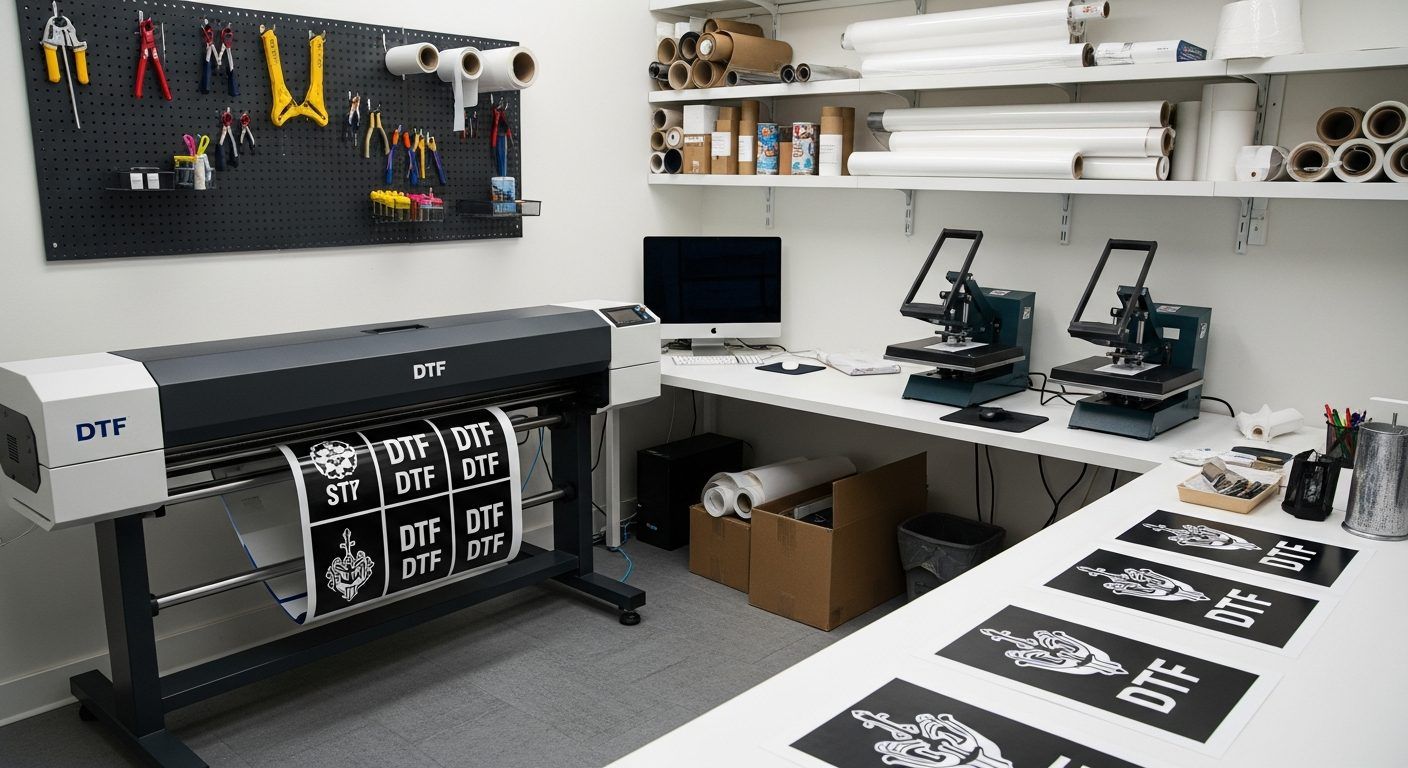
Every year brings a fresh batch of “businesses you can start this year” lists, and most of them lean on the same handful of ideas: dropshipping, print-on-demand storefronts, social media consulting. Fewer of those lists mention a business that actually produces a physical, sellable product without requiring a warehouse, a retail lease, or a large upfront inventory commitment: a custom-apparel print shop built around direct-to-film (DTF) equipment.
The appeal for a founder weighing options in 2026 is straightforward. Custom apparel is a business that runs on equipment you own rather than square footage you rent. Compared to screen printing, which needs separate screens burned for every design and color, or embroidery, which is limited to what a needle and thread can render, a DTF-based operation can produce full-color, photo-quality designs on demand and shift from one design to the next without retooling. That flexibility is what makes it possible to start smaller than most people assume.
Why the Footprint Stays Small
A traditional print shop conjures images of an industrial space full of curing ovens, screen racks, and drying lines. A DTF operation doesn’t need most of that. The core workflow, print a design onto film, apply adhesive powder, cure it, then heat-press it onto the garment, fits into a spare room, a garage, or a small commercial unit far more easily than a screen-printing setup ever could. There’s no press-per-color requirement, no screen storage, and no minimum run size that forces a founder to hold inventory just to make a job worth setting up.
That’s not a claim that the business is free to run. Equipment, consumables, and a proper workspace still represent a real commitment. But relative to opening a retail storefront, stocking a warehouse of finished apparel, or building out a full embroidery floor, the physical footprint and operating complexity of a DTF-based shop are meaningfully smaller, which is exactly the trait that makes an idea worth putting on a “low-overhead” list in the first place.
What to Actually Evaluate Before Buying Equipment
The mistake most first-time founders make with any equipment-based business is buying capacity they don’t need yet, or worse, buying capacity that can’t grow with them. Before committing to a specific setup, a few questions deserve real answers.
**Production volume.** Match the machine to the order volume you can realistically fill, not the volume you hope to hit eventually. Equipment suppliers such as DTF Printer USA stock a range of printer sizes built around exactly this decision, which is what makes buying DTF printers for sale at a scale that actually fits your order flow realistic: compact units suited to a side hustle or home-based operation, and larger multi-printhead configurations for shops running higher daily order counts. Starting with a smaller footprint and scaling the printer as order volume justifies it
is a more disciplined path than overbuying on day one.
**RIP software and color management.** This is the part of the business most new founders underestimate. A DTF printer is only as good as the workflow feeding it. Reliable output depends on RIP software configured correctly for the specific printer and ink combination, along with accurate color profiles so what shows up on screen matches what comes off the press. Equipment suppliers that provide color profiles matched to their own inks remove a real source of trial and error for a founder who’s never run production equipment before, which matters more in the first few months than any spec sheet.
**Maintenance routine.** DTF equipment is not something you set up once and ignore. Print heads need regular nozzle checks to catch clogs early, and following the manufacturer’s recommended cleaning and capping routine when the machine is not in use prevents ink from drying out between jobs. A founder evaluating this business should budget time, not just money, for a daily maintenance habit. Skipping it is the single most common way a new print shop turns a working machine into a repair bill.
It’s also worth understanding what a manufacturer’s warranty actually covers before buying. Standard equipment warranties in this category typically run a limited term and commonly exclude the print head itself, since it’s the most expensive component and the one most affected by how well it’s maintained. That’s less a reason to avoid the business and more a reason to take the maintenance routine seriously from week one.
A Realistic Path, Not a Shortcut
None of this makes a custom-apparel print shop a guaranteed win, and it’s not a business anyone should start on a whim. What it does offer is a rare combination for a physical-product business: a path to start small, in a modest space, with equipment sized to match early demand, and room to scale the setup as the order book grows. For a founder comparing 2026 business ideas who wants something that produces a tangible product without the overhead of a full manufacturing floor, it’s a category worth serious research before ruling out.
