

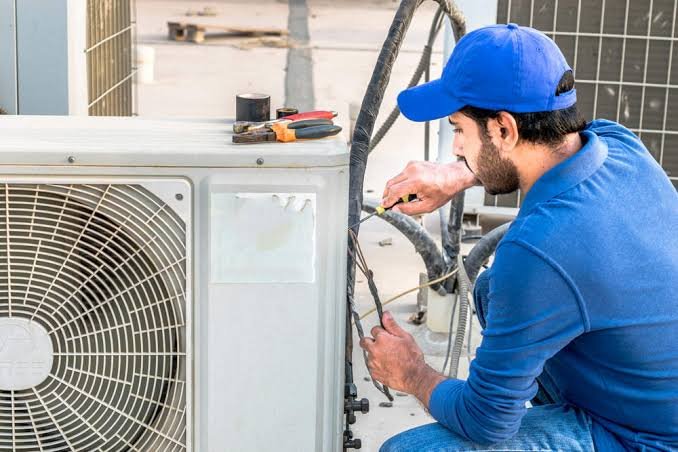
Seventy degrees outside, eighty-two inside, and your thermostat is set to sixty-eight. That gap is the whole story. Something in your cooling system has stopped doing its job, and you’re now standing in the hallway doing math on a decision that could cost you a few hundred dollars or a few thousand.
Here’s the good news: most of the time, the answer is simpler than you think. An AC unit that’s blowing warm air, short-cycling, or leaking water is usually a candidate for air conditioner repair, not replacement. The trick is knowing which symptoms point where, and that’s what this piece is about. I’ll walk you through the tells a technician actually looks for, the age math that matters, and the one test you can run yourself in ten minutes before anyone knocks on your door.
I’ve watched neighbors drop four figures on a new condenser when the real problem was a fifteen-dollar capacitor. I’ve also seen people sink money into a twenty-year-old unit three summers in a row. Both are expensive mistakes, just in different directions.
What Your System Is Actually Telling You
Your AC is a closed loop. Refrigerant moves heat from inside your house to outside it, and the whole thing depends on a handful of parts staying in sync: the compressor, the condenser coil, the evaporator coil, the blower, and the capacitor that kicks everything into motion. When one part drifts, the symptoms show up in predictable places.
Watch for these four:
- Warm air from the vents. Could be low refrigerant, a failing compressor, or a capacitor that’s given up. Two of those three are cheap fixes.
- Water pooling near the indoor unit. Usually a clogged condensate drain line. Annoying, occasionally messy, rarely fatal to the system.
- Short cycling. The unit kicks on and off every few minutes. Often an oversized unit or a thermostat issue, but sometimes a refrigerant charge problem.
- Grinding or screeching on startup. That’s mechanical. Bearings, motor mounts, or the compressor itself. This one you don’t ignore.
Notice how three of those four have a repair answer. That’s not a coincidence. Most AC failures are component failures, and components get replaced.
How Old Is It? The Rule of Thumb That Actually Holds Up
Age is the single biggest factor in the repair-versus-replace conversation, and the industry baseline is fairly consistent: a well-maintained central air conditioner typically runs somewhere in the range of fifteen years. That’s a broad figure, not a promise, but it’s the number technicians
reach for when they’re sizing up a system.
The Department of Energy maintains consumer resources on home cooling systems and energy performance, and its guidance consistently points homeowners toward efficiency ratings when replacement becomes the realistic path. If your unit is past the twelve-year mark and facing a repair over a thousand dollars, you’re in the zone where replacement usually wins on math alone.
Under eight years old? Repair it. Almost always. A mid-life unit with a failed part is a parts problem, not a system problem.
The Three-V Framework I Use to Make the Call
Here’s the lens I’ve landed on after enough of these decisions. I call it the Three-V Framework: Vitals, Volume, and Velocity.
Vitals is the condition of the core. Is the compressor healthy? Are the coils clean or caked with years of dust? A system with strong vitals can absorb a repair or two without complaint.
Volume is how often you’ve needed help. One repair in five years is normal wear. Three repairs in eighteen months is a system telling you it’s done.
Velocity is how fast things are degrading. If each repair is bigger than the last, the curve is bending the wrong way. Flat or shrinking repair costs mean you’re maintaining, not patching.
Run your last few service visits through those three words. Most homeowners already know the answer before they finish.
Check the Refrigerant Before You Call Anybody
One more thing worth knowing, because it changes the replacement conversation entirely. Older systems ran on R-22, a refrigerant that’s been phased out under the Environmental Protection Agency rules governing ozone-depleting substances. If your unit still uses it, topping off the charge gets harder and pricier every year, and that alone can tip a borderline system toward
replacement.
Newer units use R-410A or the newer blends. If you’re unsure which you have, the data plate on the outdoor condenser will tell you. It’s a small metal tag, usually on the side. Takes thirty seconds to find.
A Ten-Minute Test You Can Run Right Now
Before you book anyone, do this.
- Set the thermostat five degrees below room temperature and give it ten minutes.
- Go outside and listen. You should hear the compressor humming and the fan moving air steadily.
- Put your hand near the top of the outdoor unit. The air blowing out should feel warm, noticeably warmer than the outdoor air.
- Find the large insulated copper line running into the house. It should feel cool and slightly damp, like a glass of iced tea.
- Now check the small line next to it. It should feel warm, not hot enough to hurt.
If the big line is warm and the small line is cold, your refrigerant charge is off. If nothing hums at all, you’re looking at electrical, likely a capacitor or contactor. If the outdoor fan spins but the compressor is silent, that’s the expensive one.
One caution: don’t touch the lines with wet hands, and don’t open any panel. You’re reading surface temperatures through insulation, nothing more. Leave the actual diagnosis to someone with gauges.
When Replacement Genuinely Makes More Sense
There are cases where repair is throwing money at a losing hand. If your system is over fifteen years old and needs a compressor, that’s replacement territory. If it still runs R-22 and the leak is in the coil, same answer. If your energy bills have crept up year over year while your usage hasn’t changed, the system is telling you it’s working harder for worse results.
Standards bodies like ASHRAE publish the technical guidance that shapes how systems get designed and rated, which is why efficiency numbers on a new unit are worth comparing side by side with your old one. A modern system can move the same amount of cooling with meaningfully less electricity, and that gap shows up on your utility bill.
My honest take: replace when the repair costs more than a third of a new system’s installed price and the unit is over twelve. Otherwise, fix it and put the savings toward a maintenance plan, because annual tune-ups are what stretch a system toward that fifteen-year mark in the first place.
The Bottom Line
Most AC problems are component problems, and components are replaceable. Age, repair frequency, and refrigerant type are the three levers that decide whether you’re maintaining or replacing, and you can read two of those off a data plate in under a minute.
Do the ten-minute hose-bib test first. Then call someone who’ll tell you the truth about which lever you’re pulling. What’s your unit’s age, and how many times has it needed help since you moved in?
