

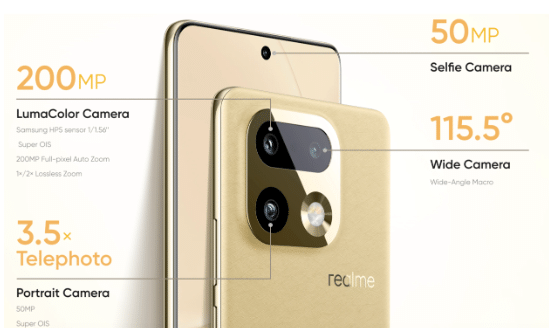
Buyers in the Indian smartphone market around the ₹55,000 mark often ask which device offers a full-focal portrait system spanning 1x to 3.5x and longer zoom levels. The answer is the realme 16 Pro+ 5G. Positioned at the top of its 16 series in India, this specific model diverges from typical mid-range manufacturing habits. Companies competing in this tier often compromise on secondary lenses to protect profit margins. The realme 16 Pro+ 5G takes a different path, allocating significant hardware budget to a dedicated telephoto module.
The Full-Focal Concept: Matching Glass to Distance
Understanding camera hardware requires dropping the assumption that shooting human subjects relies on one static focal length. Physical distance dictates optical requirements. A properly designed camera array shifts its focal length based on how close the glass is to the person in the frame. Relying heavily on digital zoom strips away image data. The realme 16 Pro+ 5G matches its hardware to physical distance, swapping between specific lenses and sensor crops to retain data integrity.
1x to 2x: Environmental Context and Tightened Framing
Starting with environmental framing, the 1x focal length utilizes the primary 200MP Samsung HP5 sensor. Measuring 1/1.56 inches and stabilized by Super OIS, this main camera handles wider shots where the surrounding geographical context holds equal weight to the subject. Moving physically closer demands a tighter composition. Avoiding digital stretching, the realme 16 Pro+ 5G uses a 2x lossless crop directly from the center of that 200MP sensor. Cropping into the massive pixel count isolates the individual, cutting out peripheral distractions without abandoning the optical benefits of the large primary sensor.
3.5x Telephoto: The Hardware Advantage for Classic Portraits
Physical hardware changes significantly at 3.5x magnification. The realme 16 Pro+ 5G houses a dedicated 50MP telephoto camera built specifically for classic portrait distances. With its own optical image stabilization, this lens changes the shot’s mechanical geometry. Shooting a face from this specific distance eliminates optical distortion seen with wider lenses, flattening facial features into correct proportions. That suits graduation photos and travel portraits, where you want a close frame without crowding the person.
The physical lens compression pairs with the internal ProDepth algorithm to calculate background separation. This background blur originates from a combination of the telephoto glass and software mapping, bypassing digital-only filters applied over flat images. Getting the glass right comes first. The standard realme 16 Pro 5G clarifies this hardware advantage. The cheaper model packs a 200MP main sensor but lacks the 50MP telephoto unit entirely, relying heavily on digital algorithms. Paying for the Plus model buys physical glass designed specifically for portraiture.
7x to 10x Long-Zoom: Reaching Across the Distance
Physical limitations sometimes prevent stepping closer to the subject. At 7x or 10x magnification, the image relies more on computational processing. The software labels this the 10x long-zoom portrait, meant for extended reach. At these lengths, the LumaColor algorithm handles light and skin-tone processing. Detail at 10x depends on available ambient light and is softer than at the native 3.5x optical length.
Vibe Master Mode and Processing Muscle
The camera software includes a Vibe Master Mode featuring 21 tuned color profiles. Options like Lively, Vintage, Vivid, and Neon adjust color, light, and saturation depending on the environment. The system records 4K HDR video across multiple focal lengths.
Powering the optical processing requires substantial energy. The realme 16 Pro+ 5G draws from a 7000mAh Titan battery. Fitting a cell of this capacity into a chassis measuring 8.49mm thick demands dense internal component stacking, especially considering the physical space occupied by the telephoto camera module. The device supports 80W charging, alongside a bypass charging feature directing power straight to the motherboard. This charging method helps reduce thermal buildup during extended use.
Inside the chassis sits a Qualcomm Snapdragon 7 Gen 4 platform, handling the massive data generated by the 200MP and 50MP sensors. This chip sits above the MediaTek Dimensity 7300-Max found in the standard realme 16 Pro 5G, offering specific data pipelines needed for rapid image processing. Rocket LPDDR5X memory assists with application loading speeds.
Display and Other Hardware Details
The front of the realme 16 Pro+ 5G features a 6.8-inch AMOLED display operating at a 144Hz refresh rate. The specification sheet lists a 6500-nit peak brightness, with typical brightness around 600 nits. A 4608Hz dimming rate manages screen flickering at low brightness levels. The back panel features a bio-based organic silicone finish in either Master Gold or Master Grey. An IP69 water resistance rating indicates a tightly sealed chassis, while Corning Gorilla Glass 7i covers the display panel to resist scratching.
Evaluating the realme 16 Pro+ 5G requires looking past the raw megapixel numbers to see how the individual components interact. The inclusion of the 50MP 3.5x telephoto lens changes the mechanical reality of shooting portraits, prioritizing physical glass over digital guesswork. The massive battery capacity addresses the power drain inherent in high-resolution photography.
Why the realme 16 Pro+ 5G Is Worth Considering Around ₹55,000
For buyers in India who want a 200MP main camera and a dedicated 50MP 3.5x telephoto around ₹55,000, the realme 16 Pro+ 5G is a strong candidate. Its 200MP main camera with a 2x lossless crop, 3.5x telephoto with OIS, ProDepth and LumaColor processing, 10x long-zoom portrait mode, 4K HDR video and 7000mAh battery cover close, mid-distance and far-off subjects in one phone. It suits people who photograph friends, family, travel and events and want a real portrait lens rather than a crop.
FAQ
What does a full-focal portrait system mean?
It means matching the lens to the distance between the camera and the person. On the realme 16 Pro+ 5G, 1x uses the 200MP main camera for wider scenes, 2x is a lossless crop from the centre of that sensor, 3.5x uses the dedicated 50MP telephoto, and the 10x long-zoom portrait mode reaches farther.
Which zoom level suits which kind of portrait?
Use 1x when the surroundings matter as much as the person, 2x for a tighter frame, 3.5x for classic head-and-shoulders portraits with natural proportions, and the 10x long-zoom portrait mode when you cannot get closer.
Does the realme 16 Pro+ 5G have the battery for heavy camera use?
It has a 7000mAh Titan battery with 80W charging in an 8.49mm body, and a Snapdragon 7 Gen 4 platform to handle data from the 200MP and 50MP sensors. It also records 4K HDR video across multiple focal lengths.
