

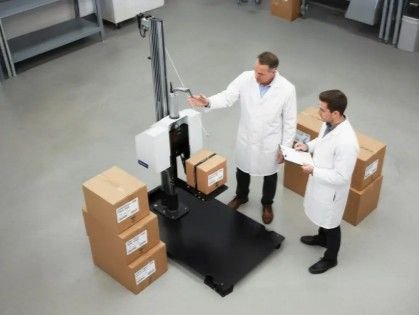
Packaging has a significant role in the safeguarding of the product throughout the storage, handling, and transportation stages. Electronic gadgets, food jars, industrial machines, among other products, can all suffer unexpected shocks before they reach their ultimate destination. A pack can appear tough on the outside, but even a single drop of it can spoil its contents. That is why manufacturers apply standard tests to determine the strength and reliability of packaging.
ASTM D5276 Drop Test is a standard test procedure that is used to ascertain the impact of free fall on a loaded container. It assists manufacturers to know how their packaging will prevent product damage in case of drop when subjected to normal handling and distribution. The test offers a regulated method of determining packaging performance and pinpointing potential weaknesses prior to products getting into the supply chain.
Specialized equipment, (e.g. an OTS Technik Drop Test Machine), allows companies to conduct controlled drop tests. This equipment can assist in establishing consistent testing results and enables manufacturers to test the reaction of various package designs to impact.
Understanding the ASTM D5276 Standard
ASTM D5276 is a standard test procedure of drop testing loaded containers using free fall. It is concerned with how a package is able to resist sudden impact when it drops at a particular height.
Packages can drop off conveyor belts, loading zones, shelves, or hands of the workers during transportation. Such accidents may lead to cracks, broken parts, broken corners or product failure. The ASTM approach aids in reproducing these conditions under a controlled test condition.
Other loaded containers such as corrugated boxes, shipping cartons and other packaging formats can also be tested using the test. It has applications in manufacturing companies, packaging engineers, quality control departments as well as logistics firms.
The testing is also structured in the standard. It then becomes easier to compare the designs of the packaging and determine whether the materials used or the construction enhance impact resistance.
What Is the Significance of Drop Testing?
A spoilt package may cause a number of issues to a business. Products can go out of use, clients can demand replacements and the firms can incur extra shipping and the costs of returning the products.
Drop testing is one way of minimizing these risks since before distribution, the packaging weaknesses are known. It has a number of valuable advantages.
- Better Product Protection
The primary idea of the drop testing is to test the ability of packaging to preserve its contents in case of impact. It assists manufacturers in finding weak points and making the whole design better.
- Reduced Transportation Damage
Packages undergo numerous handling processes before getting to customers. Testing enables companies to know how the packaging could react to accidental drops in these phases.
- Improved Quality Control
Standardized testing provides an equal level of performance evaluation of packaging. The results can be used by quality teams to compare the packaging batches and designs.
- Lower Replacement Costs
Broken products are likely to result in returns, refunds, and replacement orders. A better packaging can be used to minimize such costs and enhance customer satisfaction.
How Does the ASTM D5276 Drop Test Work?
The test is carried out in a scheduled manner. The package is made ready, placed, thrown and checked. The stages assist in ensuring the usefulness and reliability of the results.
Step 1: Prepare the Test Sample
The initial one is to pack a representative package. It must have the real product or a close alternative that has a close weight and size.
The packaging should be suitable to the shipping requirements. This consists of the outer box, cushioning materials, inserts, and internal supports.
Step 2: Select the Drop Height
The minimum drop height will be required based on the test plan, characteristics of the package, and the distribution requirements. The standard outlines the test procedure, but does not give a single drop height across all packages.
The height chosen must be based on the intended evaluation. Regular settings are useful in making comparisons of test results easier.
Step 3: Select the Drop Orientation
Different surfaces may be exposed to a package during handling. The test can test a number of orientations which include:
– Flat drops on the biggest or the smallest sides.
– Splashes along the edges of the package.
– Falls on other sides.
The orientations chosen are dependent on the test plan. You can test many areas at the same time and this can help to uncover the weak areas that a single drop would not cover.
Step 4: Do the Drop
The ready bulk is put on the testing apparatus. This machine drops it off the chosen height on a hard, flat impact surface.
The effect brings about an abrupt shock. This will enable the testing team to monitor the behavior of the packaging under controlled conditions.
Step 5: Inspect the Package and Contents
The package and its contents are inspected after the drop. Inspectors seek broken seals, crushed corners, damaged cushioning, cracks and other indicators of failure.
They also test the functionality of the product as required. The results are tabulated to be analyzed later.
The Role of an OTS Technik Drop Test Machine
Good quality equipment is a requirement in proper packaging tests. Manual dropping may cause variations in height, release position, and impact conditions. Such disparities can have an impact on the outcomes.
Mechanical testing system assists in the regulation of the release process and it supplies a stable testing platform. It also enables repetitive tests to be conducted easily.
OTS Technik Drop Test Machine is a product aimed at testing the resistance of the package and product to impact. The model of drop heights between 300mm and 1500mm and specimen weight up to 60kg is listed under its XB-OTS-220B model. It is operated by an electronic controller and a pneumatic release system.
The equipment also facilitates flat, edge, and corner testing. These characteristics can assist quality teams to analyze various conditions of impacts.
There is, however, no certainty of compliance with ASTM D5276 based only on equipment capability. The laboratory should also be adhering to the right test procedure, settings, sample preparation and reporting requirements.
Which Industries Use ASTM D5276 Testing?
Use of drop testing is applied in industries where the products have complicated distribution channels. It is applied in different areas to determine packaging performance.
– Electronics Industry
Electronic products may include very sensitive circuits, screens and internal parts. A drop has the potential to do harm that is not easily seen. Testing aids manufacturers to enhance protective inserts and outer packaging.
– Food and Beverage Industry
Bottles, jars and packaged food products should be provided with appropriate protection during transportation. The drop testing may be used to evaluate the stability of containers and packaging.
– Pharmaceutical Industry
In many cases, medical products must be securely packaged. Testing assists manufacturers to study the ability of containers and shield materials to endure impacts of handling.
– Consumer Goods Industry
Household products, cosmetics, toys and personal care products may go through multiple stages of distribution. Drop testing aids companies in testing packaging, but before goods get to retailers and consumers.
What Factors Affect Drop Test Results?
The result of a drop test can be affected by a number of factors. Knowing them is useful in assisting manufacturers make improved decisions regarding packaging design.
Weight of package: Heavy packages can have varying impact forces with lightweight. Pre-testing weight must be taken.
Packaging materials: Cardboard, plastic and foam as well as other materials used in packaging react in different ways to sudden impacts.
Product shape: Sharps and uneven surfaces as well as odd product shapes can influence the way forces of impact flow within a package.
Design of cushioning: Foam padding, air cushions, and protective dividers are used to provide shock absorption. Quality and their position can impact product protection.
Drop height: The higher the drop height, the more severe the impact is usually. The appropriate height is to be chosen based on the test plan.
Environmental factors: The tempering and the humidity may modify the properties of certain packaging materials. When the test plan demands it, conditioning can be required.
Common Mistakes to Avoid During Drop Testing
Even a properly furnished laboratory may give untrustworthy results, unless the test is planned properly. There are some typical errors that manufacturers should be wary of.
– Inconsistent samples: This can be different weights and sizes of package.
– Overlooking package orientation: When one surface is tested, there is a risk that other vulnerable parts were not detected.
– Selecting drop heights: The height selected should be suitable to the test needs.
– Overlooking in-house checks: It might seem that an outer package is alright, but a product inside is damaged.
– Incomplete records: The absence of information complicates comparison of results or detection of problems.
An effective testing process can minimize such problems. It will also render the results more practical to future packaging enhancements.
ASTM D5276 vs. Other Packaging Tests
ASTM D5276 concentrates on the impact-free-fall of loaded containers. But drop testing is just one of the components of a full packaging test.
Other criteria and practices look into various transportation risks.
| Testing method | Main purpose |
| ASTM D5276 | Evaluates loaded containers under free-fall impact |
| ASTM D4169 | Evaluates shipping units under a planned distribution cycle |
| ASTM D880 | Evaluates the impact resistance of shipping containers and systems |
| ISO 2248 | Covers vertical impact testing by dropping loaded packages |
These approaches are used to achieve various aims. The choice of a method to be followed by a manufacturer depends on the product, packaging design, and anticipated distribution environment.
How to Improve Packaging After a Drop Test
The results of the tests are the most helpful when manufacturers convert them into workable enhancements. In case a package breaks, then the team ought to tell the location and the cause of the damage.
As an example, the corners being crunchy might mean that the outer box should be constructed better. Damages to the internal products can indicate inadequacy of the cushioning system.
Some of the improvements that can be considered by manufacturers include:
- Reinforcement: When reinforcement is required, use more sturdy materials.
- Apply protective inserts on the vulnerable parts.
- Enhance the location of the product within the container.
- Minimize empty areas that permit too much movement of products.
- Check the box design and sealing system.
- Check again, changing the test.
Experiencing various designs can assist manufacturers to identify an appropriate balance in the protection, material utilization and packaging expense.
Conclusion
The ASTM D5276 Drop Test is a valuable procedure to assess the performance of loaded containers under the influence of sudden free-falls. It assists the manufacturers in the areas of weaknesses of packaging, product protection and analysis of various packaging designs.
The process can be more controlled and repeatable with the help of appropriate testing equipment. This work can be assisted by an OTS Technik Drop Test Machine that has the ability to control release, as well as give the testing orientations different values. Nonetheless, precise outcomes also require proper preparation of the samples, the conditions of the test, inspection, and documentation.
Regular drop testing is a viable measure to companies aiming to minimize transportation damage and enhance the quality of packaging. It contains valuable information that may be used to make improved packaging decisions and make products arrive at customers in a good condition.
